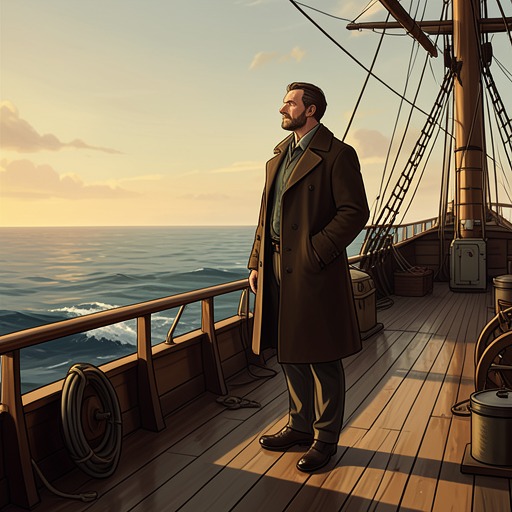
William Scoresby
The WhaleWilliam Scoresby appears in the book less as a figure in a narrated life than as a presence transmitted through portraits, books, and images. The paired display of him and his father sets their contrasting identities beside each other, while illustrations derived from his Arctic account show how his observations entered a wider visual culture of whales and polar life.
Portrait and Family Contrast
At a museum, two portraits are confusingly labelled William Scoresby. The first depicts his father, a lifelong merchantman, in a white waistcoat, with a homely cottage and a ship behind him. The second is identified as the son: William Scoresby, in a starched collar and stock, with features described as refined and associated with the Enlightenment. He was destined to become a fellow of the Royal Society. The contrast gives the pair distinct public identities—the father shaped by a maritime career, the son by learned standing—without supplying a fuller account of their private lives.
Together, the portraits preside over a collection whose once-intense enthusiasm for its subject has faded. Its decline is likened to a stamp album put away in an attic, partly through embarrassment at the youthful, compulsive fervour it records. The display thus makes Scoresby visible not only as an individual but as part of a past culture of collecting and studying whales.
Arctic Writing and Natural-History Images
Scoresby’s account of the Arctic Regions became a source for later images. The frontispiece to Oliver Goldsmith’s Animated Nature, first published in 1774 and subsequently reissued for young readers, drew freely on Scoresby’s work. Its decorously beached narwhal and a whale bucking as it throws its attackers into the air directly imitate scenes in Scoresby’s pictures.
The borrowing shows his influence extending beyond written description: images associated with his account were incorporated into an illustrated work that presented natural history to a broader readership. Yet the frontispiece also mixes observed and imagined creatures, including a sea serpent copied from another source. Scoresby’s pictures therefore served as visual evidence within a scene where natural history and fantastic representation were placed side by side.
Legacy Through Representation
The book’s brief appearances of Scoresby connect scientific authority with the unstable ways whales were pictured and remembered. His portrait marks the learned reputation attached to his name; the images drawn from his Arctic account show those observations being reused, rearranged, and circulated. His significance here lies in that passage from recorded Arctic scenes to popular illustration, where the whale could appear at once as an object of study and as part of a world still open to imaginative invention.