the whale is unpainted to the last
The WhaleThe phrase unpainted to the last expresses a central paradox in Ishmael’s account of whales: they are repeatedly pictured and described, yet their living form remains beyond exact representation. Its force lies not in dismissing images altogether, but in exposing the distance between a whale as an object of human depiction and an animal that cannot be fully known from those depictions.
The phrase and its claim
Ishmael’s claim begins with the practical conditions under which whales are seen. A whale can be observed in its entirety when beached, but that is not the same as seeing the living animal in its natural element. The living Leviathan, he argues, has never properly presented itself for a portrait; there is therefore no certain way to establish precisely what a whale looks like. The phrase unpainted to the last gives that uncertainty a concise, lasting form: the animal remains outside the reach of complete pictorial capture.
This is not simply a claim that artists have failed to acquire enough skill or information. Ishmael makes the problem more fundamental: the conditions of observation themselves obstruct certainty. The whale’s full appearance is not readily available to the observer, so an image cannot be treated as a transparent substitute for the animal.
Images and their distortions
The claim is sharpened by Ishmael’s criticism of imaginary whale portraits. He traces pictorial errors back to ancient sources and singles out Frédéric Cuvier’s 1836 Sperm whale as especially inadequate. The French Academy’s assertion that there were fourteen species of Sperm whale encouraged artists to produce varied but misleading forms: sleek, fashionably dressed bodies, fish-like tails, disproportionate bellies, and misplaced eyes. The resulting images reflected the classifications and conventions of their makers more clearly than they disclosed the animal.
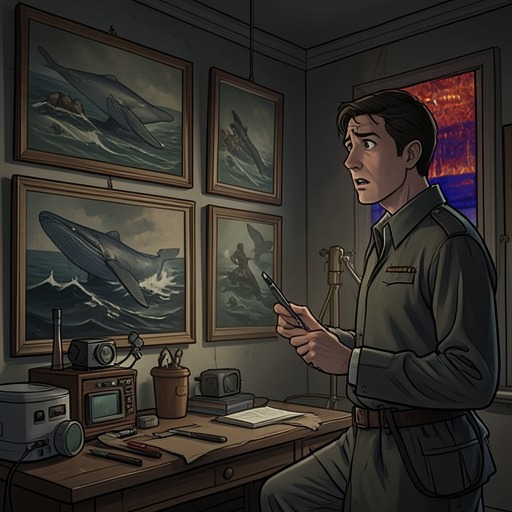
Across older whaling pictures, the mismatch between subject and depiction becomes more unsettling because the scenes are so composed. They resemble works of established artistic traditions, yet show not calm or sacred subjects but a gigantic animal in the violence of its death throes. Their stillness does not resolve that violence; it makes the distance between the image and the event more conspicuous. Images made in paint, teeth, wood, sheet iron, and stone, along with descriptions in words, repeatedly attempt to fix the whale without closing the gap between representation and reality.
Knowledge at a cost
Ishmael identifies whaling as the only way to gain even a tolerable impression of the living whale’s outline. Yet this route to knowledge carries a lethal danger: the observer risks being stove in and sunk by the animal. Curiosity is therefore placed in tension with survival. The phrase does not merely mark an unfinished picture; it warns that a more immediate encounter cannot be separated from the hazards of pursuing it.
That warning makes Ishmael’s position deliberately double. He cautions against excessive curiosity about the Leviathan, while his extended attention to whale images and their failures keeps the animal at the center of inquiry. The limits of representation do not extinguish the desire to look; they make that desire more uncertain, and potentially more dangerous.
Enduring uncertainty
The claim remains open rather than offering a final, accurate portrait to replace the inaccurate ones. The whale is not rendered knowable by accumulating more pictures: each attempt can expose how much remains outside its frame. In this sense, unpainted to the last names both a limit and a continuing invitation to look. The animal’s elusiveness is not a blank that the evidence fills in, but the condition that shapes the act of representing it.