13 Garholt Street (Garholt Street)
The Whisper Man13 Garholt Street (Garholt Street) is both a family home and the concealed archive of a decades-old crime. Its unsettling appearance first attracts Jake Kennedy, while its rooms, garage, walls, and buried spaces later disclose the fate of Tony Smith and expose a chain of violence reaching from Frank Carter to the house’s later occupants.
Appearance and First Impressions
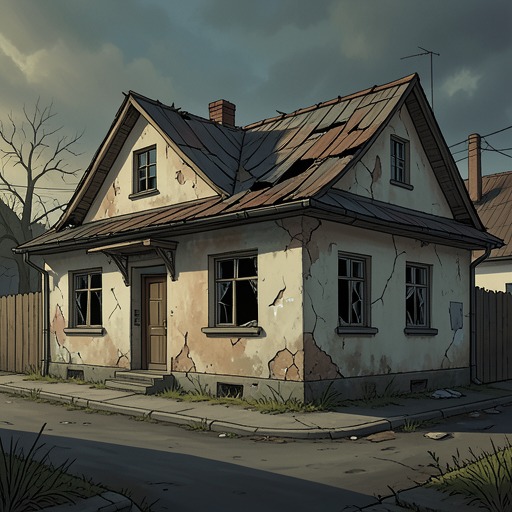
13 Garholt Street (Garholt Street) is a small, detached, two-story property with the ramshackle character of a cottage. Its windows appear strangely placed, making the interior difficult to imagine from outside, and its roof sits at a slightly incorrect angle. The result is an almost animate facade: the building seems inquisitive, angry, or tilted toward whoever is looking at it. Tom Kennedy experiences this unease as a physical sensation, described as a tickling at the back of the skull, and is disturbed by the house before he has any reason to connect it with a crime.
The house affects Jake Kennedy differently. He is immediately entranced by its online photograph and refuses to consider any alternative property. At the first viewing, he appears almost hypnotized by the building, while Tom Kennedy remains unconvinced by the grimy interior: dusty cabinets and chairs, old newspapers, cardboard boxes, and a mattress occupy the downstairs rooms. Anne Shearing, the elderly owner, explains that the belongings belong to a tenant and will be removed before the sale. The contrast between Jake Kennedy’s attraction and Tom Kennedy’s alarm establishes the house as a place whose meaning is sensed before it is understood.
When Tom Kennedy later returns with Jake Kennedy, the facade seems to change according to his state of mind. At first it looks forbidding and dangerous; on another occasion it seems to possess character. Now the irregular windows evoke a beaten, lopsided face, with one eye pushed above a bruised cheek. The image disappears when he shakes his head, but the ominous feeling remains. The still air and silence intensify the impression that the windows are watching the approaching occupants. Once the door opens, stale air briefly suggests that something has been left rotting inside, before the smell resolves into cleaning products.
Domestic Space and Gothic Uninhabitedness
The house’s rooms repeatedly blur the boundary between shelter and threat. Jake Kennedy’s drawing of the exterior makes the architecture more face-like than the real building: the curved lines elongate the windows, and the front door appears to moan. In an upstairs window, Jake draws Tom Kennedy alone in his bedroom and himself standing in the other, but he also places a little girl beside him. Her black hair spreads sharply to one side, her dress is partly blue, and red marks appear on one knee. The drawing turns the house into a container for an unseen presence, transforming a child’s new home into a space already populated by an unknown history.
The house’s decorative surfaces conceal rather than soften its function. In a room associated with Frank Carter, the walls are painted white but marked with crude green grass, childlike butterflies, and a skewed yellow sun whose black-eyed face stares toward the floor. The childish imagery resembles a nursery, yet its arrangement makes the room feel staged and accusatory. The domestic symbols of grass, insects, and sunlight become a false pastoral layer over a place connected with confinement and death.
The same contradiction appears in the attic. It is neatly carpeted, brightly painted, and decorated with grass, bees, and butterflies. A chest holds soft toys, a small wardrobe stands against the sloping wall, and the bed has old Transformers sheets. Yet the harsh bare bulb gives the room an unreal quality, while the carefully furnished child’s environment feels as though it was never intended for a real boy to inhabit. The attic therefore functions less as a bedroom than as an imitation of one: a preserved image of childhood separated from ordinary life and turned into part of the house’s concealed machinery.
The Hidden Crime Scene
The investigation changes the status of 13 Garholt Street (Garholt Street) from disturbing residence to evidentiary site. Police treat the death of Dominic Barnett, whose body is found in Hollingbeck Wood, as murder after significant head injuries are identified. Barnett had lived at the Garholt Street property until earlier that year, and the house becomes relevant when evidence connects him to events there. Norman Collins is later confronted with the fact that his fingerprints were found on the hammer used to murder Dominic Barnett inside the house that night. The building consequently contains not only the history of an older crime but also the immediate scene of a more recent killing.
A further discovery emerges from the garage. Much of its floor consists of irregularly arranged house bricks, which conceal an old mechanic’s pit beneath an apparently level surface. When one brick is lifted, a cardboard box can be seen below. The detail is physically modest but narratively decisive: the house’s floor is revealed as a false surface, and its hidden cavity offers a literal explanation for how the past could remain present without being visible. The garage does not merely store objects; it incorporates concealment into its structure.
The discovery of a second body confirms that the hidden space is connected to a much older case. A body at a house on Garholt Street is reported as the second body in the investigation, with the remains appearing to have been hidden for a long time. The forensic examination identifies the skeleton as that of a male child who was approximately six years old when he died. No cause of death can yet be established, and the remains may have been dead for roughly twenty years. The box and the clothing found beneath the bones become part of the material chain through which an unidentified child can be restored to a name.
Tony Smith and the House’s History
The remains are identified as Tony Smith. His disappearance had remained unresolved for two decades: Miranda Smith and Alan Smith had once waited in a police reception after their son went missing, and Tony was still missing twenty years later. Frank Carter had admitted killing Tony Smith, but after his arrest he refused to say where he had discarded the body. The recovery at 13 Garholt Street (Garholt Street) therefore supplies what Carter’s confession and imprisonment never could: a physical answer to the question of where Tony Smith had been taken.
Norman Collins’s account places the house at the center of the transfer. He says that he went there after paying more money to Julian Simpson and was made to wait in a downstairs room. Simpson eventually returned with a sealed cardboard box, cut it open carefully, and revealed Tony Smith’s body. This testimony connects the property to a transaction involving the remains and explains why the house is more than the scene of a single murder. It is the point at which a child’s body passes from one custodian to another, its concealment maintained through money, tenancy, and silence.
The property’s ownership and occupancy history extends that network across time. Anne Shearing inherited the house from her parents but had not lived there for decades, renting it to successive occupants. Julian Simpson had rented it for four years before 1997, the year Frank Carter committed his murders, and remained there until his death from cancer in 2008 at the age of seventy. Dominic Barnett then occupied the house until earlier in the year in which his body was found. The sequence of tenants makes the house a durable setting for concealed crimes rather than an isolated location briefly visited by a killer.
Investigative Consequences and Significance
The house gives the police a starting point for reconstructing what was missed in the original investigation. Pete Willis recognizes that the newly recovered remains require him to determine why earlier investigators failed to understand the connection, and he treats the Garholt Street property as the place from which that history must be reread. Physical details—the pit beneath the bricks, the box, the clothing, the lack of sufficient blood at a later body scene, and the fingerprints on the murder weapon—turn the building into a sequence of evidence rather than a single revelation.
Its importance also lies in the distinction between finding a killer and bringing a child home. Tony Smith’s parents had endured the continuing absence of both certainty and remains, while Pete Willis holds to the belief that everybody should get to go home. The discovery at 13 Garholt Street (Garholt Street) cannot undo Tony’s death, but it ends the most absolute form of his disappearance by locating his remains and identifying the place that held them.
By the time investigators examine the house, its earlier atmosphere of watching windows and sealed air has acquired a concrete explanation. The building’s face-like appearance, its false floor, its childlike wall paintings, and its imitation bedroom all participate in a single pattern: ordinary domestic forms have been made to contain violence, secrecy, and the dead. 13 Garholt Street (Garholt Street) is therefore significant not simply because crimes happen there, but because the architecture itself repeatedly stages the story’s central collision between the appearance of home and the reality of captivity, murder, and concealed memory.