13 Garholt Street house
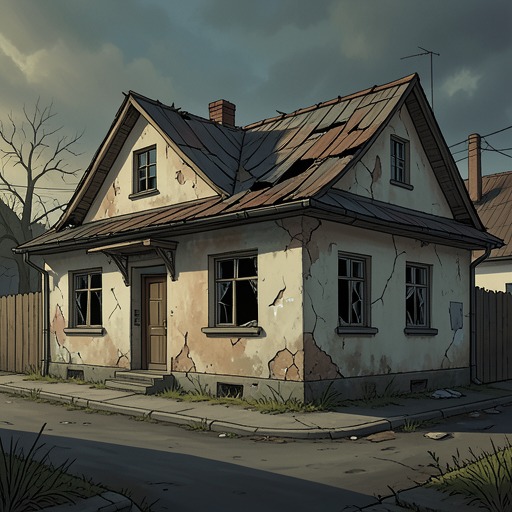
The Whisper Man13 Garholt Street house is far more than the small detached property that Tom Kennedy and Jake Kennedy move into. At first it is merely an odd, old two-story cottage in Featherbank; gradually, its misplaced windows, skewed roof, concealed spaces, and accumulated debris turn it into a physical archive of fear. The house attracts Jake before Tom understands why, and its apparent strangeness eventually connects the family’s present to the criminal history of Dominic Barnett and the violence associated with Norman Collins and the Carter family.## Appearance and First Impressions The house initially resists ordinary domestic description. It is small, detached, and ramshackle, with the feel of a neglected cottage, but its windows are arranged so strangely that the interior layout is difficult to imagine from outside. The roof sits at a slightly incorrect angle, making the whole face of the building seem inquisitive, angry, or both. Tom’s first response is physical unease, described as a tickling sensation at the back of his skull rather than as a reasoned objection. The building appears to look back at the person examining it, establishing the house’s recurring association with faces, eyes, and hostile attention.
Jake Kennedy chooses the property almost immediately. At the first viewing he seems nearly hypnotized by it, while Tom Kennedy notices only its grime and awkwardness. Inside are dusty cabinets and chairs, bundles of old newspapers, cardboard boxes, and a mattress in the downstairs spare room. Anne Shearing, the elderly owner, apologizes for the condition and explains that the contents belong to a tenant who had been renting the property and that they will be removed before the sale. The house therefore enters the story already burdened by another person’s abandoned life, though its history remains concealed from the buyers.
A second viewing changes Tom’s interpretation without removing the unease. The same distorted architecture begins to possess a kind of mongrel charm; what seemed like an angry expression starts to resemble wariness, as if the property itself had been hurt and would require trust before becoming a home. This shift is important because the house does not become safe when Tom changes his mind. Instead, its apparent character becomes more intimate and more troubling: it is imagined as wounded, watchful, and capable of remembering.## Moving In and the House as a Watcher When Tom and Jake collect the keys from the estate agent in Featherbank, Jake is excited and Tom is anxious. Tom worries that the house will look different now that the purchase is real, that he will hate it, or that Jake will. On arriving, the building still appears unchanged, yet its windows seem to offer different forms of observation. The same facade has already seemed forbidding, dangerous, and then characterful; now its uneven arrangement resembles a beaten face, with one eye pushed above a badly bruised cheek and the skull made lopsided by injury. Tom rejects the image with a shake of his head, but the ominous feeling remains.
The first walk through the property deepens this sense of an inhabited absence. Tom and Jake open doors and cupboards, switch lights on and off, and draw and close curtains. Their footsteps echo through the rooms, while the rest of the house is absolutely silent. Tom cannot escape the irrational impression that somebody else is present, hiding just beyond sight and waiting to be seen around a doorframe. Jake’s excitement does not dispel the feeling. He moves rapidly from room to room, but occasionally looks puzzled, as though expecting to find something that is not there. The house thus becomes a space of anticipation before it becomes a space of revelation: the threat is first registered as a missing presence.
Jake’s drawing makes the house’s visual symbolism explicit. He has rarely produced straightforward realistic scenes, preferring convoluted battle scenes, but here he attempts an approximation of the property’s exterior, recalling the online photograph that first caught his attention. His rough, childlike lines exaggerate the elongated windows and stretch the building into something more like a face. The front door appears to be moaning. Even the child’s representation of the house cannot make it ordinary; drawing translates its architecture into a living expression and confirms the connection between the property and Jake’s involuntary recognition of it.## Hidden History and Concealed Spaces The house’s domestic surfaces conceal a criminal past. Tom later discovers that Dominic Barnett, identified by the street name in a document, had lived there; the realization makes the present rooms suddenly specific. The possibility that Barnett sat where Tom is sitting or slept in what has become Jake’s bedroom converts ordinary domestic space into a site of historical proximity. The house is no longer simply strange in appearance. It is implicated in the lives of people whose actions have altered the meaning of the rooms.
Anne Shearing explains that she inherited the property from her parents but had not lived there for decades, instead renting it to numerous tenants. She denies that there was evidence of Barnett selling anything from the house, while acknowledging that the situation had been deeply sad. After his death, she could have searched for another tenant, but age and exhaustion led her to sell instead. Her stated hope is that the old house will have a new chance with someone who can make a better life in it. The sale is therefore framed as an attempt to draw a line under the past, but the narrative shows that ownership cannot erase what the building has contained.
The abandoned contents remain visible when Tom returns: old furniture, the dirty mattress, and damp cardboard boxes are still scattered through the garage. A spider occupies a thick web, while pale knots of string appear to be the remains of butterflies chewed apart. The image is small but characteristic of the house’s ecology, where childhood motifs, decay, and predation coexist. In the garage, a section of floor made from haphazardly arranged house bricks conceals an old mechanic’s pit. Once Tom recognizes the filled-in pit, the flat floor becomes a cover rather than a stable foundation; when a brick is removed, the top of another cardboard box appears below. The house’s surfaces repeatedly promise closure while indicating something buried beneath them.
The connection to the Carter crimes becomes more concrete in the decorated spaces. White walls bear crude green grass, childlike butterflies, and a skewed yellow sun with dead black eyes staring down at the floor. In the attic, the sloping walls, bright paint, drawn grass, bees, and butterflies might have made the room pleasant under other circumstances, but the harsh bare bulb gives it an unreal quality. A chest of soft toys, a small wardrobe, and worn Transformers sheets turn the room into a child’s environment made uncanny by confinement and artificial brightness. The attic’s apparent neatness does not contradict the house’s menace; it intensifies the sense that innocence has been arranged inside a place of captivity.## Rebecca Kennedy and Jake Kennedy’s Recognition The house’s strongest personal significance emerges through a photograph. Jake Kennedy’s immediate attraction to the property is explained when Tom realizes that Jake has seen it before, with his mother, Rebecca Kennedy, standing in front of it. The building has therefore entered Jake’s memory before it becomes his home, although Jake himself does not initially supply a clear explanation for his response. What looks like instinct or fascination is retrospectively recognized as an encounter with a familiar image.
The photograph shows Rebecca at approximately seven or eight years old, wearing a blue-and-white checked dress with a hem high enough to reveal a graze on her knee. Her hair is swept to one side, suggesting a breezy day. These precise details give the house a human frame: it is not only a threatening facade but the background to an earlier image of Rebecca. The photograph binds the property to Jake’s family history and makes the house’s uncanny familiarity legible as a form of inherited memory.
Jake’s drawing and the photograph also create a contrast between representation and knowledge. He can reproduce the house’s distorted look before the adults understand why it matters, while the photograph eventually supplies the missing context. When the question of who drew the picture arises, the drawing becomes evidence of Jake’s relationship to the building rather than merely a child’s artistic response. The house has been perceived by him through images before it is consciously understood through facts.## Investigation, Exposure, and Narrative Significance The discovery of the buried material changes the house from a private residence into a crime scene. By the time Tom returns, police activity has intensified: two cars and a van stand outside, officers and crime-scene investigators work within the taped-off driveway, and the garage appears to be the main focus. Two officers secure the pavement around the property, while the open front door presents an invasive and wrong interruption of domestic privacy. The building that had seemed to watch its occupants is now under official observation, its concealed history made visible through investigation.
The house’s significance lies in the way it joins architecture to memory and violence. Its windows resemble eyes, its roof gives it an injured head, its door appears to moan, and its walls carry images whose apparent childishness is darkened by dead eyes and harsh light. The mechanic’s pit and the box below the floor add literal depth to the metaphor of buried history. The property is both shelter and evidence, a place meant to contain family life that instead preserves traces of strangers, victims, and crimes.
Its role is also relational. Jake’s attraction, Tom’s shifting interpretations, Rebecca’s appearance in the earlier photograph, Dominic Barnett’s residence, and the later police presence all converge on the same address. The house’s mystery is not supernatural in the supplied evidence; its power comes from the mismatch between ordinary domestic functions and the violence that has occupied, passed through, or been hidden within them. A hoped-for new beginning cannot simply overwrite the building’s past. 13 Garholt Street house remains a structure whose apparent face changes according to what its occupants know, while every new discovery makes the earlier unease look less irrational.