567 Club
The Whisper Man567 Club is the child-care setting that first presents Jake Kennedy as both an ordinary lonely child and the bearer of something inexplicable. Children play, adults supervise, and parents collect their sons and daughters, yet within this familiar routine Jake remains absorbed in a private world of drawings, imaginary companionship, and repeated warnings about doors and whispers. The club therefore functions as an ordinary social space made ominous by what Jake says and by what the adults cannot see.
Setting and Daily Life
Most of the children at 567 Club spend the afternoon outside in the sun. Jake can hear their laughter, shouting, and the sound of a soccer ball moving back and forth, but he remains indoors working on a drawing. The contrast establishes the club as a place of communal childhood activity from which Jake is emotionally separated, even though he is physically among the other children.
Jake is not presented as simply rejecting company. The little girl is usually the only child who wants to play with him, and he is normally pleased to see her. On the afternoon in question, however, she is unusually serious and insists that he remember what she has told him. Jake would rather finish his drawing alone, but her persistence pulls him away from it. His reluctance is therefore mixed with familiarity: the club is where an ongoing private relationship, invisible to the other children and adults, can continue.
The scene gives the little girl a distinctive recurring appearance. She wears a blue-and-white-checked dress, has a graze on her right knee that never seems to heal, and has hair spread untidily to one side while the other girls have neat shoulder-length hair or tight ponytails. These details make her visually specific within the club while also marking her as unlike the children around her. Jake accepts her presence as part of the club’s world, whereas the narrative quietly encourages the reader to question what kind of presence she is.
Jake Kennedy and the Invisible Companion
Jake’s drawing provides a refuge from the other children and a visible expression of his inwardness. When Sharon, one of the grown-ups working at 567 Club, notices his distress and asks whether he is all right, he answers that he is. She praises the picture, but her intervention does not reach the source of his unease. Jake has been drawing circles around stick figures, turning them into force fields, an image that suggests protection without explaining what he believes must be kept out.
The club also exposes Jake’s longstanding solitude. Tom Kennedy remembers that his son has always had imaginary friends and has seemed closed away and introspective, as though other children are pushed away by the intensity of his inner life. Tom can sometimes interpret this as self-containment and happiness, but more often he worries that Jake is not like the other children. The club makes that worry concrete: ordinary play is audible just outside, while Jake remains indoors with his picture and the little girl who speaks to him.
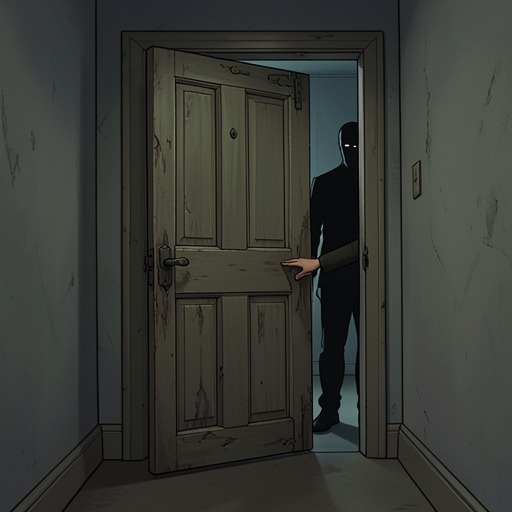
The little girl repeatedly demands that Jake recite the warning about a half-open door. He initially tries to ignore her, then sighs, puts down his pencil, and repeats it. She tells him that the words are important and makes him promise to remember them. Before she can explain their meaning, the buzzer announces that his father has arrived, and she whispers that Tom is there. The interruption leaves the warning suspended between childish play and genuine knowledge, allowing the club to become the first setting in which the rhyme acquires narrative force.
Collection and Departure
When Tom arrives, the children outside appear happy and normal, and he searches among them for Jake before finding him indoors, hunched over his drawing. Jake’s smallness and posture make him seem especially vulnerable, as though he is trying to disappear into the picture. Tom’s perception of the club is consequently shaped not by its cheerful surface but by the sight of his son withdrawing from it.
Tom asks Jake to collect his things and leave. Jake folds the drawing and gives it to his father, but carries the Packet of Special Things himself. The distinction matters: the drawing can be entrusted to Tom, while the Packet remains Jake’s private container of emotionally important objects. Tom has learned that Jake began filling it after finding it among Rebecca’s possessions, adding letters, photographs, trinkets, drawings, and other items whose significance belongs to him. Like a protective companion, the Packet rarely leaves Jake’s side.
At the door, Tom presses the green button to release the exit and asks whether Jake wants to say goodbye. Jake waves toward an empty table. Tom recognizes this as another instance of the imaginary friendships that have accompanied his son for years. The moment is painful because the club is populated by real children and supervising adults, yet Jake’s farewell is directed toward someone the others do not acknowledge. The ordinary act of leaving becomes evidence of his separation from shared reality.
The Rhyme Beyond the Club
The words Jake repeats at 567 Club do not remain confined to that afternoon. After moving to the new house, he continues asking to be told the rhyme and refuses at times to recite it. He also insists that doors must be closed and locked, linking the club’s verbal warning to a practical fear of intrusion. What begins as an exchange with the little girl becomes a pattern that follows him out of the child-care setting and into family life.
Karen Shaw recognizes the wording when Tom mentions it. She recalls that it sounds like something children say in the playground, and later confirms that it is a rhyme some children repeat. She describes it as a warning against the bogeyman. The explanation gives the words a plausible route into Jake’s imagination: children can inherit frightening language through oral repetition without knowing its origin. Yet the rhyme’s appearance in Rebecca’s old handwriting complicates that explanation. Tom later finds it written on a faded sheet from her teenage years, establishing that the words belong not merely to the present-day children at 567 Club but to an older chain of memory.
The club is thus a point of transmission between private history and public folklore. Children repeat the warning as playground language; Jake experiences it as an urgent instruction; Rebecca preserved it in writing; and the adults initially treat it as something harmless or familiar. The same lines shift meaning according to who carries them. At 567 Club they sound like a child’s secret, but their recurrence makes the club the first audible location of a fear that precedes Jake and reaches beyond him.
Narrative Significance
567 Club’s decisive function is to make Jake’s vulnerability visible before the larger danger is understood. It supplies the normal world of sunlight, football, laughter, washing-up, and parental collection, then places Jake just slightly outside that world. The setting does not need to be physically described as dangerous; its unease arises from the gap between what the adults observe and what Jake insists is present.
That gap also governs the novel’s treatment of the Whisper Man rhyme. At the club, adults can see Jake drawing and hear him speak, but they cannot share the little girl’s apparent presence or determine whether his words are inherited folklore, imagination, or warning. The building becomes a listening chamber in which a child’s voice carries an older threat. Its cheerful surface and Jake’s inward retreat remain in tension, making 567 Club the first ordinary place where the supernatural and the psychological cannot be cleanly separated.