Corpse moth
The Whisper ManThe corpse moth is a rare native butterfly distinguished by vivid yellow, green, and purple wing patterns and by its attraction to decaying flesh. In The Whisper Man, it is more than an unusual creature: its repeated appearances connect the apparently domestic space of 13 Garholt Street house with concealed violence, turn an obscure natural-history fact into investigative evidence, and embody the story’s persistent overlap between the living world and the remains of the dead.
Appearance and Identification
The creature first appears in the garage of the new house chosen by Jake Kennedy. Among dusty furniture, damp cardboard boxes, Christmas decorations, and a large spider’s web, one butterfly repeatedly strikes the gray window with a soft “Tap, tap, tap.” Its size initially makes it seem as large as the spider, but its appearance is radically different: yellow and green swirls cover the wings, with hints of purple at the tips. The beauty of the coloring contrasts with the garage’s grime and abandonment, making the insects seem both delicate and misplaced.
Several more butterflies are found on the surface of tinsel and on the sides of the stacked boxes. Some appear dead, while others move slowly, their wings lifting and lowering as gently as breath. Their apparent fragility makes physical intervention risky; attempts to waft them toward the open door fail, and the narrator leaves them where they are. The scene establishes the butterflies as a small, self-contained ecosystem inside a neglected domestic outbuilding, where they coexist with the spider and the old objects surrounding them.
The insects are later identified as corpse moths. Despite the name, Pete Willis recalls that the corpse moth is a butterfly rather than a moth. It is native to the country but relatively rare, and a documentary he once watched explained that it is attracted to decaying flesh. Pete has never previously seen one in person, yet the documentary has left him scanning country lanes and hedgerows during his weekend searches, wondering whether the creature’s presence might indicate that he is looking in the right place.
Recurrence in the House
The corpse moths remain in the garage after the initial discovery. When the narrator returns, one still rests delicately on the window, while another perches on a box of Christmas decorations, its wings lifting and lowering. Their presence recalls Jake’s drawing of butterflies in yellow, green, and purple, a drawing that is disturbing because Jake could not have seen the insects in the garage. The butterflies therefore occupy two registers at once: they are observable animals, but they also form part of the mystery surrounding Jake’s knowledge and the house’s concealed history.
The garage becomes more active when the investigation disturbs its contents. Five or six butterflies crawl over the unpacked debris while two more flutter against the window. One flies toward the open door, loops back into the room, and lands on a brick in the floor. It then crawls across the brick and disappears into a crack. Following that movement, the investigator notices that the garage floor is not a solid, ordinary surface but a section of haphazardly arranged house bricks covering an old mechanic’s pit.
The butterfly’s path thus directs attention to a concealed architectural feature. When the brick is lifted, it reveals the top of another cardboard box below. The creature does not explain the buried history by itself, but its movement becomes the immediate physical prompt for exposing the hiding place. The natural world appears to know the structure of the house before the human investigator does: a small insect passes into a gap, and the floor’s false flatness becomes visible.
Connection with Tony Smith
The box discovered beneath the garage floor ultimately connects the corpse moth to Tony Smith’s long-unresolved disappearance. At the forensic examination, several butterflies are found in the box containing the child’s remains. One corpse moth is caught in cobwebs; it is dead, but the colored patterns on its wings remain clear and vivid. Pete recognizes it and names the species, turning the earlier, seemingly incidental garage encounter into a retrospectively legible clue.
The remains are those of a male child who was around six years old when he died and who had been dead for a considerable period, possibly twenty years. The skeleton is arranged in the shape of a small child, with no flesh remaining, and the clothes are recovered beneath the bones. The box has been sealed, reopened, and sealed again over many years, its overlapping layers of brown parcel tape suggesting repeated handling and concealment. Within this context, the corpse moth’s attraction to decay gives its presence a direct material significance: the insects were drawn to the hidden remains rather than appearing merely as decorative details.
Pete’s recognition also carries a personal history. He had spent years searching for Tony Smith, and after watching the documentary he had repeatedly wondered whether a corpse moth might signal that he was near the missing boy. When the species is finally found beside Tony Smith’s remains, that private habit of observation becomes part of the case’s evidence. The discovery does not restore the boy’s life or resolve Pete’s emotional orbit around the disappearance, but it confirms that the natural sign he had imagined could, in fact, accompany the truth.
Symbolic and Narrative Function
The corpse moth occupies the boundary between attraction and repulsion. Its wings are beautiful, richly colored, and almost jewel-like, while its food source is decaying flesh. That contrast mirrors the book’s treatment of hidden violence: the visible surface may be ordinary, even beautiful, while death persists beneath floors, inside boxes, or behind the routines of a house. The butterfly’s delicacy also contrasts with the durable evidence around it—bricks, cardboard, tape, bones, and old clothing—yet its presence survives as a clue when the human body has been reduced to remains.
Its recurrence produces a pattern of delayed recognition. At first, the butterflies seem to be part of the garage’s strange atmosphere and Jake’s impossible drawing. Later, their movements lead toward the filled-in mechanic’s pit. Finally, the dead specimen in the box identifies the connection between the insects and Tony Smith’s remains. The sequence converts observation into interpretation: what first looks like a curious detail becomes a biological explanation for why the creature is present at the site of concealed death.
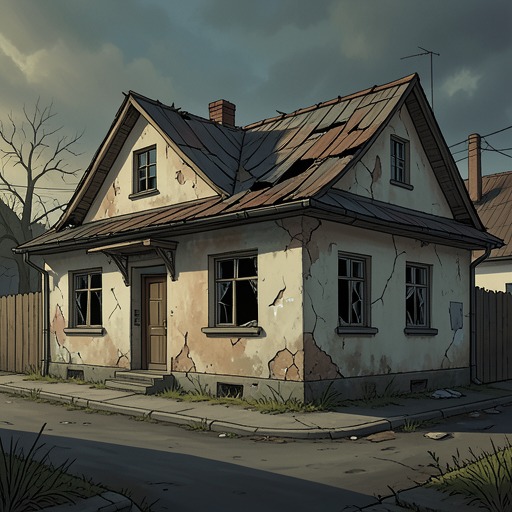
The corpse moth also intensifies the uneasy status of the house. The building already appears to watch those who approach it, with oddly placed windows and a skewed roof that can resemble a damaged face. Its garage contains childlike grass, butterflies, and a sun with dead black eyes, while the floor hides a box holding a child’s bones. Against this setting, the real butterfly becomes an emissary of the buried past—not a supernatural explanation, but a living organism whose behavior exposes the house’s relationship with death. Its power lies precisely in that uncertainty: it belongs to nature, yet within the narrative it seems to move through the house as if carrying knowledge.
For Pete, the corpse moth is finally a sign of proximity. He had searched for Tony Smith through the ordinary disciplines of policing and persistence, while the butterfly offered a different form of indication, one grounded in decay and place. The creature cannot speak, accuse, or identify a killer; it can only respond to what is already there. Yet that limited response helps transform the concealed box from an unexplained object into part of a recoverable history, making the corpse moth one of the book’s most distinctive links between forensic fact, Gothic space, and the long afterlife of a missing child.