Featherbank
The Whisper ManFeatherbank is both a promised refuge and a landscape haunted by violence. Tom Kennedy selects the village as the place where he and Jake Kennedy might rebuild their lives, yet its streets also preserve the traces of missing children, past crimes, and unresolved investigation. The village’s decisive significance lies in that contradiction: it offers the possibility of belonging while forcing its newcomers into the history they hoped to escape.
A Place Chosen for a Fresh Start
Tom Kennedy is initially terrified by the prospect of moving. Part of him has even hoped that the bank manager would reject the mortgage application after seeing through the half-truths he told about his finances. Once the decision is made, however, the old home’s dusty, discarded remnants make continuation there impossible. Tom concludes that he and Jake need to leave, despite the difficulties the move will create for him.
The practical reasons for choosing somewhere new are inseparable from the emotional ones. The new home is meant to spare Jake the need to be carried up and down stairs and to give him the chance to find friends beyond his own imagination. Tom also wants to escape the ghosts he sees in every corner of their former house. Featherbank therefore enters the narrative as an intended correction to a life constrained by grief, isolation, and an unsuitable domestic environment.
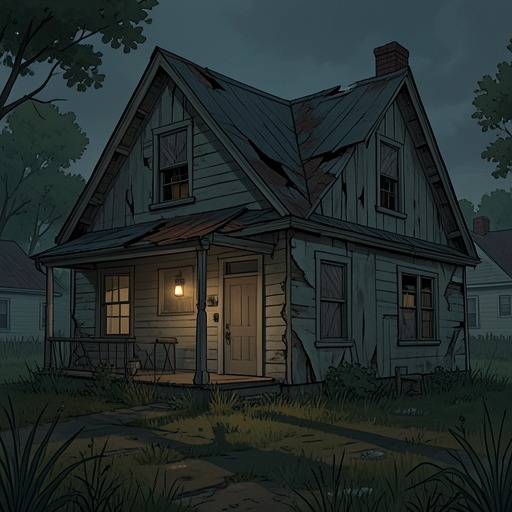
Looking at the house on his computer screen, Tom sees an affinity between the village and himself and Jake. Featherbank seems like an outsider that has difficulty fitting in, and that apparent estrangement makes it feel compatible with the family he is trying to reconstitute. Even the village’s name sounds warm and comforting to him. Before he has properly arrived, he invests Featherbank with the promise of safety.
Arrival and First Impressions
The move exposes a sharp contrast between Jake’s response and Tom’s. Jake is excited when they collect the keys from the estate agent in Featherbank, while Tom feels anxious during the drive to their new home. He worries that the house may not resemble the place he remembers from the viewings, that he may hate it once inside, or that Jake may hate it. The possibility that the entire effort might have been for nothing turns the journey toward Featherbank into a threshold charged with uncertainty.
The village later appears peaceful and settled. Its houses look comfortable in the darkness, their illuminated windows suggesting laughter and conversation inside. Tom Kennedy, returning through Featherbank, imagines people together as people should be. The image intensifies rather than resolves his loneliness, because the community he observes from the road represents a form of shared life from which he remains separate.
Featherbank’s visual calm is reinforced by its enormous trees and quiet streets. Streetlights touch the leaves only in patches, scattering yellow-green patterns across the road as the breeze moves them. This beauty makes the village’s history harder to believe: the same peaceful place once hosted atrocities as terrible as those committed by Frank Carter. The setting’s comfort is consequently unstable, always capable of opening onto remembered horror.
A Village Marked by Disappearance
The history of violence is not confined to the past. A flyer attached to a lamppost near Tom’s street carries a photograph of Neil Spencer, details of the boy’s clothing, and an appeal for witnesses. The summer sun has faded both image and text. As Pete Willis drives past, the poster resembles wrinkled flowers left at an old accident, and Neil’s disappearance seems to be happening again as the physical evidence of public concern begins to fade.
Nearly two months after Neil Spencer goes missing, the police know little more than they did on the evening he vanished, despite the resources and emotional effort devoted to the investigation. Amanda Beck has handled the case efficiently, and DCI Colin Lyons has kept her in charge partly because her performance has earned his support. Yet Amanda looks worn out when Pete sees her in the corridor, suggesting that Featherbank’s burden falls not only on the missing child’s family but also on those attempting to find him.
Neil’s poster gives Featherbank a living connection to the earlier crimes associated with Frank Carter. The village is not simply a former crime scene remembered by outsiders; it is a community in which disappearance remains an active condition. Its streets carry the ordinary signs of habitation while also displaying appeals for information about a child whose absence has become increasingly difficult to read.
Roads, Houses, and Criminal History
Featherbank also matters as a geographical network. Pete Willis loads a map of the village while considering Norman Collins, Julian Simpson, and Dominic Barnett. Garholt Street lies on a natural route between the scene of Tony Smith’s abduction and the direction in which Frank Carter fled. Forensic evidence had established that Tony had been inside the killer’s vehicle, raising the possibility that Carter, if warned that his house was being searched, might have left the boy’s body at the Garholt Street property before going on the run.
Julian Simpson was living at that property at the time, although his name had not appeared in the investigation among Carter’s known associates. Norman seems to know what had been stored there, while Simpson and Dominic had both lived at the house. The map therefore converts Featherbank from an atmospheric setting into a field of investigative connections: roads, houses, and movements may reveal a relationship that earlier inquiries missed.
The village’s domestic appearance conceals this network of secrets. Comfortable homes and lit windows suggest ordinary social life, but the same built environment contains routes associated with abduction, a property linked to possible concealment, and residents whose connections to Frank Carter remain uncertain. Featherbank’s apparent safety is thus not disproved by its history; it is made more disturbing by the fact that violence can exist within such familiar surroundings.
Narrative and Thematic Significance
Featherbank functions as a threshold between escape and confrontation. Tom chooses it because he believes he and Jake need a fresh start, and because its name and appearance seem to promise protection. Yet the village places them inside a community shaped by the crimes of Frank Carter and by the unresolved disappearance of Neil Spencer. The hoped-for refuge becomes a setting in which private grief meets public fear.
The location’s strongest recurring contrast is between visibility and concealment. Windows are illuminated, streets are open, and a missing poster publicly asks for witnesses; nevertheless, the most consequential facts may lie in a house on Garholt Street, in the movements connecting different parts of the village, or in knowledge withheld by people who were present twenty years earlier. Featherbank is readable only in fragments, and each fragment carries the possibility of a deeper history.
For Tom and Jake Kennedy, the village promises belonging without guaranteeing it. For Pete Willis and the investigators, it is a map of evidence whose quiet surfaces may still contain the aftermath of crimes. Featherbank’s significance finally rests in its double identity: it is the place where a damaged family seeks safety and the place where the past refuses to remain buried.