Featherbank’s climate of fear surrounding the Whisper Man
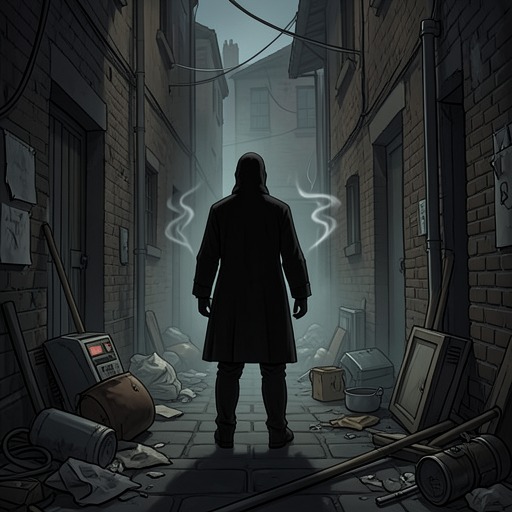
The Whisper ManFeatherbank’s climate of fear surrounding the Whisper Man is the atmosphere that turns an apparently peaceful village into a landscape of suspicion, memory, and threat. Its decisive force lies in the contrast between the village’s warmth and the danger embedded in its houses, stories, and silences: Featherbank looks like a place where Tom Kennedy and Jake Kennedy might begin again, yet the community’s ordinary spaces carry the residue of child abduction and murder. Fear is therefore not confined to a single criminal or crime scene. It has become part of the village’s shared imagination, passed between adults and children until a warning about a killer sounds like a playground rhyme.
A Peaceful Village with an Ominous Edge
Featherbank first presents itself as a refuge. In the late-summer sun it is beautiful, suburban, and almost rural despite being only five miles from a busy city center. Cobbled roads and cottages line the river to the south; farther north, sandstone houses rise along steep, tree-lined streets, while cut grass, music, and children playing create an impression of slowness and tranquillity. Tom imagines Jake running happily in the large field opposite their new home, and even the village’s name sounds warm and comforting. For a father seeking a fresh start, Featherbank seems to promise safety.
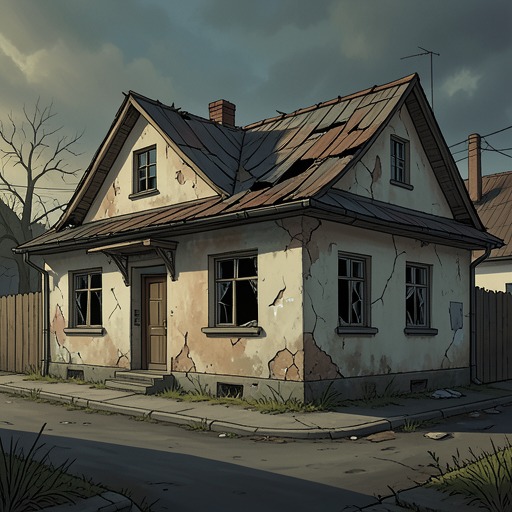
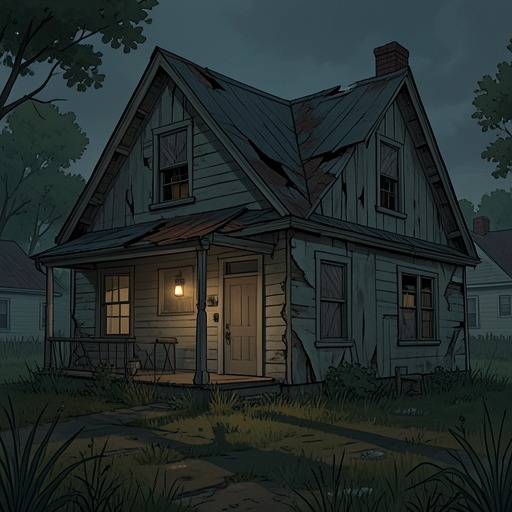
That promise is unsettled by the place where Tom and Jake are meant to live. The house is small, detached, old, and cottage-like, but its windows are oddly positioned and its roof sits at a wrong angle, making the building appear inquisitive or angry. Tom experiences the unease physically, as a sensation at the back of the skull, while Jake is immediately entranced by the property and refuses to consider another. When Tom returns with him, the house seems first forbidding and dangerous, then merely full of character, and finally like a beaten, lopsided face. The changing impression does not dispel the threat; it shows how quickly the building turns perception itself into a source of fear.
The house’s interior deepens that impression of a place that has never become fully domestic. Dusty cabinets, chairs, newspapers, boxes, and a mattress remain from an earlier tenant’s life, while stale air briefly suggests that something has been left rotting inside before the smell resolves into cleaning products. A single footstep from upstairs is followed by a landing with nobody on it and a silence that seems to ring in Tom’s ears. The house appears to watch its new occupants through its windows, turning architecture into a presence rather than a neutral shelter.
The House as Local Scary Space
The fear associated with the property predates Tom and Jake. Norman Collins recalls that children once dared one another to enter its garden and photographed themselves there. Even in his own childhood, the building had been known locally as the scary house. Some children believed it was haunted; others claimed that a former murderer had lived there, although these explanations had no known basis. Its appearance alone had made it frightening, giving the house a reputation before the community knew the criminal history concealed within it.
Later information makes the reputation grimly legible. The property had belonged to Anne Shearing, who inherited it from her parents but did not live there for decades, renting it to a succession of occupants. Julian Simpson had been the tenant during the period beginning before 1997, when Frank Carter committed his murders, and remained there until 2008. Dominic Barnett occupied the house after Simpson and until shortly before the present events. The house’s history thus links a familiar local landmark to hidden human activity, even though the police did not initially know Simpson’s name or understand the significance of the property.
The same association is recognized by Francis Carter. From his own childhood, he remembers Jake’s former home as a monstrosity that other children regarded as dangerous without knowing why. The rumors of haunting and murder were inaccurate in their details but accurate in their emotional response: the place felt wrong because its visible form registered a history that the children could not articulate. In this way, the house becomes a Gothic container for buried knowledge. It is frightening before the facts are available, and more frightening once the facts explain what the community had sensed.
From Crime to Children’s Rhyme
The village’s fear is transmitted most powerfully through language. Jake insists that doors must be closed and locked, and when Amanda Beck asks him to tell the rhyme, he resists before being pressed to repeat it. Tom later remembers that he himself once had an imaginary visitor called Mister Night, an unseen figure who came into his room at night and hugged him. The adult explanation that children say frightening things does not account for the rhyme’s timing: Jake had used it before his first day at school in Featherbank, so its presence cannot simply be attributed to something he heard in that playground.
The rhyme’s warning structure makes ordinary domestic boundaries ominous. Its opening line states, “If you leave a door half open, soon you’ll hear the whispers spoken.” A partly open door is transformed from a minor household detail into an invitation to an unseen presence. Karen Shaw recognizes the wording as something children say in the playground, and later explains that Adam had never heard of Frank Carter, suggesting that the rhyme has survived independently of the man’s name. It has passed down as a warning against a bogeyman, with the original crime displaced by a form children can repeat, remember, and use.
The written record reveals that the rhyme is also part of family memory. After Jake’s disappearance, Tom searches through the Packet of Special Things, handling its papers, faded tickets, receipts, notes, and one of the few party invitations Jake had received. Among these objects he finds an older page torn from a ring-bound notebook and recognizes Rebecca’s handwriting. The poem was apparently written when Rebecca was a teenager, long before Jake’s current fear, and begins with the same line about a half-open door before continuing, “If you play outside alone, soon you won’t be going home.” The discovery collapses the distance between childhood folklore, adult family history, and the present threat.
Fear, Vulnerability, and the Children of Featherbank
The climate surrounding the Whisper Man is not abstract for the children who live within it. Mrs. Shelley tells Tom that a boy named Neil Spencer was in Featherbank the previous year and had gone missing. The news is initially only a vague bell in Tom’s memory, but the disappearance gives the local atmosphere a concrete victim and makes Jake’s behavior impossible to treat as a harmless eccentricity. Jake’s fear of unlocked doors, his insistence on household precautions, and his statement that he hates himself reveal how deeply danger and self-blame have entered his emotional world.
The threat is made more terrible by the knowledge that care and violence can coexist. Amanda Beck reminds Tom that, assuming the same man took Neil Spencer, Neil was cared for at first; Tom answers that Neil was then murdered. This contrast destroys the comforting distinction between a dangerous stranger and a visibly monstrous captor. The Whisper Man may temporarily imitate protection, making the language of safety itself unstable. In Featherbank, a locked door can be protection, a house can be a trap, and apparent care can precede irreversible harm.
The same instability is embedded in the spaces connected to the crimes. In Frank Carter’s decorated extension, crude green grass, childlike butterflies, and a skewed yellow sun with dead black eyes cover the walls. In the attic where Jake is held, a neatly carpeted room is painted with grass, bees, and butterflies, but the harsh bare bulb makes the drawings seem unreal; old Transformers sheets, a chest of soft toys, and a small wardrobe create the imitation of a child’s bedroom without making it feel naturally inhabited. The room’s domestic signs are not reassuring because they reproduce the appearance of childhood while enclosing a child in captivity.
A Community Memory That Outlives the Killer
Featherbank’s fear survives because the Whisper Man has become more than an individual criminal. The name condenses the history of Frank Carter, the disappearance of Neil Spencer, the frightening house, the locked door, and the rhyme that children repeat without necessarily knowing its source. The village’s folklore does not replace the crimes; it is the form through which the crimes remain socially present after their factual circumstances have been obscured.
That process also explains the power of the setting’s recurring contrasts. Featherbank is beautiful, but its tranquillity resembles a surface over buried danger. The house promises a fresh start, yet its windows seem to watch and its rooms retain traces of earlier occupants. A child’s rhyme sounds like a game, yet its language predicts abduction. Even the idea of being cared for can conceal a progression toward murder. The climate of fear is thus produced by the collision of the ordinary and the threatening, not by constant visible violence.
The village ultimately functions as a memory system. Its children carry rumors, its adults recognize fragments, its houses preserve evidence, and its families unknowingly repeat words written years earlier. What begins as a local reputation attached to a strange-looking building becomes a communal grammar for danger. Featherbank feels safe because it is peaceful, but it feels unsafe because peace cannot erase what its spaces and stories continue to say.