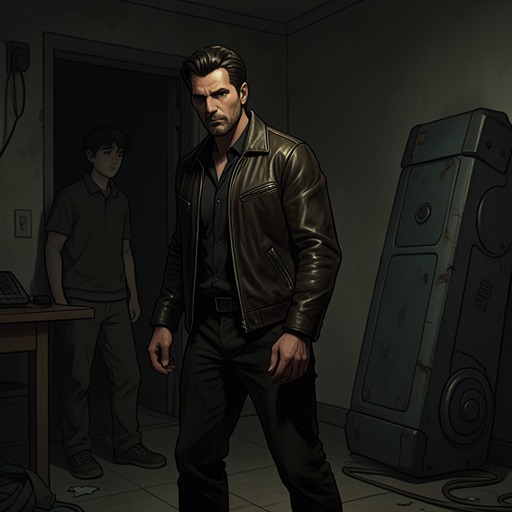
Francis Carter arrest
The Whisper ManFrancis Carter arrest is the decisive exposure of the man hiding behind the identities George Saunders and David Parker. The investigation turns a seemingly unremarkable school employee into Francis Carter, the son of serial killer Frank Carter, and converts scattered forensic and investigative clues into an urgent rescue operation for Jake Kennedy. The arrest matters not only because it removes Carter from immediate reach of another child, but because it reveals how an inherited criminal history has been concealed inside an ordinary public identity.
The Evidence Trail
The case develops through a chain of physical evidence rather than a single confession. At the scene where a boy has been found, Pete Willis notices that the child’s clothing includes blue tracksuit pants and a Minecraft T-shirt pulled over the face. The lack of sufficient blood around the body indicates that the boy was killed elsewhere, distinguishing the new crime from Frank Carter’s established practice of killing children where they were found and keeping their remains in his house. A second body is then reported at a house on Garholt Street, and the remains are identified as those of a male child who had been about six years old at death. The child had been dead for a considerable period, possibly twenty years, while the box and clothing recovered with the bones preserve a material link to the past.
The investigation also produces a direct forensic connection to Norman Collins. Amanda Beck tells him that his fingerprints were found on the hammer used to murder Dominic Barnett at the relevant location. Collins responds with no comment, but the evidence demonstrates the widening network around the killings and shows that the inquiry is not relying only on impressions or family resemblance. The earlier discovery that Tony Smith was missing, and remained missing two decades later despite Frank Carter’s admission that he had killed him, establishes the unresolved scale of the Carter crimes and gives the new investigation a historical depth.
George Saunders Unmasked
Amanda Beck makes the crucial identification by reviewing the employees of the school attended by Neil Spencer. She is looking for a man in his late twenties and finds four male employees, including the groundskeeper; only George Saunders is approximately the right age. Francis Carter would be twenty-seven, while George Saunders is twenty-four, a discrepancy small enough to be compatible with a purchased false identity. The name David Parker also enters the investigation as another possible identity Carter may be using, reinforcing the uncertainty created by deliberate renaming.
Saunders had already been interviewed after Neil Spencer disappeared. The transcript presented him as erudite and convincing, and he had no alibi for the precise period of the abduction. That absence alone had not seemed unusual, and there had been no warning signs or official record that demanded further pursuit. The decisive break comes when a new search reveals that the real George Saunders died three years earlier. The identity is therefore not merely suspicious or incomplete: it belongs to a dead man, making the living school employee an impostor and supplying the bridge from Neil Spencer’s disappearance to Francis Carter.
From Identification to Rescue
The identity revelation immediately changes the operational stakes. Amanda understands that Saunders may kill Jake Kennedy if cornered, so the police approach his house with care. Vehicles stop out of the house’s sightline to prevent him from seeing the operation, barricading himself inside, or turning the building into a hostage situation. The plan depends on surprise because the suspected offender is not simply someone to be questioned; he is believed to be holding a child whose survival may depend on the timing of the arrest.
The operation accelerates when Amanda sees a car outside with its driver’s door open and finds the door of George Saunders’s house ajar. Inside, bodies and blood make it initially unclear who has been injured. Karen Shaw is kneeling on one of Francis Carter’s arms, trying to hold it still, while Tom Kennedy presses down on Carter. Carter has been physically pinned, his eyes shut as he concentrates on moving despite the combined weight restraining him. The arrest is therefore presented as a chaotic intervention rather than a controlled interview: the police arrive at the point where concealment has collapsed into a struggle.
Above the struggle, Amanda hears hammering and shouting, followed by the cry of Daddy. The sounds keep the rescue from ending with Carter’s restraint. They indicate that Jake is still upstairs and that another danger remains active inside the house. The arrest consequently functions as one part of a larger emergency: securing Carter is necessary, but the decisive objective is to reach Jake before the offender can complete another act of violence.
Captivity and the Carter Pattern
The evidence surrounding Jake clarifies what makes Francis Carter dangerous. While held in the house, Jake is told to get into bed and pretend to be asleep when the man is coming. The instruction turns ordinary domestic behavior into a survival technique; sleep is no longer rest but a performance designed to avoid detection or punishment. Francis later greets Jake brightly, praises the fact that he has dressed himself, and tells him he can have a day off because he cannot find his school clothes. The language of care and routine masks the coercive structure of the captivity.
That mask fails when Jake’s drawings do not satisfy George. The room becomes threateningly silent, and Jake recognizes that the criticism of the pictures is only an excuse for anger. George tells him that he will have to be punished. From Jake’s perspective, the apparent goodness and kindness fall away with the force of a discarded costume, exposing the monster beneath the role. This sequence explains why Amanda rejects any comforting interpretation of Carter’s earlier treatment of Neil Spencer. She acknowledges that Neil was well cared for at first, but immediately confronts the consequence that he was then murdered. Care within Carter’s captivity is therefore conditional, unstable, and inseparable from the power to punish.
Arrest, Imprisonment, and Aftermath
After the struggle at the house, Francis Carter is in a prison cell, waiting in darkness two weeks later. He remains fully dressed on his bunk, his hands resting on his thighs as the metallic echoes and catcalls of the other prisoners fade. His anticipation is physical—his skin sings and his body trembles—but the narration distinguishes this sensation from fear. Carter understands himself as a man being tested, someone who has survived harsh treatment and intends to endure whatever is imposed on him.
His imprisonment also brings him face to face with Frank Carter. During a prison-canteen meal, Francis is seated separately under guard and eats cold mashed potato, interpreting the poor food as part of a test he can survive. He then sees his father enter. Frank appears immense, powerful, and socially dominant even inside prison, with other inmates flanking him and the guards keeping their distance. This encounter gives the arrest a further consequence: Francis is not only removed from the immediate scene of the crime but returned, psychologically and symbolically, to the paternal figure whose criminal shadow has shaped the investigation.
The arrest thus closes one identity mystery while opening the deeper question of transmission. It confirms that the threat associated with the Carter name has continued through a concealed son who adopts false identities, gains access to children through an ordinary institution, and reproduces the cycle of apparent care followed by punishment and murder. At the same time, the physical restraint of Francis and the recovery of investigative control create the conditions for Jake Kennedy’s rescue. The event’s significance lies in that double movement: the false identity is stripped away, and the family history behind it is finally brought into view.