Frank Carter’s extension
The Whisper ManFrank Carter’s extension is the hidden room attached to Frank Carter’s house, and the decisive significance of the location is that it turns an apparently ordinary home into a deliberately constructed site of captivity, murder, concealment, and recurring memory. Its discovery gives the four murdered boys a physical resting place, establishes Frank Carter’s identity as the killer known publicly as the Whisper Man, and leaves a pattern of painted grass, insects, and an angry sun that later connects new crimes to the old case.
Discovery and Physical Setting
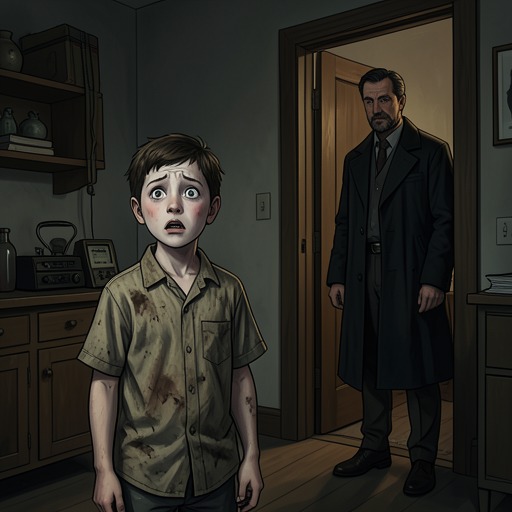
Frank Carter’s extension is first encountered through Pete Willis’s recollection of the day he finally gained access to it. He had been searching for four missing boys for three months, and although he had anticipated the possibility that they were dead, he had not entirely abandoned hope. Jane Carter’s trembling hands unlocked the door with a key she had stolen, while her young son hid behind her legs and Pete pushed the door open with one gloved hand. The house was silent, and the approach carried the suspense of a monster who might return at any moment, although Frank Carter would never come back: within an hour, police and crime-scene investigators would fill the property, and an alert would be issued for Carter and his van.
The extension’s first sensory impression is the hot smell of rotting meat. Pete initially sweeps his flashlight across the white walls rather than immediately lowering it toward the floor. That hesitation exposes the room as a carefully staged environment. Carter had painted crude green blades of grass along the walls, childlike butterflies above them, and a skewed yellow sun near the ceiling, complete with a face whose dead black eyes stared down at the floor. When Pete finally follows that gaze, he sees the four bodies lying in warm, rank darkness. Their clothes remain intact except for their T-shirts, which have been pulled over their faces, making them resemble lifelike dolls that have been broken and left still.
A Domestic Room Made Criminal
The extension’s horror lies partly in its collision of nursery imagery and violence. The painted grass, flowers, bees, butterflies, and sun suggest a child’s cheerful landscape, but the decoration is not evidence of ordinary habitation. It is a controlled visual frame for the dead children, and the sun’s black-eyed face converts a familiar symbol of safety into a watching presence. The room therefore functions as both a murder site and a representation of Frank Carter’s private world, in which childish surfaces conceal the most extreme form of adult violence.
The location also embodies the contradiction between a house as shelter and a house as trap. Pete’s relief on returning to the police department after seeing the room is immediately undermined by the arrival of Miranda Smith and Alan Smith, whose son Tony Smith is missing. Carter has a name, and four victims have been found, but the extension cannot provide a complete ending. Frank Carter remains at large for another day and a half, and although forensic evidence later shows that Tony Smith had been held in the back of Carter’s van, Tony’s body is never recovered. Carter admits killing him but refuses to disclose where he discarded the remains. The extension thus supplies terrible proof while preserving an unresolved absence.
Recurrent Pattern and Forensic Meaning
Years later, the extension’s decoration becomes a pattern investigators recognize rather than a detail confined to the old case. When Pete examines the body of Neil Spencer, the boy’s blue tracksuit pants and Minecraft T-shirt are visible, with the shirt pulled over his face in a manner that had never been made public. There is no real blood, or not enough for the injuries, indicating that Neil was killed elsewhere. Pete identifies this as a difference between the new killer and Frank Carter: Carter killed the children where he found them and kept them in his house, whereas the new offender transports and abandons the remains. Yet the covered face and other details establish a connection to Carter’s methods.
A second body is then reported at a house on Garholt Street. The remains are much older and appear to have been hidden for a long time. Examination identifies them as those of a male child approximately six years old at death; the cause cannot yet be determined, but the child has been dead for some time, possibly twenty years. The remains have been placed in a cardboard box, with the clothing recovered beneath the bones. The discovery extends the reach of the extension’s history beyond the four bodies found there and turns its visual language into a clue about a continuing chain of concealed violence.
The decorative motif is confirmed inside another room whose walls have been painted more recently than the surrounding interior. Careful drawings of grass, flowers, bees, and butterflies run around the base, and close to the ceiling an angry sun stares back with black eyes. Amanda Beck remembers the photographs of the inside of Frank Carter’s extension before slowly directing her flashlight upward. The room’s resemblance is not merely atmospheric; it provides investigators with a material and symbolic bridge from the historic murders to a present-day abduction and murder investigation.
Boundaries, Concealment, and the Uninhabited House
The extension’s significance is reinforced by its architectural echoes elsewhere. The house chosen by Jake Kennedy has oddly placed windows and a roof whose angle makes the building appear tilted, inquisitive, or angry. Its rooms are difficult to imagine from the outside, and its initial appearance gives off an uneasy sensation before its interior is even known. A garage floor contains a former mechanic’s pit filled with bricks; when one brick is lifted, a cardboard box is visible below. The detail recalls the extension’s function as a place where a building’s ordinary surfaces conceal a lower, more terrible use.
A further echo appears in the attic where Jake Kennedy is held. The space is neatly carpeted and painted bright white, with grass at the bottom of the walls and bees and butterflies above. A bare bulb makes the drawings seem unreal, while soft toys, a small wardrobe, and worn Transformers sheets create the outline of a child’s bedroom that does not feel as though it was ever meant to be lived in by a real boy. The extension establishes the visual grammar of this false domesticity: rooms appear prepared for children but are actually designed for control, concealment, and observation.
Memory and Narrative Consequences
For Pete Willis, the extension is not a closed chapter after Frank Carter’s arrest. He visits Carter at least once a year during the latter’s incarceration, and Carter deliberately makes him wait through petty delays before appearing. That ritual recreates the old imbalance of power: Pete can leave afterward, but Carter possesses the only thing Pete still wants from him, namely information. The extension therefore continues to operate through memory and withheld knowledge, keeping the investigator psychologically within its locked space even after the physical crime scene has been processed.
The location also marks the difference between apprehending a murderer and bringing every victim home. Pete believes that everybody should get to go home, but the extension contains only four of the children connected to Frank Carter’s crimes. Tony Smith’s fate is admitted yet materially unresolved, while the older remains found elsewhere require identification and explanation. The extension’s deepest narrative function is consequently double: it is the place where the original horror becomes undeniable, and the place whose evidence proves that recognition alone cannot restore what violence has taken.