Julian Simpson
The Whisper ManJulian Simpson is the dead tenant whose four-year occupancy of the house on Garholt Street places him at the hidden center of the mystery surrounding Tony Smith. He is never encountered alive in the present-day investigation, yet the property he occupied preserves the material traces of the past: Tony’s remains, Carter’s childlike decorations, and a chain of later visitors and intermediaries. Simpson’s significance lies precisely in this delayed presence. He is not merely a former resident but the person who turns an apparently isolated murder investigation into a buried network extending beyond Frank Carter.
Identity and Residence
Julian Simpson rented the Garholt Street property for four years before 1997, the year Frank Carter committed his murders, and remained there until 2008. The house had previously belonged to Anne Shearing, who inherited it from her parents and did not live there herself for decades, instead letting it to a succession of tenants. Simpson therefore occupied the property during the period most relevant to Tony Smith’s disappearance and continued to live there long afterward.
Pete Willis discovers that Simpson died of cancer in 2008 at the age of seventy. His death removes the possibility of direct questioning, leaving the investigation dependent on records, physical evidence, and the testimony of people who dealt with him. The absence is consequential: Simpson’s name did not appear in the original inquiry into Carter’s known acquaintances, even though he was living in a house situated along a plausible route between the place where Tony Smith was abducted and the direction in which Carter fled.
The House as Simpson’s Legacy
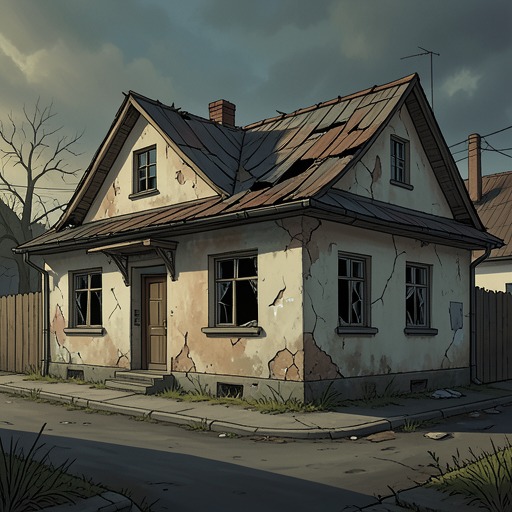
The house itself is repeatedly perceived as unnerving. Its oddly positioned windows make its internal layout difficult to imagine, while its slightly misaligned roof gives the facade the appearance of an inquisitive or angry face. On another visit, the windows suggest a beaten face, with one eye displaced above a badly bruised cheek. The house’s shifting appearance turns architecture into a form of suspicion: it seems to watch those who approach, while its stale air briefly suggests that something long sealed away may still be rotting inside.
That unease is linked to the building’s history. When Pete examines the property, its walls are painted white but decorated with crude green grass, childlike butterflies, and a skewed yellow sun with dead black eyes. In the garage, a section of floor conceals an old mechanic’s pit filled with bricks; lifting one brick exposes the top of a cardboard box beneath. These details make the house more than a setting. Its domestic surfaces have been adapted to conceal, contain, and disguise the remains of violence, creating a grotesque overlap between children’s imagery, ordinary household space, and criminal infrastructure.
Norman Collins remembers that Simpson was regarded as an unsavory man with poor personal hygiene and that he was not entirely mentally sound. People mocked him, but they were also afraid of him. The house already had a local reputation as a scary place: children dared one another to enter its garden and photographed themselves there. That folklore had not been based on the facts of Carter’s crimes, but retrospectively it gives Simpson’s residence an ominous social dimension. The community had identified the property as frightening without knowing what it concealed.
Connection to Tony Smith
Garholt Street’s location makes Simpson relevant to the Tony Smith case. The street lay on a natural route between the scene of Tony’s abduction and the direction of Carter’s flight. Forensic evidence had established that Tony had been inside Carter’s vehicle, but Pete considers the possibility that Carter, if warned that his house was being searched, could have taken the boy’s body to the Garholt Street property before fleeing. Simpson was the tenant there at the time.
The original investigation did not identify Simpson as one of Carter’s acquaintances. Pete knows that Carter’s known associates were investigated carefully, yet Simpson’s name never surfaced. This omission becomes one of the case’s most painful implications: the failure was not caused by an obviously inaccessible suspect, but by a man and a house that remained outside the investigators’ field of attention.
The later account supplied by Norman Collins confirms the connection. Collins explains that he was directed to Simpson after being vetted through Victor Tyler and paying money delivered to Tyler’s wife. At Simpson’s house, after another payment and a period of waiting in a downstairs room, Simpson returned with a sealed cardboard box and carefully cut it open. The body inside was Tony Smith. Collins’s description identifies Simpson as the custodian or intermediary through whom Tony’s remains were made available, even though the available evidence does not establish every detail of how Simpson acquired them or what his full relationship with Carter was.
Role in the Hidden Network
Simpson forms one point in a chain that also includes Frank Carter, Victor Tyler, Norman Collins, and Dominic Barnett. Tyler arranged access to the people who came to him and vetted prospective visitors; Carter knew about the procedure but did not wish to be directly involved. Collins was then directed to Simpson, whose house functioned as the place where Tony’s remains were stored and revealed.
The property’s successive occupants deepen the mystery. Simpson lived there until his death in 2008, after which Dominic Barnett became the tenant and remained there until shortly before the present investigation. Barnett was a minor underworld figure associated with drugs and extortion. He later died after being struck with a hammer; although the weapon carried partial fingerprints, no database match or credible suspect was found, and the police publicly treated the killing as an isolated, targeted incident. Simpson, Barnett, and Norman therefore become connected through the house and through knowledge of what had been kept there, even though the precise relationship among the three remains a question Pete must reconstruct.
Narrative and Thematic Significance
Simpson represents the difference between arresting a murderer and returning a missing child to his family. Frank Carter admitted killing Tony but refused to say where he had discarded the remains, leaving Tony’s parents with twenty years of uncertainty. The discovery and identification of Tony’s body confront the investigators with the unfinished nature of justice: Carter is imprisoned, but the family’s ability to bring Tony home depends on recovering the truth hidden in places and relationships the original investigation overlooked.
That concern echoes Pete Willis’s belief that everyone should get to go home. Simpson’s house is where that principle has been violated most starkly: Tony was removed from the path of return and reduced to something concealed in a sealed cardboard box. The later investigation attempts to reverse that process by naming him, locating his remains, and tracing the chain that kept him from his family.
Simpson’s characterization is consequently built from absence, reputation, and material residue rather than direct action on the page. He is remembered as frightening, degraded, and socially marginal, but those labels prove insufficient to explain his importance. The apparently eccentric tenant belongs to the concealed history of the house, and the house in turn becomes a physical record of violence that the authorities failed to read in 1997. Even the children’s room later found in the building, with painted grass, bees, butterflies, toys, and worn Transformers sheets, recalls the same disturbing collision between innocent imagery and the captivity or disposal of children. Simpson’s enduring narrative function is to embody the hidden custodian of that collision: a dead man whose house continues to speak through what it concealed.