Mister Night
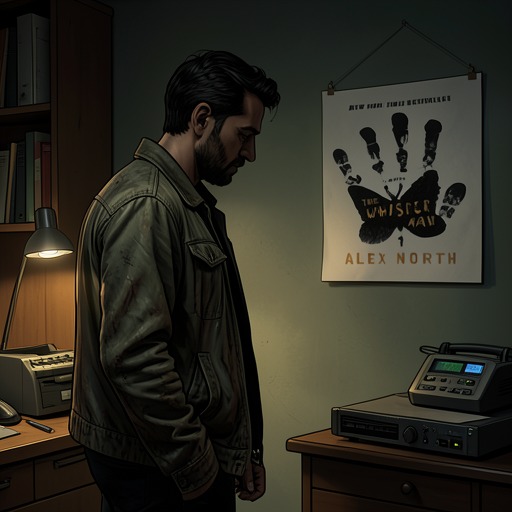
The Whisper ManMister Night is the name Tom Kennedy gave to an imaginary nighttime visitor from his childhood, but the figure ultimately becomes more than a childhood invention. It embodies the uncertain boundary between memory and reconstruction: what Tom experiences as a supernatural or imaginary presence is partly explained by his father’s secret visits, while its emotional reality remains intact. Through Mister Night, the novel connects fear, domestic violence, paternal absence, and the consoling force of remembered intimacy.
Definition and First Recollection
Tom recalls Mister Night during a conversation with Karen Shaw about children’s imaginary friends. The memory returns suddenly after Karen suggests that children commonly invent frightening or comforting companions. Tom then remembers that, when he was young, he told his mother that someone came into his bedroom at night and hugged him. He called this visitor Mister Night.
The memory is disturbing in retrospect because Tom had not regarded the visitor as frightening. Mister Night was not a monster who threatened him, but an invisible presence associated with physical comfort. The name therefore carries an unusual doubleness: it belongs to the darkness and secrecy of night, yet also to the reassurance of being held while asleep. Karen treats the story as the sort of unsettling childhood material that might be useful to a writer, but Tom’s response indicates that the recollection has deeper personal significance.
Connection with Tom’s Childhood Trauma
Mister Night appears alongside Tom’s memories of his childhood home and of conflict between his parents. In a dream that feels like a memory, Tom sees himself as a frightened child leaving his bed and approaching the kitchen after hearing his mother and a man arguing. He remains small, terrified, and powerless, drawn toward an event he does not want to witness. The scene is presented through fragments of sound, dread, darkness, and an approaching catastrophe rather than through a fully reliable account of what happened.
This pattern matters because Tom’s memories of childhood are not simply factual records. They combine sensory vividness with emotional certainty, and the novel repeatedly asks whether a clear image is necessarily an accurate one. The imagined visitor occupies the same unstable territory. Mister Night may initially seem to be a child’s explanation for a mysterious presence, but the memory also preserves a bodily experience of being comforted when Tom could not understand the adult world around him.
The Father’s Revelation
The meaning of Mister Night changes when Tom’s father corrects Tom’s account of the night he believed he had witnessed violence. Tom remembers his father shouting and his mother screaming, and he has a vivid image of his father throwing a glass at her. His father explains that Tom was not present that night; he had been sleeping over at a school friend’s house. Yet the father admits that Tom’s recollection was close to the truth: he had behaved violently, although he had not thrown the glass because his anger had been directed at the glass itself.
The correction does not simply erase Tom’s memory. Instead, it distinguishes between the precise event and the emotional truth attached to it. Tom’s image may have been reconstructed from what he knew, felt, or later learned, but the violence itself was real enough to shape his understanding of his family. The father’s admission also confirms that Tom’s childhood was marked by instability, shame, and the consequences of his drinking. He describes his former alcohol use as arising from many reasons, while acknowledging that those reasons were not excuses, and Tom identifies his failure to be a good husband as part of that history.
The father then reveals that he did not disappear from Tom’s life immediately after being expelled from the family home. On occasions when he was sober, Sally allowed him to return after Tom had gone to bed. He entered Tom’s room while the boy slept, embraced him, and left without waking him. Tom had never known that these visits occurred. His father’s account therefore supplies a possible real-world source for Mister Night: the mysterious figure who came at night and hugged the sleeping child was, at least in part, the father himself.
Comfort, Loss, and Reinterpretation
Tom does not respond to the revelation with simple relief. He remembers Mister Night as an imaginary friend who had disappeared from his life, and he recalls having found the visitor comforting rather than frightening. When Mister Night vanished, Tom felt bereft, as though he had lost an important part of himself. The reinterpretation is consequently both consoling and painful. The figure was imaginary in the sense that Tom did not know the visitor’s identity, but the embrace he associated with it may have been a real act of paternal affection.
That affection does not cancel the father’s failures or the violence that damaged the family. The same man who drank, hurt his marriage, and behaved aggressively could also have entered his son’s room to offer comfort. Mister Night preserves this contradiction without resolving it into innocence. Tom’s memory becomes a record of how a child can experience love and danger through the same damaged adult relationship, while lacking the knowledge needed to separate them.
The figure also exposes the limits of certainty in Tom’s self-narration. He can see the image of the glass with absolute clarity, yet his father’s testimony forces him to question whether its vividness represents a literal recollection, a later reconstruction, or an emotional summary of what happened. Mister Night produces a parallel uncertainty: the childhood explanation was not wholly accurate, but neither was it meaningless. The novel treats memory as something capable of being factually unstable and emotionally exact at the same time.
Recurrence and Narrative Significance
Mister Night resonates with the novel’s broader pattern of nighttime fear, hidden presences, and children trying to make sense of adult violence. Tom later wakes to find Jake Kennedy standing at the foot of the bed as a black silhouette in the darkness, swaying gently from side to side. The scene recalls the nocturnal figure from Tom’s own childhood, but it also reverses the positions: Tom is now the adult confronting a child whose behavior he cannot immediately understand. The recurrence makes inherited fear visible without proving that the two experiences are identical.
The idea of an unseen nighttime presence also connects to Jake’s strange saying about whispers and to the threatening atmosphere surrounding the house. Yet Mister Night remains distinct from the genuinely predatory forces in the story. Its central action is an embrace, not an attack. That distinction is crucial: the novel places a potentially frightening figure beside acts of protection and asks how the same image can carry menace, tenderness, and grief depending on what the character later learns.
The motif extends beyond Tom’s immediate family. Francis Carter’s childhood is defined by a father who forced him to watch the murder of boys and treated those victims as substitutes for the child he hated in his own son. Francis believes that he cannot save the boys he witnessed or comfort the frightened child he once was, but he imagines rescuing other children as a form of amends. Against that history of destructive paternal inheritance, Mister Night represents a damaged but genuine attempt at contact. Its final significance lies not in proving that the supernatural is real, but in showing how an unexplained childhood presence can become a vessel for buried truth, unresolved grief, and the fragile possibility of forgiveness.