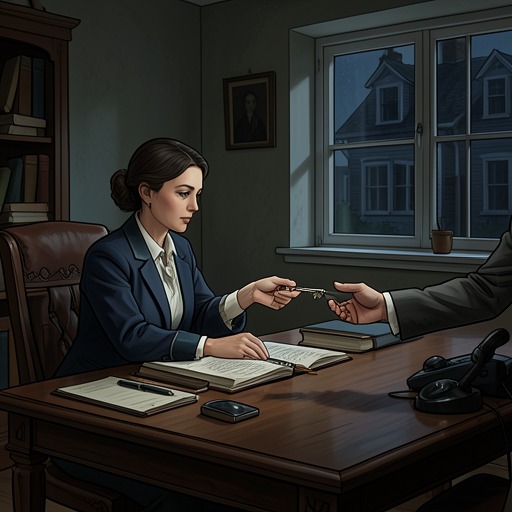
Pete Willis–Tom Kennedy father-son relationship
The Whisper ManThe Pete Willis–Tom Kennedy father-son relationship is one of the novel’s central studies of inherited fear, failed parenthood, and belated repair. Pete’s absence helped shape Tom’s childhood, while Tom’s traumatic memory preserved Pete as a man capable of throwing a glass at his mother. Their adult reunion does not erase the past, but it exposes the difference between what Tom remembers, what Pete can disclose, and what both men may still choose to become.
Identity and Background
Pete’s relationship with Tom begins under the pressure of Pete’s own failures. Pete later acknowledges that he used to drink and that there were many reasons for it, while refusing to treat those reasons as excuses. He specifically accepts that he had struggled to be a good husband. His drinking, shame, and inability to remain reliably present made fatherhood another part of the life he lost rather than a role he sustained.
Tom grows up carrying an image of Pete connected to domestic violence. When Tom is a child, he experiences a terrifying memory of glass smashing, his mother screaming, and a red-faced man throwing a glass at her in rage. Tom later tells Jake that this was the last time he saw his father, presenting the memory as a nightmare with a happy ending even though its emotional force remains active. The scene is not merely an old recollection: it becomes a template through which Tom judges his own adequacy as a father.
That inheritance becomes explicit when Tom worries about Jake and hears Rebecca’s reminder in his mind: “You’re not your father, Tom.” The words identify the danger at the heart of the father-son relationship. Tom fears that violence, inadequacy, and emotional failure can pass from one generation to the next, even as he tries to protect Jake from the fear that shaped him.
Separation and Traumatic Memory
For years, Pete and Tom exist as strangers whose relationship survives chiefly as absence. Pete has become numb to the fact of his fatherhood and has trained himself not to imagine the man Tom might have become. Thinking about his failure toward Tom is too painful to approach, so emotional avoidance becomes his method of survival. Tom, meanwhile, treats Pete as a figure from a sealed childhood past, associated with fear rather than care.
The separation is complicated by uncertainty. Tom believes he remembers seeing Pete attack his mother, but Pete later tells him that this did not happen: Tom had been sleeping over at a school friend’s house that night. Pete also corrects Tom’s belief that the violent encounter was the last time they ever met. After his mother expelled Pete, Sally sometimes allowed him to return when he was sober. He came into Tom’s room after Tom had gone to sleep, hugged him, and left without being recognized.
This revelation does not simply restore Pete as a loving father. The hidden embraces are acts of affection that Tom never knew about, and therefore could not use as protection against the abandonment he felt. The relationship has been shaped by a painful asymmetry: Pete remembers attempts at contact that Tom cannot remember, while Tom remembers a violent scene that Pete says never occurred. Truth arrives not as a clean replacement for memory but as a destabilizing confrontation between two incompatible versions of childhood.
Reunion and Recognition
Tom and Pete meet again when Beck introduces Pete to Tom and Jake. Tom immediately recognizes him; the recognition produces a physical shock, and buried memories seem to break back into consciousness. Pete recognizes Tom as well and approaches him in a professional, formal manner, concealing or controlling the expression of sickness that Tom believes he sees on his face.
Pete’s first sustained response to the reunion is self-judgment. He believes he has no right to think of himself as a father, yet he cannot prevent himself from evaluating the man Tom has become. He learns that Tom is a writer, a fact that fits Pete’s memory of Tom as a creative child who invented stories and elaborate games. He also sees that Tom has suffered hardship and tragedy while capably raising Jake alone, and concludes that his estranged son has grown into a good man.
Tom initially resists Pete’s approval. When Pete suggests that Tom seems able to do many things well, Tom wants to reject both the judgment and the praise, believing that Pete has no right to assess him and that the assessment is mistaken. He hides his weakness instead of answering honestly. Yet Tom gradually recognizes that Pete is no longer exactly the man preserved in his memory, just as Tom is no longer the child Pete abandoned. The crucial change is not forgiveness but uncertainty: Tom admits that he does not dislike Pete, while also recognizing that he does not know him at all.
Alcohol, Repetition, and Changed Conduct
Pete’s struggle with alcohol gives the relationship a concrete behavioral pattern. At home he performs a ritual involving a bottle of vodka and a photograph, handling the bottle and remembering the comforting sound of its seal breaking. At another point he sits at his dinner table in a dark, cold kitchen, staring at the bottle and photograph after confronting the renewed connection between the old cases and his own family history.
The bottle repeatedly turns the past into a present choice. Pete wakes to find that its seal has been broken but that the vodka remains untouched. He had fought the urge through the night, even bringing the bottle and a tumbler to bed while resisting the voice that urged him toward relapse. Later, he places the bottle and photograph on the table again, adds a glass, pours two fingers of vodka, and frames the decision as a matter of whether he will reach the end of the road.
Tom and Jake become part of the reason Pete interrupts that cycle. After remembering Jake’s warmth and imagining the possibility of speaking with him or playing with him, Pete decides not to drink. He carries the glass to the kitchen and pours the vodka into the sink. The action does not pretend that the craving has vanished; its significance lies in the fact that Pete chooses a different response at the moment when repeating the old one would have been easy.
Reading to Jake deepens the meaning of that choice. Pete observes the boy’s attentiveness, strong vocabulary, and desire to take over the reading despite a faltering delivery. Looking at Jake asleep, Pete reflects on what drinking had cost him and on what sobriety has made possible. He sees that Tom’s childhood damage has not automatically been passed to his son. The relationship with Tom therefore becomes linked to a difficult but real generational contrast: Pete failed Tom, yet Tom has still created safety and care for Jake.
Correction, Accountability, and Repair
Pete’s conversation with Tom about the glass is an act of correction, but not a complete absolution. He tells Tom that the remembered attack did not happen and supplies the factual explanation that Tom was away at a sleepover. He also recounts the later visits when he was sober and quietly embraced Tom while the child slept. These disclosures force Pete to assume responsibility for the difference between his actual conduct and the monstrous version preserved in Tom’s memory, without denying the broader damage caused by his drinking and absence.
Pete’s accountability is clearest when he accepts Tom’s accusation that he was not a good husband. He does not defend himself. His admission that he drank and struggled with many things is immediately answered by the recognition that one of those things was being a good husband, and he agrees. The exchange is restrained because the relationship cannot bear a grand declaration; responsibility appears in the willingness to accept an unfavorable truth.
The possibility of repair remains tentative and practical. Pete imagines talking with Jake and playing with him as he should have played with Tom, but he knows that his involvement with Tom and Jake may end within days. He does not claim a restored family or presume a right to permanent access. His new feeling toward Jake therefore carries both tenderness and grief: it reveals what he might have offered Tom, while also showing that a late opportunity cannot recreate the lost childhood.
Ending and Narrative Significance
Near the end, a different man enters Pete’s bedroom, approaches the bed, and embraces him. The scene is framed as a possible completion of a cycle, with Pete sensing or imagining that he is understood and forgiven and that a missing part of him has been returned. The encounter gives emotional form to the relationship’s unresolved history: the absent son, the failed father, and the child who once needed an embrace are brought together in an uncertain, dreamlike moment rather than through a simple reconciliation.
Tom’s later experience with Francis Carter makes the father-son relationship even more consequential. After the attack, Tom recognizes that he had been ready to die for Jake. He remains injured, bandaged, and unable to put his weight properly on one foot, but his instinct was to reach his son. That willingness to sacrifice himself marks the decisive contrast with Pete’s earlier failures. Tom cannot undo what Pete did or did not do, yet he can refuse to let that history determine his own conduct as a father.
The relationship thus ends in neither full restoration nor total estrangement. Pete’s sobriety, his willingness to correct the past, and his care for Jake establish the possibility of change, while Tom’s guarded recognition and protective commitment show how the next generation can interrupt transmission of harm. Their bond remains wounded and incomplete, but its final movement is away from repetition: the glass is poured down the sink, the child is protected, and the father’s absence is finally confronted rather than silently inherited.