Pete Willis’s alcoholism and sobriety
The Whisper ManPete Willis’s alcoholism and sobriety form one of the novel’s clearest accounts of private damage and difficult recovery. He has lived for years with an urge to drink that can recede, return, and suddenly become overwhelming. The struggle is dramatized through repeated encounters with a bottle of vodka and an old photograph of Sally, turning abstinence into an active, precarious choice rather than a settled condition. His eventual refusal to drink is linked not to the disappearance of pain but to the reappearance of hope, relationship, and a future he can still inhabit.
The Shape of His Dependence
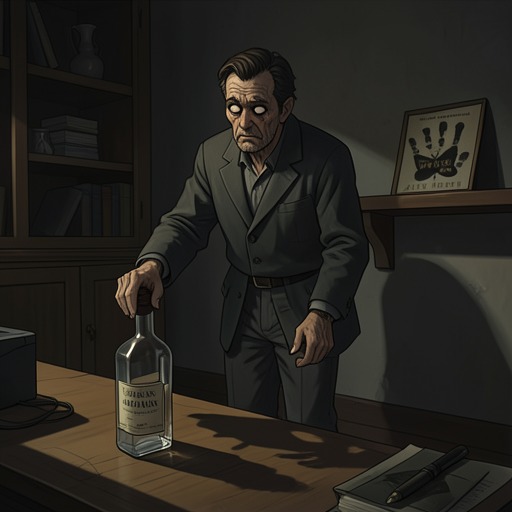
Pete lives alone and socializes rarely, filling his evenings with cookbooks, elaborate meals, films, books, and ritual. These routines offer distraction from thoughts that might move in more dangerous directions, but they also reveal how carefully his life has been organized around avoidance. The crucial ritual begins when he takes vodka from the kitchen cabinet, handles the bottle, retrieves Sally’s photograph, and sits at the dinner table to ask whether he wants to drink. The repeated arrangement of bottle and photograph makes alcohol inseparable from memory and loss.
The desire is intermittent rather than constant. Over the years, it has come and gone, sometimes apparently waking at random and sometimes being stirred by recognizable pressures. For the two months preceding one crisis, however, the bottle seems to have been speaking increasingly loudly. The language attributed to it is coercive and fatalistic: drinking is presented as inevitable, while delay is reframed as pointless suffering. The bottle therefore functions both as an object and as an externalized voice, giving the compulsion a presence that Pete must answer.
That voice is often the voice of Pete’s father. Although the older man has been dead for forty years, Pete can still picture him sprawled in a threadbare armchair, contempt on his face, calling his son worthless and useless. Pete understands as an adult that his father was a disappointed and frustrated man who used his child as a target, but that understanding arrived too late to prevent the judgment from becoming part of his internal programming. Objectively, Pete knows the insults are false; emotionally, they retain the force of truth. Alcoholism is thus bound to an inherited vocabulary of shame, in which self-destruction repeats the verdict imposed during childhood.
Triggers, Relapse Risk, and Delay
The investigation into Neil Spencer’s disappearance intensifies Pete’s vulnerability. Although he is not directly involved in the Neil Spencer investigation, the missing child casts a shadow over the police department, and the case recalls similar speculation from twenty years earlier. Seeing Frank Carter is another recurring strain. Carter’s presence always takes a toll, and learning that Carter has described a dream about Tony Smith connects the present investigation with older violence and makes Pete feel personally implicated. By the time Pete sits staring at the bottle and photograph, he recognizes that the cases are connected and that he is involved.
After seeing Neil Spencer’s body on waste ground, Pete races home and remembers the reassuring weight of the bottle in his hand and the clicks as he breaks its seal. The next morning, the bottle is beside him with its seal broken, yet it is still full. The detail preserves the danger while also recording a victory: Pete came close enough to open the bottle, even carried it and a tumbler to bed, but did not consume the vodka. Sobriety appears here as a narrow space maintained through repeated resistance, not as freedom from temptation.
Later, after leaving the safe house, Pete drives too fast toward home because the kitchen cabinet seems to be calling him and he has decided to surrender. Once inside, he locks the door and draws the curtains. The house’s stillness mirrors his condition: its rooms are tidy, carefully organized, and almost entirely empty, as though order has become a substitute for living. He describes the life represented by this house as one barely lived and deliberately avoided. The bottle is not merely a source of intoxication; it is the apparent endpoint of that self-erasure.
At the table, Pete adds a glass to the familiar bottle-and-photograph arrangement. He opens the bottle and pours two fingers of vodka, leaving the decision suspended between action and refusal. The liquid looks innocent until it folds over itself and reveals the mist hidden in its apparent clarity, an image that captures the deceptive surface of alcohol. Pete knows he has been in this place before and believes he can survive it, but survival itself seems insufficient when he asks why he should bother.
Relationships as Counterweights
The photograph of Sally carries the emotional history that alcohol threatens to erase. It is many years old, its colors faded as though the paper were trying to return to blankness. Sally appears joyful in the summer light, while Pete squints and smiles beside her. For a long time, Pete maintained the fantasy that Sally was alive somewhere, living a contented and loving life, and that his own loss had become her and Tom’s gain. Learning that Sally is dead destroys that consoling fiction. He feels that there has been no gain and that everything is dead, a realization that makes the bottle’s invitation more dangerous.
Pete’s connection with Jake Kennedy introduces a different emotional possibility. After remembering something strange and funny Jake had said, Pete allows himself to imagine talking and playing with the boy in the way he might, and should, have played with Tom when Tom was a child. He regards the thought as foolish because his involvement with Jake and Tom Kennedy is expected to end within days, but the imagined relationship nevertheless interrupts the closed circuit of shame and loss. He decides that he will not drink that night.
The decision is concrete rather than symbolic. Pete pours the vodka slowly into the sink and watches it trail away down the drain. Alongside the continuing urge, he feels something he has not experienced in years. The text does not turn this feeling into a simple cure or assign it an easy explanation; its importance lies in its existence. Jake has given Pete an image of care and participation that competes with the bottle’s demand for withdrawal.
Pete’s earlier trauma also appears through recurring memories and dreams. One dream returns him to the house of his childhood, where he approaches a kitchen doorway after being awakened by an argument downstairs. He remains under the covers at first, terrified and powerless, then tiptoes toward the bright kitchen while hearing his mother’s quiet anger and a man’s loud, uncaring voice. The words cannot be made out, but their ugliness builds toward something awful. The memory’s uncertainty—whether it records an exact event or condenses an emotional truth—shows how deeply fear has entered Pete’s recollection.
When Pete later acknowledges that his father did, in fact, behave violently, the childhood image becomes more than a vague nightmare. Pete remembers his father shouting and his mother screaming, while his father explains that he did not throw a glass at her only because he was angry at the glass itself. The confession confirms that Pete’s adult self-condemnation has a material history. Alcohol’s inner voice repeats the emotional structure of the childhood kitchen: threat, contempt, helplessness, and the demand that Pete accept punishment as deserved.
Sobriety Through Choice and Care
Pete’s refusal to drink is initially framed as a single-night decision—“Not tonight”—rather than a promise that temptation has ended. He knows how easy it would be to throw the glass, and the possibility of abandoning control remains close at hand. Yet he chooses to empty the drink instead. This action distinguishes delay from surrender: the urge remains present, but it no longer dictates the next movement.
The change becomes more durable when Pete reads to Jake. Used books, food, television, and ritual have previously served as ways of turning his attention aside from danger. Reading to Jake is different because it creates contact rather than merely distraction. Jake listens quietly, then wants to take over; although his delivery is faltering, his vocabulary is impressive. The room becomes peaceful, and Pete recognizes that whatever damage he caused in Tom’s childhood has not been passed automatically into Jake’s experience.
After Jake falls asleep, Pete looks down at him and measures the stakes of sobriety through what can be lost and gained. He has often told himself to look at what drinking costs while looking at Sally’s photograph, but the recent months have been the hardest tests. His resistance now feels like having dodged a bullet he did not know was coming. The future is uncertain, but it exists. That distinction is decisive: sobriety is no longer only refusal of vodka; it is preservation of the possibility of tomorrow.
Meaning and Ending State
The novel does not present Pete’s sobriety as the elimination of addiction. After the night of reading, the urge remains detectable, like smoke from a stubbed-out candle, but its fire and brightness have gone. The metaphor preserves both progress and vulnerability. Pete has not become untouched by the bottle; rather, the compulsion has lost its immediate command because another form of attachment has become emotionally available.
His recovery therefore moves from shame-driven resistance toward value-driven choice. The father’s insults can still make drinking feel inevitable, and grief for Sally still presses against the present, but Jake gives Pete a reason to remain present without pretending that the past has been repaired. The bottle, the photograph, the silent house, and the repeated question of whether to drink all belong to the old structure of his life. The glass emptied into the sink, the book shared with Jake, and the recognition that the future remains possible belong to a new one. Pete’s sobriety matters because it changes what his suffering is allowed to lead toward: not oblivion, but care, responsibility, and the chance to live differently.