Caldwell Development
The Wife He Never Wanted: A Marriage-In-Crisis Billionaire Romance (Second Chance Billionaires)Caldwell Development is an unfinished apartment complex owned by Maddox Caldwell that changes meaning during the Harbor Street crisis. Initially an empty, incomplete property, it becomes the only available roof for thirty animals after the shelter’s eastern wing collapses in a storm. Later, its emergency use leads to a more consequential transformation: Maddox offers the resources behind the development for a new Harbor Street, while Paige Templeton and Claire retain authority over what the shelter must be. The site therefore marks the movement from construction as control to construction as service, and from a private asset to a deliberately shaped public refuge.
Definition and Initial Function
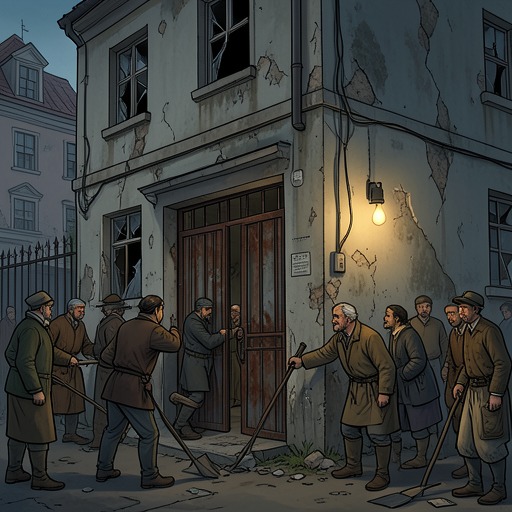
Caldwell Development is described as an empty development whose apartments are not finished and whose utilities have been shut off. Before the crisis, it belongs to the world of Maddox’s building work and represents an available but unused resource rather than an established community space. When Paige Templeton calls him from the flooded Harbor Street, she identifies it in strictly practical terms: she needs “the empty one,” the unfinished apartments, because thirty animals have nowhere else to go and the building has a roof that holds.
The request is significant because Paige does not approach the property as a gesture toward reconciliation. She needs a building capable of solving an immediate logistical problem, and Maddox’s development is useful precisely because it is unfinished, empty, and structurally available. The location’s incompleteness, ordinarily a sign of delay or failed development, becomes the condition that allows it to receive animals when the established shelter cannot.
Emergency Shelter During the Collapse
The development enters the story during a severe storm that destroys part of Harbor Street’s intact wing. Water pours into the main kennel room, while thirty animals must be moved within an hour. The emergency boarders and veterinary clinics are full, and flooding has affected much of the county. Harbor Street itself becomes a dangerous worksite, with runoff on the floor, a section open to the sky, frightened dogs, cats, puppies, and volunteers moving through rising water.
Paige calls Maddox because he can mobilize the building and the labor needed to make it usable. He agrees immediately. Although the utilities are off, he says they can be restored within forty minutes and that he will get the heat running, contact the site manager and local crew, and send people and trucks to the shelter. His response treats Caldwell Development not as a bargaining chip but as an emergency resource. He does not require Paige to explain the request fully before acting, and he arrives at Harbor Street after organizing the practical support needed for the transfer.
The rescue gives the unfinished property a temporary social function. Caldwell trucks come through the storm, carrying men in rain gear and the site manager. Maddox does not seek Paige first; he goes to Claire, who is directing the evacuation, asks what she needs, and follows her instructions. The development opens its doors twenty minutes later, with utilities working and heat pushing back the cold. The animals are settled in an unfinished lobby among crates and blankets, surrounded by the smell of wet animals and the relief of walls that hold while rain continues to strike the glass.
The scene also alters how the building is perceived. It is no longer merely an incomplete commercial project. Its value is measured by the shelter it provides: a dry lobby, functioning heat, and enough interior space to keep frightened animals alive and together after the collapse. The property’s unfinished state remains visible, but its lack of completion does not prevent it from becoming, for one night, a place of protection.
Maddox Caldwell’s Labor and the Space of Redemption
Caldwell Development is connected to Maddox’s changing understanding of responsibility. Earlier, he had relied on money, orders, and spectacle, even trying to repair his marriage by arranging an anniversary dinner, contacting a jeweler, and writing David Templeton about financial concessions. He eventually recognizes that Paige’s needs cannot be purchased and stops sending things. At Harbor Street, he begins arriving before opening, accepting the jobs no one else wants, cleaning kennels, hosing runs, hauling soiled bedding, and scrubbing drainage grates without attaching his name to the work.
That distinction matters when the development is used in the storm. Maddox’s help appears as labor rather than as a branded gift. He hauls crates in soaked clothing like another member of the line, and he is already holding a shivering terrier mix when Paige finds him near midnight. There is no press event and no carefully staged display for her benefit. The building becomes part of a pattern in which his construction expertise is valuable only when it answers other people’s needs without demanding recognition in return.
The development also reverses the power arrangement that had shaped Maddox and Paige’s marriage. He had treated requests such as a Tuesday dinner or undivided attention as items to be handled after the next business close. His instinct was to control variables and present completed answers. In the shelter crisis, however, Paige identifies the need, Claire directs the evacuation, and Maddox supplies the building, crews, utilities, and heat. The property works because authority is distributed according to knowledge: the builder makes the space available, while the shelter workers determine how it must function.
From Emergency Refuge to New Harbor Street
After the collapse, Maddox brings preliminary plans and feasibility materials to the Templeton kitchen table. He explains that the insurer’s numbers are correct: Harbor Street cannot be rebuilt on its original site and could not afford to do so even if rebuilding were possible. He presents three potential sites, notes on zoning, access, and flood-plain data, and a construction commitment backed by the Caldwell name.
The proposed reconstruction is deliberately not a finished answer. Alongside the sketches is a mostly blank program document with fields for intake capacity, an isolation ward, quiet rooms, and community space. Maddox tells Paige Templeton and Claire that he knows buildings but does not know shelters. They are to specify every room, run, and missing function; he will provide the money, land, and crew, while they decide what gets built. The development thus becomes the material and conceptual bridge between emergency response and institutional reconstruction.
This arrangement gives Paige and Claire the authority that Maddox’s earlier methods would have taken from them. Claire can name the quarantine wing, independent air handling, and an indoor community room needed for adoption events. Paige recognizes that the offer puts the pen in her hand instead of taking it away. The rebuilt shelter is not simply a Caldwell project imposed on Harbor Street; it is a space produced through collaboration with the people who understand animal care and community use.
Maddox briefly reintroduces his old transactional logic when he says he will build the shelter if Paige comes back. He immediately recognizes the condition as another attempt to turn a gift into a deal, retracts it, and states that the shelter will be built whether or not Paige ever speaks to him again. Caldwell Development therefore becomes associated with a crucial correction in his behavior: resources remain available, but access to them is no longer conditional on marital reconciliation.
Narrative Significance and Final Transformation
The property’s significance lies in its spatial transformation. A private, unfinished development first serves as an emergency refuge, then supplies the land, capital, and construction capacity for a shelter designed by Harbor Street’s own workers. Its empty rooms expose the limitations of a building conceived without its eventual users, while the later planning process corrects that failure by placing intake, quarantine, isolation, quiet space, and community activity at the center.
The final Harbor Street opens on a Saturday in October, retaining its old name after two decades and one collapse. The completed building contains the functions Claire had specified at the Templeton kitchen table: an isolation ward with its own air handling, a real quarantine wing, and a community room large enough for indoor adoption events. Families move through rows of animals beneath a roof that no longer requires anyone to pray against the weather. The development is no longer presented as a destination in its own right, but its resources have enabled that durable transformation.
Caldwell Development consequently embodies a contrast between ownership and stewardship. In its first appearance, the unfinished complex is an asset Maddox controls. During the storm, it becomes a roof offered without hesitation. In the reconstruction plan, its value is redistributed through Paige and Claire’s decisions. The location’s decisive role is not that it becomes beautiful or complete on its own, but that it teaches the story what construction can mean when walls are built around the lives they must protect.