Harbor Street’s rebuilt operation
The Wife He Never Wanted: A Marriage-In-Crisis Billionaire Romance (Second Chance Billionaires)Harbor Street’s rebuilt operation is the practical and symbolic outcome of the shelter’s collapse. What begins as an emergency response to a failing roof becomes a reconstruction designed around the animals’ actual needs, with Claire and Paige retaining decision-making authority while Maddox supplies land, money, and construction labor. The finished shelter does not merely replace a ruined building: it gives durable form to a new ethic of care and to the rebuilt partnership between Paige and Maddox.
From Structural Failure to Crisis
The reconstruction is rooted in a failure that had been developing long before the storm. Maddox recognized a sagging roofline, a dip in the fascia, and water staining the block above Skipper’s run. His construction experience told him that the problem had moved beyond cosmetic damage toward a failing load path. Claire later identified the same corner as the section that collapsed, explaining that the deterioration had triggered an insurance exclusion and left most of the structural cost uncovered.
The storm turned that hidden vulnerability into an immediate humanitarian crisis for the animals. The east runs opened to the sky, water entered the main kennel room, and thirty animals had to be moved within an hour while emergency boarders and veterinary clinics were already full. Harbor Street’s volunteers carried frightened dogs, cats, and puppies through ankle-deep runoff as rain and flooding eliminated the ordinary alternatives. The old shelter was not simply damaged; it had become impossible to reopen safely, and the limits of its cramped design were exposed at the same time.
Emergency Operation and Temporary Refuge
Paige joined Claire and the volunteers during the evacuation, helping move animals through rising water and the exposed east end of the building. The work was immediate and physical: crates passed from hand to hand, a senior cat was carried in a pillowcase when carriers ran out, and a terrified pit bull had to be coaxed from a run nearest the collapse. The shelter’s rebuilt operation therefore begins with an understanding that rescue depends on coordination, presence, and attention to individual vulnerability rather than on abstract institutional goodwill.
Maddox’s response marked a change in how he used his resources. Caldwell trucks arrived with workers in rain gear, but he did not approach Paige first or turn the emergency into a personal display. He went to Claire, who was directing the evacuation, asked what she needed, and followed her instructions. The Caldwell development opened its unfinished lobby twenty minutes later, providing heat and dry space for the displaced animals. By midnight, Maddox was still carrying a shivering terrier mix inside his ruined jacket, a detail that made his care visible as action rather than performance.
Reconstruction by Shared Authority
A week after the storm, Claire brought the insurance figures to the Templeton kitchen table. The storm coverage was partial, code upgrades were excluded, and a modern-code rebuild would cost more than Harbor Street had ever possessed. Maddox arrived with preliminary feasibility sketches, three possible sites, zoning and flood-plain notes, and a construction commitment backed by the Caldwell name. The proposal was substantial, but its defining feature was not the amount of money offered; it was the authority he refused to take for himself.
Maddox told Paige and Claire that he knew buildings but did not know shelters. He offered to provide the money, land, and crew while they determined the intake capacity, isolation ward, quiet rooms, and community space. He would not draw another wall until they filled in the program requirements and decided where the rooms belonged. Claire immediately began specifying the facilities she had needed for years, including a genuine quarantine wing and an isolation ward with its own air handling. The rebuilt shelter was therefore planned from operational knowledge outward, not imposed as a finished gesture by its financier.
For Paige, the blank program document carried a particular significance. Earlier gifts and promises had treated material provision as a substitute for emotional presence, while her marriage had left her feeling as though she was tending to a building with nobody inside. This time, Maddox offered a structure she and Claire could shape. The gesture mattered because it returned the pen to the people who would live with the consequences of the design. His rebuilding commitment became a form of restitution only because it accepted their judgment instead of purchasing their submission.
The New Harbor Street
The new Harbor Street opened on a Saturday in October. Skipper was the first dog through the door, and Paige had placed his torn ear in the logo above the intake wing. The name also survived the collapse. Claire believed that a name carried through two decades and a roof falling down was worth more than a name attached to a check, and Maddox supported that decision without argument. Continuity was preserved, but the physical conditions of that continuity were radically improved.
The completed building contained everything Claire had identified at the Templeton kitchen table: an isolation ward with independent air handling, a real quarantine wing, and a community room large enough for indoor adoption events. Families moved among animals housed beneath walls that held and a roof that no longer required anyone to pray against the weather. The shelter’s design answered both the immediate disaster and the older inadequacy of the former building, turning reconstruction into an opportunity to create a more resilient operation rather than restore the same vulnerability.
Meaning for Care and Reconciliation
Harbor Street’s rebuilt operation makes care concrete. Its walls, ventilation, quarantine spaces, and community room translate repeated practical needs into institutional form, while its history insists that safety is not a minor convenience. The old building taught Paige that a roof and sound walls mattered; the new one embodies that lesson for the animals who will pass through it in the years ahead.
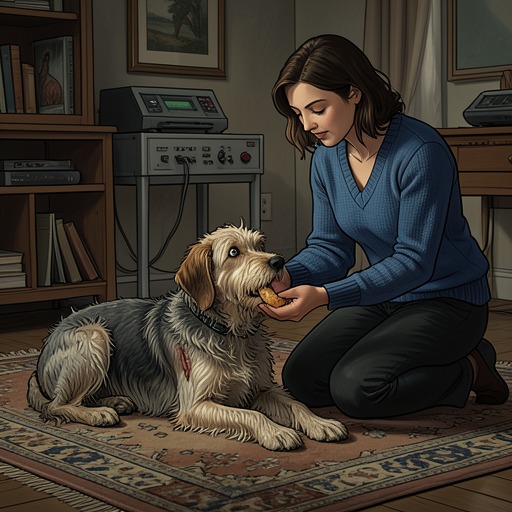
The shelter also gives material shape to Maddox’s ethical change. He once reached for checks, plans, and controllable solutions to avoid showing up, but at Harbor Street he began with unobserved kennel labor, recognized the roof’s danger, joined the evacuation without seeking an audience, and later offered reconstruction without controlling its design. The same principle appears in his private life when he cleans mud from the rug after Skipper destroys a pillow, distinguishing the replaceable object from the living creature that can feel. In the finished shelter, practical work and emotional responsibility finally occupy the same structure.
At the opening, Paige crosses the floor to join David in a drainage argument while Maddox follows, and Skipper sleeps in a patch of sun nearby. The shelter continues operating around them: animals, families, staff, and relatives occupy the space, while the couple’s relationship is no longer presented as a grand promise detached from labor. Harbor Street stands as a refuge for animals and as the solid foundation of a marriage rebuilt through choice, collaboration, and repeated work. Its final condition is captured in the building’s simplest achievement: walls holding and the roof sound.