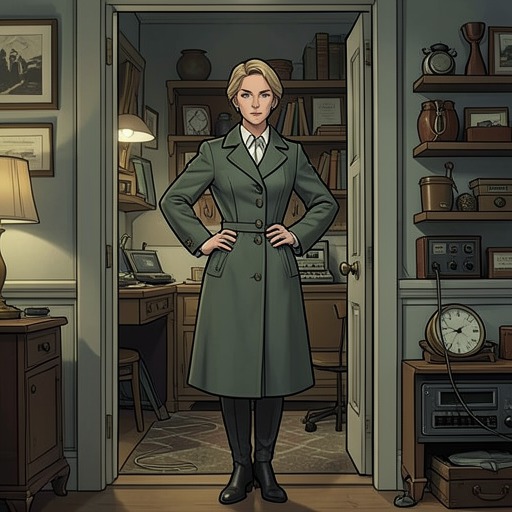
Templeton Family Home
The Wife He Never Wanted: A Marriage-In-Crisis Billionaire Romance (Second Chance Billionaires)Templeton Family Home is both a physical refuge and a moral counterweight to the Caldwell world of contracts, leverage, and strategic marriage. Its rooms hold Paige Templeton’s childhood, her father David Templeton’s authority, and the family’s capacity to receive her when the marriage she entered as part of a business design finally breaks apart. The home’s decisive significance lies in the way it turns private hurt into agency: Paige comes there not as someone waiting to be rescued, but as a daughter reclaiming the ground from which she can decide what happens next.
Grounds, Buildings, and Family Structure
The Templeton grounds preserve a recognizable family arrangement. The large old main house stands fully lit because David Templeton likes light regardless of the electric bill, while the guesthouse sits to one side, close enough to David to matter and distant enough to give Kelsey Templeton her own space. The arrangement makes the property more than a single residence. It expresses a family that remains connected without requiring every member to occupy the same room or surrender private boundaries.
That balance becomes important when Paige arrives after deciding that she will no longer live as Maddox Caldwell’s wife. She parks and remains in the car, caught between wanting to enter the house where she grew up and not wanting to say the necessary words aloud. The guesthouse door opens before she can resolve the conflict. Kelsey crosses the grass in an old college sweatshirt with a dish towel over her shoulder, reads Paige’s face through the windshield, and understands the situation without an explanation. When Paige cannot move, Kelsey opens the car door herself and leads her toward the main house. The grounds therefore stage an immediate movement from isolation to familial recognition.
Inside, the home is identified through ordinary domestic details rather than grandeur: David’s terrible coffee and the lemon oil used by the housekeeper on Fridays. David emerges from his study wearing reading glasses and holding a contract, a detail that places family life and business authority in the same interior space. When he sees Paige, he sets the contract down on the hall table without looking where it lands. The gesture marks the interruption of business by the more urgent fact of his daughter’s distress.
Refuge After the Marriage Breaks
Paige’s arrival changes the meaning of the home. She had been the wife in the big house on the corner, but within an hour she would stop living as Maddox Caldwell’s wife. The approaching separation frightens her less than expected; relief, rather than grief, becomes the emotion that unsettles her most. After wiping her face in the visor mirror, she recognizes that she looks older but steadier than she had that morning. She drives to Templeton Family Home because it is the place where she can stop performing the marriage and be received as Paige again.
Kelsey’s response establishes the house as a shelter that does not demand a polished account of suffering. She tells Paige that she is coming inside and acts when Paige cannot. Later, Kelsey insists that Paige’s love for Maddox was not shameful and that Maddox used something Paige had given honestly. Her words do not instantly repair Paige’s self-understanding; Paige can absorb them only partially. The home’s protection is therefore not sentimental erasure. It gives Paige enough safety to hear a defense of her own sincerity without requiring her to forgive before she is ready.
David’s response transforms the home from refuge into a site of judgment. The shock in him hardens into the focused competence Paige has watched throughout her life, the same focus with which he built the family firm into the largest in the state and kept it out of Elim Caldwell’s hands for thirty years. In the house, the father who has been wounded by his daughter’s pain becomes the businessman capable of acting on it. His declaration that the merger will not close begins in the domestic sphere but carries immediate corporate consequences.
The Merger Decision and the House as Boundary
David Templeton’s decision is not presented as a tactical adjustment. He tells Paige that the merger is not closing, and later tells Maddox Caldwell that the Caldwell and Templeton transaction will be terminated: his people will withdraw the amendments, and his lawyers will send the withdrawal by the end of the day. The house is thus the setting in which the Templeton family’s private trust and commercial power become inseparable. David had once walked Paige down the aisle, shaken Maddox’s hand, and called him his son; after learning why Maddox married her, he understands that Maddox took both his daughter and his business trust because Elim Caldwell directed him to do so.
David’s confrontation with Maddox is controlled rather than explosive. He refuses an explanation, orders Maddox to stay away from Paige, and directs all further contact through her lawyers. He distinguishes the two losses with deliberate precision: the merger is business and can be survived, while what Maddox did to Paige is not business and must be understood as a different kind of violation. The house therefore establishes a boundary around Paige before it establishes any possibility of reconciliation. Its welcome is unconditional toward her, but access to her is no longer Maddox’s to assume.
The setting also gives David a form of authority distinct from the Caldwell model. Maddox’s marriage treated Paige as an instrument within an acquisition strategy, whereas David’s action rejects the idea that family consent and commercial cooperation can be traded as though they were interchangeable assets. Templeton Family Home becomes the spatial expression of that refusal: the place where a contract is set aside because the person standing in the doorway matters more than the transaction on the table.
Dinner, Negotiation, and Conditional Return
The home later becomes the site of a carefully limited opening rather than an automatic reconciliation. Maddox calls Paige to ask for a meeting about rebuilding Harbor Street Shelter, and David deliberately makes himself scarce when Paige says Maddox is coming. He goes to a job site he could have handled by phone, taking Kelsey with him, because he does not trust himself to sit across from Maddox without ending the conversation too soon. He tells Paige that the meeting is hers to run. The absence of her father is therefore an act of protection and restraint: he leaves Paige authority over a decision that concerns both her emotional boundaries and the shelter’s future.
Claire, the shelter director, waits with Paige at the kitchen table. Maddox arrives with drawings in a cardboard tube and a laptop rather than roses, and he sits instead of standing over the table as he once did during a pitch. He presents an offer based on the insurer’s numbers: Harbor Street cannot be rebuilt on its former site and could not afford reconstruction there even if it could. The house becomes a negotiating room in which Paige can inspect his proposal without allowing the proposal to become a disguised claim on her.
Paige does not forgive him or promise to return. She notices that when an old reflex rises in him, he recognizes and corrects it without her prompting. That self-monitoring is evidence of change, but not proof sufficient to restore the marriage. She responds by setting a condition in the home itself: Maddox is to come to dinner on Saturday at her father’s house and bring the drawings. The invitation is explicitly one dinner, not a promise. Paige requires him to endure a meal with David without managing him or pretending that the past did not happen, making the family home a test of conduct rather than a stage for a grand romantic gesture.
Shared Plans and Unresolved Future
The dinner is tense and prolonged. David meets Maddox at the door without shaking his hand and looks at him as the man who married his daughter as though she were a merger clause. His physical restraint appears deliberate; after glancing at Paige, he allows Maddox inside, apparently choosing a table between them rather than risking a confrontation that could become physical. Kelsey is already present with her arms crossed and an icy greeting. The household receives Maddox under scrutiny, not hospitality in the ordinary sense.
David questions Maddox about the shelter, the build, and whether the Caldwell name on a contract means anything now that the old man is dead. Maddox answers plainly and does not reach for charm. The contrast with his former behavior matters: the old Maddox would have controlled the table, warmed David to him, and attempted to close the encounter by dessert. In Templeton Family Home, he instead sits and takes the questions. His willingness to remain in a hostile domestic space without manipulating its occupants is the practical evidence Paige is watching for.
After dinner, Maddox spreads the shelter drawings across the cleared table, and he and Paige work through the plans together. Paige identifies where the isolation ward must go and explains why. Maddox asks builder’s questions and records her answers on the feasibility sketch without trying to improve or overrule them. Her knowledge and his technical skills point in the same direction, while her notes and his measurements occupy the same page. His knee comes to rest against hers beneath the table, and neither moves away. The moment allows intimacy to return, but only within the structure of shared work and acknowledged limits.
Paige’s final decision in the house remains conditional. She tells Maddox that she is not moving back in, not yet and perhaps not for a while, because one good night and one difficult truth do not restore a marriage. Maddox accepts that he does not get the marriage back automatically. Templeton Family Home therefore does not conclude the separation or guarantee reconciliation. It provides the setting in which Paige can define the terms of any future, while Maddox must demonstrate that he can honor a boundary he cannot buy, manage, or hurry.