Harbor Street No-Kill Policy
The Wife He Never Wanted: A Marriage-In-Crisis Billionaire Romance (Second Chance Billionaires)Harbor Street No-Kill Policy is the principle that keeps Harbor Street Shelter from treating difficult animals as disposable. Its meaning is established through Skipper, an older scarred dog who has remained at the shelter for sixteen months because prospective families pass him by. The policy turns his continued presence from an administrative inconvenience into an obligation: he stays, and the people who care for him must keep showing up.
Definition and Daily Practice
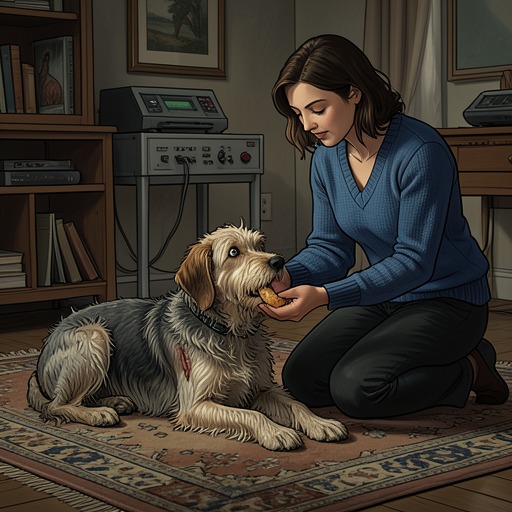
At Harbor Street Shelter, the no-kill commitment is expressed through endurance rather than abstraction. Skipper is a Shepherd and Lab mix more than eight years old, with a torn ear and a pink rope of scar tissue along his ribs. He has been overlooked in favor of puppies and small fluffy dogs, yet the shelter continues to house him. Paige Templeton cannot take him home because David Templeton is allergic to fur, while Maddox Caldwell had previously dismissed the idea of keeping a dog in their great room. Her answer is therefore repeated presence: she visits Skipper every day, feeds him boiled chicken by hand, waits for his cautious approach, and accepts his weight against her shins.
That routine also exposes the policy’s cost. Claire identifies the shelter as a place where too many animals are always still waiting, and Skipper seems destined to become a lifelong resident. His shelter name matters because he was found rather than surrendered by a family; no former household is coming back for him. The rule consequently protects animals whose histories, age, appearance, or distrust make them especially unlikely to be chosen, not only animals whose adoption is easy or commercially attractive.
Skipper as the Policy’s Test Case
Skipper does not become a passive emblem of institutional goodness. He trusts Paige but nobody else, and his refusal to approach Maddox Caldwell lasts through three shifts after Maddox begins volunteering. Maddox first comes to Harbor Street Shelter as a quiet man working through private trouble, then returns for an early Saturday shift, adds a Wednesday evening, and accepts whatever hours the coordinator cannot fill. He learns the names of the dogs and volunteers and the correct sanitizer mixture, turning a single visit into continuing labor.
The decisive change occurs on Maddox’s fourth shift. He sits on the concrete floor of Skipper’s run with his back against the block wall and does not reach for the dog. After a long while, Skipper crosses the space and lies two feet away, not touching but permitting Maddox’s presence. Trust is therefore treated as something the animal may withhold and grant, not something a human may seize through force, money, or performance. The policy’s ethic depends on making room for that refusal.
Skipper also redirects Maddox’s professional expertise. Sitting beside the dog, Maddox notices a sagging roofline, a dip in the fascia, and water staining the block. His attention to the building’s structural danger leads directly to the later emergency. The animal’s continued sheltering does not merely give Maddox a moral lesson; Skipper’s location allows a hidden defect to be seen before it becomes catastrophic.
Crisis, Evacuation, and Institutional Consequences
When the roof fails during severe weather, the no-kill principle becomes an emergency command. Claire tells Paige Templeton that the east end has collapsed, taking part of the intact wing with it, while water enters the main kennel room. Thirty animals must be moved within an hour, but emergency boarders and veterinary clinics are full and flooding affects half the county. The policy leaves no acceptable solution in abandonment; the animals must be transferred despite the lack of space and the danger to the rescuers.
Harbor Street Shelter becomes a scene of ankle-deep runoff, rain entering through the open roof, and volunteers carrying frightened dogs, yowling cats, and whimpering puppies hand to hand. Paige helps stop a border collie from bolting, carries a senior cat in a pillowcase when carriers run out, and holds a flashlight in her teeth while Claire draws a terrified pit bull from a collapsing run. The work narrows attention to the next crate and the next animal, making care a sequence of concrete responses rather than a sentimental principle.
The collapse also confirms the consequence of Maddox’s earlier decision. Skipper’s former kennel is the section that comes down. Had Maddox not sat with him, noticed the roof problem, and taken him home days before the disaster, the older dog would still have been in the damaged run. His survival does not erase the scale of the crisis, but it shows how the policy links ordinary, patient attention to life-preserving consequences.
Rebuilding Without Taking Control
After the collapse, Maddox Caldwell offers to rebuild Harbor Street, but the form of the offer determines whether it honors the policy. He brings feasibility sketches, three possible sites, zoning and access notes, flood-plain data, and a construction commitment backed by the Caldwell name. He does not bring finished plans. Instead, he places a mostly blank program document before Paige Templeton and Claire, with fields for intake capacity, an isolation ward, quiet rooms, and community space.
Maddox states that he knows buildings but does not know shelters, while Paige Templeton and Claire know what every room and run must accomplish. He offers the money, land, and crew, but leaves them authority over the design. Claire immediately specifies a real quarantine wing, separate air handling for the isolation ward, and an indoor community room for adoption events. The rebuilt shelter is thus designed around the animals’ requirements rather than imposed as a donor’s monument.
This arrangement gives institutional form to the no-kill promise. A policy of keeping animals alive requires more than goodwill: it requires intake space, quarantine capacity, quiet areas, safe circulation, and a building able to withstand weather. Maddox’s offer becomes meaningful because it supports those conditions without removing the people who understand them from decision-making. The gift is shaped by Paige Templeton and Claire, rather than used to control them.
Survival, Memory, and Significance
The rebuilt Harbor Street opens on a Saturday in October, and Skipper is the first dog through the door. He enters as though he owns the place because, in the shelter’s moral history, he does. Paige Templeton has placed his old torn ear on the logo above the intake wing, preserving the mark of the animal whose long wait exposed the shelter’s purpose and whose kennel revealed its danger.
The organization also keeps the name Harbor Street. Claire considers a name that survived two decades and a roof collapse worth more than one attached to a donor’s check, and Maddox Caldwell supports the decision without argument. The choice prevents reconstruction from becoming erasure: the new building is not a replacement that forgets the damaged shelter, but a continuation that carries its commitments forward.
The completed facility contains the isolation ward, the real quarantine wing, and the indoor community room Claire had named at the Templeton kitchen table. Families move through rows of animals beneath walls that hold and a roof that no longer requires prayer when the sky darkens. Harbor Street No-Kill Policy therefore reaches beyond the prohibition of killing. It defines a continuing practice of sheltering the unwanted, respecting animal distrust, mobilizing under catastrophe, and building the material conditions in which protection can endure.