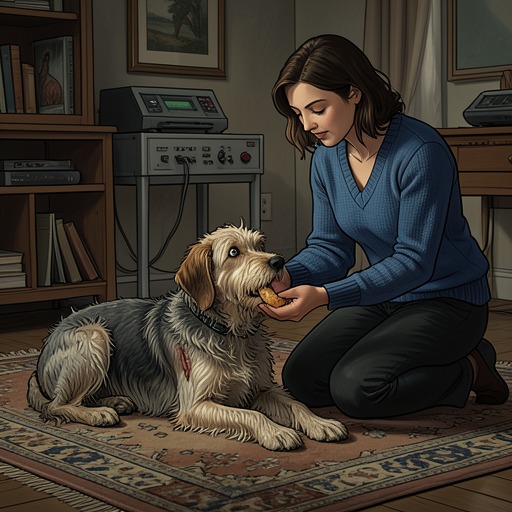
Maddox Caldwell and Skipper’s bond
The Wife He Never Wanted: A Marriage-In-Crisis Billionaire Romance (Second Chance Billionaires)Maddox Caldwell and Skipper’s bond is the clearest material expression of Maddox’s movement from transactional control toward patient, unobserved care. Skipper is not merely a symbol of redemption: he is a frightened, scarred senior dog whose refusal to trust sets the terms of the relationship. By remaining present without forcing contact, Maddox learns to respond to another creature’s needs rather than impose his own timetable, and Skipper’s eventual place in Maddox’s home becomes inseparable from the reconstruction of Maddox’s marriage to Paige Templeton.
Skipper Before Maddox
Skipper is a Shepherd and Lab mix somewhere north of eight years old, large, black, scarred, and marked by a torn ear reduced to a soft nub and a pink rope of scar tissue along his ribs. He had spent sixteen months at Harbor Street Shelter, where prospective adopters passed him by for puppies and small fluffy dogs. The staff described him as the dog nobody could approach, and his shelter name carried a painful distinction: no family had brought him in, and no family had ever claimed him. His history makes his distrust a concrete condition rather than a convenient obstacle in Maddox’s path.
Paige Templeton had already begun meeting Skipper on his own terms. She crouched on the concrete with the kennel gate open and boiled chicken balanced on the back of her hand, promising that she was not going anywhere and could stay all afternoon. Her approach establishes the care that Maddox later learns to practice: it offers food, time, and presence without turning trust into an obligation. Skipper watches from the back of the kennel, preserving his distance while another person proves that attention can remain steady.
The Bond Forms Through Presence
Maddox first notices Skipper while working at Harbor Street Shelter. He has gone there before opening on a Saturday morning and accepted whatever job other volunteers avoided, including cleaning kennels, hosing runs, hauling soiled bedding, and scrubbing neglected drainage grates. He returns for early Saturday shifts, adds a Wednesday evening, and accepts hours the coordinator cannot fill. The relationship therefore grows alongside a new routine of service rather than through a single emotional encounter.
For three shifts, Skipper continues to watch Maddox from the back of the run without approaching. On the fourth, Maddox sits on the concrete with his back against the block wall and does not reach for him. After a long interval, Skipper crosses the space and lies two feet away. The dog does not touch Maddox, but he permits Maddox’s presence. That small distance is the bond’s first terms: trust is granted in increments, and Maddox accepts the limit instead of converting the moment into possession.
The encounter also redirects Maddox’s attention. While sitting beside Skipper, he sees that the roofline above the kennel is sagging, with a dip in the fascia and a water stain bleeding down the block. His construction experience tells him that the problem is not cosmetic but a slowly failing load path. The dog’s kennel becomes the place where Maddox recognizes a danger that will later threaten every animal in the shelter. Skipper thus acts within the plot as a living presence with immediate needs, not simply as an emblem of Maddox’s conscience: the dog’s location enables Maddox to notice the compromised roof.
Care Without an Audience
Maddox’s care for Skipper is defined by repetition and the absence of spectators. He had initially understood generosity as a check or a named wing, but he recognizes that sending money can allow him to avoid showing up. At six on a Saturday morning, before Harbor Street Shelter opens, he chooses the work no one wants and deliberately arrives when no audience is present. The staff know him only as a quiet man working through private trouble; a teenager named Devon teaches him the sanitizer dilution, and Maddox accepts the drains and other unpleasant tasks without presenting his identity or status.
Skipper remains distant even as Maddox becomes a regular presence. Maddox learns the shelter’s routines and the names of other dogs and volunteers, while Skipper continues to decide whether he will come closer. The contrast matters: Maddox’s former world rewarded control, appearances, and outcomes, whereas Skipper offers no immediate recognition and no reliable return. Maddox continues anyway. His labor becomes meaningful precisely because Paige Templeton is not watching and because the work cannot be converted into a performance for her approval.
When Paige later discovers that Skipper’s kennel is empty, she assumes Maddox has quit or has adopted the dog only to create another display. Claire corrects her. Maddox took the worst dog in the building, sat on the concrete floor through multiple shifts until Skipper trusted him, completed the adoption paperwork, and continued coming even after his hours were moved. Claire’s point is decisive: if the work had been for show, Maddox would have stopped when Paige failed to witness it; instead, he did the opposite. Skipper’s adoption therefore verifies the durability of Maddox’s changed behavior.
Skipper in Maddox’s Spaces
After the adoption, Skipper enters the spaces Maddox once kept under strict control. Paige finds him asleep across the white leather sofa in Maddox’s office, sprawled on his back with his torn ear flopped inside out and dog hair covering the cushions. A chew toy lies on the floor, a water bowl sits beside a costly credenza, and Maddox’s spreadsheet is ignored on the monitor while Maddox sits on the floor in shirtsleeves. The dog has not been placed in a carefully managed corner; he occupies the designer furniture with complete, undignified comfort.
At home, Skipper claims the rug by the window during the day and the left side of Maddox’s bed at night. The office sofa, once expensive enough to be protected from a stray hair, gathers a permanent drift of black fur. Maddox vacuums and hopes rather than restoring the old order. Skipper’s rules rewrite a decade of carefully arranged domestic space, and Maddox allows the change because the dog’s comfort has become more important than preserving surfaces. After a lifetime that the narrative presents as marked by loss, Skipper is allowed his victories, softness, and indulgence.
The bond is tested through ordinary damage rather than melodrama. Skipper tracks mud through the house, destroys a designer pillow, and ruins an upscale rug. Paige waits for Maddox to react as the man whose silence and judgment once exposed the failure of their marriage. Instead, Maddox looks at the damage, observes that Skipper may dislike the pillow’s print, and begins cleaning the rug himself on his knees in good trousers. He scratches the dog behind the torn ear and softens while calling him a menace. Maddox distinguishes between an inanimate rug and a living animal that can feel, then sets a boundary about wiping Skipper’s feet at the door. Care does not require surrendering every limit; it requires placing the boundary around a manageable behavior rather than treating the dependent creature as disposable.
Shelter, Marriage, and Shared Reconstruction
Skipper’s presence links Maddox’s emotional awakening to the fate of Harbor Street Shelter. The roof section over the east runs eventually collapses during a storm, sending water into the kennel room and forcing Claire to move thirty animals in an hour. Paige helps carry dogs, cats, and puppies through ankle-deep runoff, while Maddox arrives with Caldwell trucks and rain-soaked workers. He goes first to Claire, who is directing the evacuation, asks what she needs, and follows her instructions. The animal whose former kennel exposed the structural danger is now safely absent from the collapse because Maddox took him home days earlier.
During the emergency, Maddox hauls crates through the rain without seeking Paige’s attention. The animals are moved to a dry unfinished lobby at the Caldwell Development, where utilities provide heat and the crates, blankets, and frightened animals can be sheltered from the storm. Near midnight, Paige finds Maddox holding a shivering terrier mix inside his ruined jacket. Skipper’s earlier adoption has become part of a larger pattern: Maddox no longer treats care as a purchase or a staged image, but as physical presence beside vulnerable lives.
Maddox later brings Paige Templeton and Claire a cardboard tube of preliminary drawings, feasibility sketches, possible sites, zoning and flood-plain notes, and construction figures for a new Harbor Street. He also brings a mostly blank program-requirements document covering intake capacity, an isolation ward, quiet rooms, and community space. He knows how to build, but he does not decide what a shelter needs. Paige and Claire are given the authority to fill in the design, while Maddox commits the money, land, and crew. Skipper’s bond has helped make this change legible: Maddox has learned that providing a structure does not entitle him to control the lives lived inside it.
Ending and Narrative Significance
The new Harbor Street opens on a Saturday in October, and Skipper is the first dog through the door. He enters as though he owns the place, a fitting reversal for an animal once confined to the last kennel and passed over by every family. Paige has placed his torn ear in the shelter logo, while the name Harbor Street survives the collapse because Claire believes a name that endured a roof coming down is worth more than one attached to a check. Maddox supports that decision without argument.
The rebuilt shelter contains the isolation ward with its own air handling, a real quarantine wing, and a community room large enough for indoor adoption events. Its walls hold and its roof is sound. Skipper finds a patch of afternoon sun on the new concrete, collapses onto his back, and sleeps in the middle of the building he helped make possible without knowing he was involved. His physical comfort is not reduced to a metaphor, yet the scene also connects his shelter and Maddox’s marriage: both have acquired a solid foundation through repeated acts of care.
Maddox Caldwell and Skipper’s bond consequently joins animal welfare, ethical change, and marital repair without making the dog subordinate to any one of them. Skipper’s fear, refusal, eventual trust, territorial claims, and unselfconscious comfort alter Maddox’s labor, office, house, and understanding of responsibility. The relationship proves that redemption in this narrative is not bought, announced, or completed by a promise. It is accumulated through showing up, accepting another being’s boundaries, doing work no one sees, and allowing the once-untouchable sofa, the rebuilt shelter, and the marriage itself to be reorganized around life rather than control.