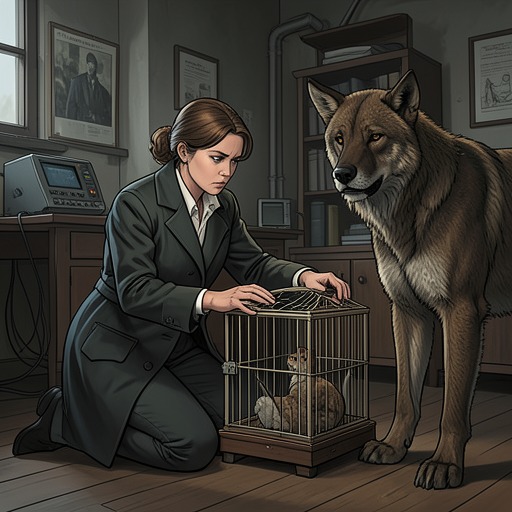
New Harbor Street Shelter Opens
The Wife He Never Wanted: A Marriage-In-Crisis Billionaire Romance (Second Chance Billionaires)New Harbor Street Shelter Opens is the public and material fulfillment of Harbor Street’s survival after the old building’s roof collapsed. The new shelter is not merely a replacement structure: it embodies Paige Templeton’s restored agency, Claire’s professional knowledge, Maddox Caldwell’s changed understanding of help, and the animals’ continuing claim to safety. Its opening turns a wet ruin and a blank page into a durable refuge whose walls, roof, and governing principles all mark a break with the past.
Causes and Reconstruction
The rebuilding begins with the failure of the original Harbor Street building during a severe storm. Claire reports that the corner Maddox Caldwell had previously identified as dangerous gives way, taking part of the east wing with it. Water pours into the main kennel room while thirty animals must be moved within an hour, and the emergency boarding options and veterinary clinics are already full. Paige Templeton joins Claire and the volunteers in the evacuation, carrying frightened dogs, cats, and puppies through ankle-deep runoff as rain enters through the open section of the building.
The collapse is therefore both an immediate emergency and the consequence of a structural problem that had been visible before the disaster. Maddox had noticed the sagging roofline while sitting in Skipper’s kennel, where he had spent four shifts waiting for the scarred older shepherd mix to approach him. His observation links the shelter’s physical vulnerability to the new form of attention he has learned through unglamorous work. He does not merely become associated with the shelter through a donation; he identifies a danger because he has occupied the kennel floor and allowed Skipper to decide the terms of contact.
Maddox later brings Paige and Claire preliminary feasibility sketches rather than a finished scheme. The materials include three possible sites, zoning and access notes, flood-plain data, and financial figures supporting a construction commitment from Caldwell. More importantly, he brings a largely blank program-requirements document with spaces for intake capacity, an isolation ward, quiet rooms, and community space. He states that he knows buildings but does not know shelters, and places the decisions about rooms, runs, and long-needed functions with Paige and Claire. The new building is thus planned through expertise shared rather than imposed.
That arrangement reverses Maddox’s former method. He had been accustomed to entering negotiations with the answer already determined and controlling every variable. Here, he commits money, land, and a crew while leaving the design authority with the shelter’s own practitioners. Paige recognizes the blank page as the essential gift because it gives her the say instead of taking it away. The reconstruction becomes an exercise in agency: Maddox supplies resources, but Claire and Paige determine what those resources must make possible.
Opening and Physical Design
The new Harbor Street opens on a Saturday in October. Skipper is the first dog through the door, an apt choice because the shelter’s transformation is inseparable from his history. He enters as though he owns the place, and in the sense that matters, he does. Paige has placed his torn ear on the logo as a small line drawing above the intake wing, preserving the mark of the dog who had spent sixteen months overlooked in the old facility. The image makes his formerly unwanted body part of the institution’s public identity rather than something to be hidden.
The organization also keeps the name Harbor Street. Claire believes that a name surviving two decades and a roof collapse is worth more than a name attached to a donor’s check. Paige agrees, and Maddox supports the decision without attempting to rename the shelter after Caldwell. That restraint matters because the new building and its land are deeded to Harbor Street’s nonprofit, with no Caldwell name attached and no conditions extending beyond his financial contribution. The shelter therefore opens with resources from Maddox but without becoming his possession.
The finished structure realizes the requirements Claire named at the Templeton kitchen table. The isolation ward has its own air handling, the quarantine wing is fully established, and the community room is large enough for indoor adoption events. Families move along rows of animals under walls that can hold and a roof that does not require anyone to fear the next storm. The building’s design answers specific failures of the old shelter rather than treating reconstruction as a symbolic gesture. Safety, separation, quiet, access, and public participation are built into its daily operation.
The contrast with the old structure is deliberately concrete. Paige remembers the former Harbor Street as a wet ruin with one corner open to the sky, but she does not romanticize it. She loved the old building for what it taught her, especially that a roof and walls capable of holding are not minor conveniences. The new shelter carries that lesson forward materially: it is intended to remain standing through the next storm and the one after it, even when the emotional history of its construction is no longer visible to those who use it.
People, Animals, and Shared Authority
The opening gathers the people whose relationships have been altered by Harbor Street’s reconstruction. Claire remains the director, and the building reflects her long-standing knowledge of the shelter’s needs. Paige stands in the middle of the community room with a clipboard she is not reading, briefly allowing herself to experience the achievement before returning to the work. Her position is not that of a passive beneficiary of Maddox’s generosity; she participates in decisions, argues over practical matters, and retains control of the shelter’s future.
Maddox’s presence is equally significant because he no longer treats assistance as a performance or a transaction. He has already learned to work at Harbor Street without an audience, taking early Saturday shifts, Wednesday evenings, and whatever hours the coordinator cannot fill. The staff know him as a quiet man doing difficult jobs, not as a powerful developer. His willingness to scrub drains and learn sanitizer dilution becomes the behavioral foundation for the construction commitment. The rebuilt shelter is credible as redemption because the labor begins before anyone rewards him for it and continues in forms that cannot be converted into publicity.
Skipper remains the clearest animal participant in this history. At the old shelter, he was a large black senior dog with a torn ear, scar tissue along his ribs, and a deep distrust that kept him at the back of his run. After watching Maddox for three shifts, he crosses the kennel and lies two feet away, not touching but permitting Maddox’s presence. That limited act of trust changes Maddox’s relationship to the shelter and leads him to see the compromised roof. Later, Skipper occupies Maddox’s pristine white leather office sofa, covered in dog hair and asleep with his legs in the air, while Maddox accepts the disorder he once would have guarded against.
At the opening, Skipper again alters the meaning of the space simply by using it. He finds a patch of afternoon sun on the new concrete and falls asleep in the middle of the shelter, his torn ear turned inside out and his four legs raised. His comfort is not presented as a decorative symbol detached from his life; it is the practical result of a building in which an animal once rejected can rest, move, and belong. The shelter’s human relationships are reorganized around the requirements of animals who cannot authorize plans in words but whose fear, illness, vulnerability, and trust determine what responsible care must provide.
Continuing Work and Consequences
The opening does not end Harbor Street’s work or freeze the relationships that made it possible. When Paige observes that the cat room will need to be larger by spring because of the coming baby season and irresponsible pet reproduction, Maddox has already considered the problem. He has left space in the eastern footprint so the room can be extended whenever she decides. The offer is notable not because it anticipates her needs, but because it explicitly leaves the timing and authorization with her. The building remains adaptable without turning his foresight into control.
This principle continues beyond the shelter’s architecture. The merger remains dead, and the reconstruction rules stay in writing. The land and completed building belong to Harbor Street’s nonprofit whether or not Paige ever wears Maddox’s ring again. David Templeton, who had resisted cooperation with Maddox, begins by taking stiff phone calls from him and eventually asks his opinion about a drainage problem. Even that limited professional exchange indicates that Maddox’s changed conduct has consequences beyond his marriage, although trust is rebuilt gradually rather than declared complete.
Paige also retains physical and emotional distance where she needs it. She still sleeps at her father’s home when she wants separation, and Maddox does not pressure her. They name old habits when those habits return instead of swallowing resentment until silence takes over. The rebuilt shelter therefore provides the setting for a different model of partnership: resources can be shared, problems can be addressed, and love can continue without erasing the other person’s authority.
Narrative Significance
New Harbor Street Shelter Opens completes the book’s recurring contrast between immaculate spaces and inhabited ones. Earlier, Laila Denatto makes herself at home on the white sofa in the Templeton Family Home, recalling the moment when Maddox looked at the upholstery rather than the foster dog Barney. That memory had taught Paige that the marriage’s disorder was not really about a dog or a sofa; it was about Maddox valuing surfaces over living presence. At the new Harbor Street, Skipper’s torn ear becomes a logo, dog hair and muddy life are welcome, and the building is judged by the refuge it provides rather than by its untouchable finish.
The shelter also gives physical form to Maddox’s emotional awakening. After Paige leaves, he experiences the house as a different kind of quiet, haunted by the singing, interruptions, complaints, and warmth he had ignored. He eventually understands that he misses Paige herself and the entire life he had walked past. The new shelter cannot buy back the marriage, and its construction is not allowed to function as a substitute for accountability. Its significance lies in the way Maddox learns to build without possessing, to help without dictating, and to remain present without demanding immediate emotional payment.
The final image gathers the event’s central meanings. Paige crosses the floor to join David over a drainage plan, Maddox follows, and she adds her own opinion to the argument while Skipper snores in a patch of sun. Around them, New Harbor Street continues its ordinary work: animals and families move through the building, practical disputes continue, and the shelter offers refuge. The ending’s quiet assurance is architectural and relational at once: the walls hold, the roof is sound, and the people inside are no longer required to surrender their choices in exchange for being cared for.