Skipper Is Adopted by Maddox
The Wife He Never Wanted: A Marriage-In-Crisis Billionaire Romance (Second Chance Billionaires)Skipper Is Adopted by Maddox is both a concrete rescue and a decisive moral turn in Maddox Caldwell’s redemption. The adoption gives a scarred senior dog a home after sixteen months of institutional neglect, but its deeper importance lies in the labor surrounding it: Maddox learns to remain present without an audience, accepts trust on the animal’s terms, and allows Skipper’s needs to reorganize his supposedly untouchable life. The dog’s adoption later becomes the practical link between Maddox’s unobserved change, the collapse of Harbor Street Shelter, and the rebuilding of a new shelter shaped by the people who use it.
Background at Harbor Street Shelter
Skipper is a Shepherd and Lab mix somewhere north of eight years old, large, black, scarred, and marked by a torn ear and a rope of pink scar tissue along his ribs. He has spent sixteen months at Harbor Street Shelter, where prospective families repeatedly pass him for puppies and small fluffy dogs. His age, size, visible injuries, and guarded behavior make him easy to overlook, while his long stay turns him into a record of how quickly adoptability is confused with youth, prettiness, and immediate sociability.
When Maddox first notices him, Skipper is the dog in the last kennel, watching from the back of the run and refusing to approach. Devon explains that nobody has shown interest and that Skipper had been found rather than surrendered by a family. The distinction matters: he has no known household waiting to reclaim him and no inherited story of belonging beyond the shelter name. His history is therefore defined by abandonment and uncertainty, not by a temporary interruption in an otherwise secure home.
Maddox’s Unobserved Work
Maddox begins volunteering at Harbor Street Shelter as a quiet man working through private trouble. The staff give him the tasks that more squeamish volunteers avoid, including scrubbing drains, and a teenager named Devon teaches him the sanitizer dilution without asking about his career. Maddox has spent years managing rooms of bankers who examined him for weakness; at Harbor Street, a teenager hands him a scrub brush and trusts him with unpleasant work. The labor feels different from penance because nobody is turning it into an article, presentation, or public achievement. It is described as the first honest labor he has done in a decade.
After learning about Skipper, Maddox keeps returning. He takes the early Saturday shift, adds a Wednesday evening, accepts whatever hours the coordinator cannot fill, learns the names of the other dogs and the volunteers, and remembers how Devon likes the sanitizer mixed. The shelter changes from a place he visited once into a place he regularly attends. Skipper remains in the back of his run and does not come near him, so Maddox cannot measure his progress through quick affection or a visible reward.
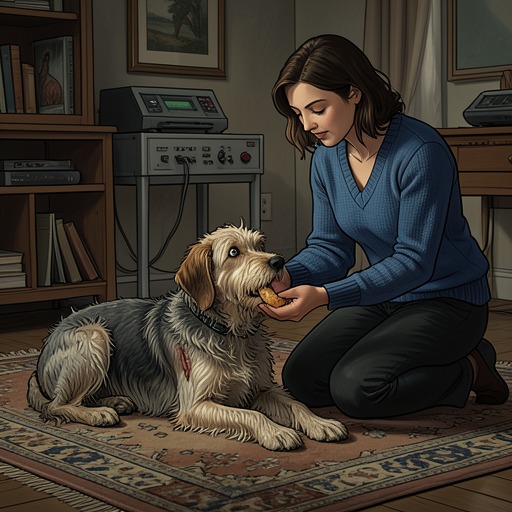
The decisive movement occurs across four shifts. For three shifts, Maddox works without gaining Skipper’s trust. On the fourth, he sits on the concrete floor of the run with his back against the block wall. He does not reach for the dog or force contact. After a long while, Skipper crosses the space and lies two feet away, still not touching but allowing Maddox’s presence. The distance is small enough to mark a change and large enough to preserve Skipper’s refusal of unwanted intimacy. Trust begins not with obedience or possession, but with the dog retaining control over how close another being may come.
Adoption and Its Immediate Consequences
Skipper’s kennel is empty when Paige Templeton arrives for an evening shift on a gray Tuesday in the second week. Because an empty kennel at Harbor Street Shelter can mean either adoption or death, Paige initially fears the worse possibility. Claire corrects her: Skipper was adopted three days earlier by the weekend volunteer, the person Paige had once asked Claire to reschedule.
Claire explains that Maddox took the worst dog in the building, sat on the concrete floor through multiple shifts until Skipper decided to trust him, completed the adoption paperwork, and brought him home. More importantly, Maddox did not stop volunteering after Paige stopped watching him. He kept the scheduled hours, continued with the worst jobs, and sometimes came when he was not scheduled. Paige suspects the entire effort was designed to attract her attention, but Claire identifies the crucial contradiction: someone performing for an audience would have quit when the audience disappeared. Maddox did the opposite.
Paige later finds Skipper in Maddox’s office, stretched across the white leather sofa with all four legs in the air and his torn ear flopped inside out. Dog hair covers the leather Maddox once guarded from a stray hair; a chew toy lies on the floor, and a water bowl sits beside a credenza that cost a thousand times more than the bowl. Maddox is on the floor in shirtsleeves, his tie gone, while an ignored spreadsheet glows on the monitor. He does not rise to move Skipper. The scene reverses the old order of his life: the office, the furniture, and the financial apparatus no longer dictate what may occupy the room. Skipper’s comfort does.
The Roof Collapse and the Wider Rescue
Maddox’s adoption also leads to a practical discovery. While sitting with Skipper, he notices that the roofline above the dog’s former run sags, the fascia dips, and a stain runs down the block where water has been entering. His construction experience makes the structural danger impossible to ignore. Claire later reports that the east end of Harbor Street Shelter has collapsed in a storm, taking part of the intact wing with it. Water pours into the main kennel room, and thirty animals must be moved within an hour while emergency boarders and veterinary clinics are already full amid county flooding.
The collapsed section is Skipper’s old kennel row. Paige realizes that the senior dog would still have been there—unadopted, scarred, and unwanted—if Maddox had not spent four shifts sitting on the concrete floor and then taken him home. During the emergency, Harbor Street fills with runoff, barking dogs, whining animals, soaked volunteers, frightened cats, puppies, and rising water. Paige carries a senior cat in a pillowcase when the carriers run out and helps move animals through the open, rain-exposed building. Skipper’s adoption therefore becomes more than a private happy ending: it removes one animal from the path of structural failure while revealing how many others remain vulnerable when a shelter’s physical foundation is neglected.
From Possession to Shared Design
After the collapse, Maddox brings Paige Templeton and Claire a cardboard tube of drawings and a laptop rather than roses or a finished public gesture. He presents preliminary feasibility sketches for three possible sites, including zoning, access, and flood-plain data, together with a construction commitment backed by the Caldwell name. He also brings a mostly blank document titled Program Requirements, with fields for intake capacity, an isolation ward, quiet rooms, and community space.
Maddox states that he knows buildings but does not know shelters. He asks Paige and Claire to determine every room, run, and function the new facility needs before he draws another wall. He commits the money, land, and crew while they decide what gets built. Claire immediately begins specifying the isolation ward, separate air handling, a real quarantine wing, and a community room large enough for indoor adoption events. The shelter is not imposed as a finished monument by Maddox; it is designed through the expertise of the women who operate it.
This arrangement matters because Maddox’s earlier marriage to Paige was engineered as an acquisition strategy. He had treated her as the route into the Templeton family and approached emotional life through plans, control, and outcomes. The blank page at the kitchen table is the opposite of that method. He gives Paige and Claire the authority to shape the gift, and he does so without dramatizing how much this reverses the habits that built his power. Skipper’s adoption has prepared the change: with the dog, Maddox learned to wait without reaching; with the shelter, he learns to build without deciding everything himself.
Long-Term Meaning and Ending
Skipper remains central to the opening of the new Harbor Street. When the rebuilt shelter opens on a Saturday in October, he is the first dog through the door and enters as though he owns the place. Paige has placed his old torn ear, rendered as a small line drawing, on the logo above the intake wing. Claire knows its meaning, and Maddox, refilling the water station in the isolation ward, knows it as well. The image preserves the dog’s visible history rather than erasing it in favor of a cleaner emblem.
The shelter also retains the Harbor Street name through two decades and a roof collapse. Claire believes a name that survives a roof coming down is worth more than one attached to a check, Paige agrees, and Maddox backs her without argument. The completed facility includes the isolation ward with its own air handling, a real quarantine wing, and a community room large enough for indoor adoption events. Families move among animals beneath walls that hold and a roof that no longer requires prayer when the sky darkens.
Skipper’s adoption thus changes the value of rescue in the narrative. It is not a grand gesture that purchases Paige’s forgiveness, and it does not automatically restore the marriage. Paige later gives Maddox only dinners and the opportunity to prove, slowly and under her terms, that the man from the shelter floor is genuine rather than conducting a longer campaign. Skipper’s refusal, eventual trust, and new life provide the standard by which Maddox’s change is judged: care must be patient, materially responsible, and willing to continue when nobody is watching.