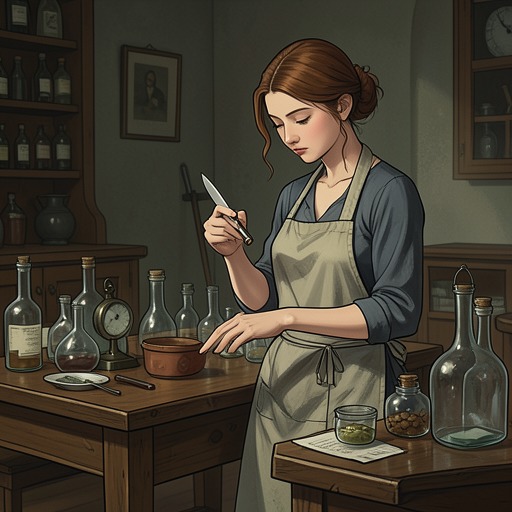
Ada Founds Maison Cendre in Paris
The Wife He Threw Away: A Billionaire Secret Baby, Marriage-in-Crisis, Second-Chance Grovel RomanceAda Founds Maison Cendre in Paris marks the central reversal of Ada Hart’s story: after Sebastian Vale allows Chloe Beaumont to be presented as the creator of Éternel, Ada refuses to remain the invisible chemist behind a stolen success and turns her loss into a new house of fragrance. Maison Cendre is not merely a replacement for the career and marriage she has lost; it is the material form of her decision to control her own name, work, and future.
Origins in Betrayal
Maison Cendre begins in the aftermath of the Éternel launch, where Vale Group publicly celebrates Chloe Beaumont as “the heart and the hands” behind a fragrance Ada created. Sebastian Vale has already reduced Ada’s contribution to technical labor, telling her that she is “a chemist” while Chloe offers the marketable face and family connections he believes a four-hundred-million-dollar brand requires. The institutional betrayal deepens when Chloe is typed into the title of Creative Director, and Sebastian signs the paperwork that places the creative authority of Maison Éternel in the hands of a woman who has never entered Ada’s laboratory. A further spousal-disclosure form forces Ada’s marriage into the same machinery that has erased her authorship.
Ada leaves rather than accept the role assigned to her. In Paris, she approaches Estelle under a condition of concealment: no one is to learn whom she married, and even her birth name is to remain outside the threshold. Estelle identifies the contradiction at the center of Ada’s situation—the woman who built a four-hundred-million-dollar fragrance has been made to watch another woman wear it as if it were borrowed clothing. She then proposes the name Cendre. The name is both a burial and a beginning: Adeline Hart, the identity Ada has used in Paris, is symbolically buried so that something capable of surviving the fire can be built from its remains.
Building the House
Ada begins working for Estelle in the same week, despite severe pregnancy sickness. Her mornings are organized around nausea and the perfume organ; her afternoons become a regimen of blind smelling, in which Estelle trains her to distinguish individual materials, including a single molecule of orris within a chord. The discipline is not decorative apprenticeship. It restores Ada’s technical authority at the exact moment when Sebastian’s organization has used the language of business to deny that authority any public value.
At night, Ada translates what she cannot say into scent. She works with ash, wet stone, green growth, and a defiant thread of jasmine, refusing to surrender even the flower associated with her marriage and with the field in Grasse where Éternel’s language had first been formed. Estelle recognizes the result as a confession disguised by the formal name of perfume. Ada’s grief therefore becomes neither a private wound nor a sentimental story for a marketing campaign; it becomes a method of composition.
The physical establishment of the house follows this transformation. Ada and Estelle lease a narrow shopfront on the Rue des Cendres, paint it grey, and hang only the single word Cendre as its sign. The modest premises sharply oppose Vale Group’s tower, its launch machinery, its cameras, and its four-hundred-million-dollar commercial logic. Maison Cendre begins without inherited prestige or a public family name, but its austerity is deliberate: the house will be identified by what the work contains rather than by the social authority surrounding its creator.
Estelle and Delphine Cross
Estelle is the founder’s teacher and the keeper of the philosophy that makes Maison Cendre possible. She gives Ada her old two-hundred-tier organ, the instrument on which she built her early career, and tells Ada only to finish the work. The gift transfers more than equipment. It gives Ada a material inheritance grounded in craft rather than dynasty, and it places Maison Cendre within a lineage that is earned through making.
Estelle also gives Ada Sillage, her discontinued composition, and explains that perfume is not the living flower but what can be distilled from the flower as it dies. This principle becomes the house’s governing idea. Beauty is not preserved by pretending that loss has not occurred; it is transformed through pressure, decay, and survival. Cendre is what the fire could not take, while its surviving soil makes future growth possible.
Delphine Cross enters the story during the dead weeks of winter, arriving from the rain to ask for work. She is hired to mind the counter but becomes Ada’s closest companion and practical support. Delphine learns Ada’s orders before they are spoken, never demands an explanation for Ada’s midnight grief, and remains beside her despite not knowing her true name. By spring, she is the nearest thing to family Ada will permit herself. Her loyalty gives Maison Cendre a human structure before it has a commercial one.
Revenant and the House’s Rise
Ada names the first fragrance made under Maison Cendre Revenant. Its composition carries the biography of the house without reproducing the stolen formula of Éternel: smoked iris, cold stone, an indestructible green heart, and a base of ash and cedar that some perceive as grief and others as fury. The scent appears to violate the rules of the luxury counter, yet its very refusal of easy prettiness becomes its distinction.
Delphine sells the first two hundred flacons by hand, one wrist at a time, in the back rooms of shops unwilling to place the new house in their windows. Maison Cendre therefore grows through intimate contact rather than through the spectacle of a launch gala. Its customers encounter the fragrance as a bodily experience, and the house’s reputation develops from the response of individual wearers instead of from a celebrity creator’s assigned story.
The contrast with Éternel becomes explicit as Maison Cendre expands. Within five years, it has no legacy advertising or inherited heritage, yet it is consuming Vale Group’s fragrance business. Maison Cendre’s newest launch sells out across three continents in a weekend, while reviewers describe its work as alive and human. The qualities that Vale Group’s chemists can no longer earn—emotional immediacy, remembered history, and the sensation of life in the scent—are precisely the qualities Ada builds into the house from her experience of betrayal.
Authorship, Power, and Consequence
Maison Cendre reverses the hierarchy that ruined Ada. Under Vale Group, a fragrance can be separated from its maker, given a more photogenic face, and converted into a corporate asset through titles, signatures, licensing, and publicity. Maison Cendre instead makes authorship inseparable from the act of creation. Its name originates in Ada’s survival, its first scent embodies her grief, and its growth demonstrates that a house without inherited legitimacy can defeat the institution that once treated her work as commercially useful but personally negligible.
The reversal also changes Sebastian’s relationship to power. When Maison Cendre threatens Vale Group’s fragrance arm, which has fallen forty percent year over year, Sebastian initially proposes buying the rival house because he cannot replicate or stop thinking about the nose behind it. Later, when the merger places the fragrance division at the center of a struggle over control, he signs the entire house into an independent merged entity and removes the board’s ability to decide whose name belongs on whose work. He writes full creative and commercial control, including the founder’s seat, into an authority answerable to no Vale. This restitution cannot erase the original theft, but it acknowledges that Maison Cendre’s legitimacy rests on Ada’s authorship rather than on Sebastian’s ownership.
The house’s significance is therefore both personal and structural. Ada does not simply recover from Sebastian Vale’s decision; she creates an institution capable of exposing the decision’s false logic. The fragrance that once turned her into a nameless chemist becomes the proof that the creator cannot be reduced to a face, a family connection, or a line in corporate paperwork. Maison Cendre survives because Ada makes survival itself part of its aesthetic, its business identity, and its claim to truth.