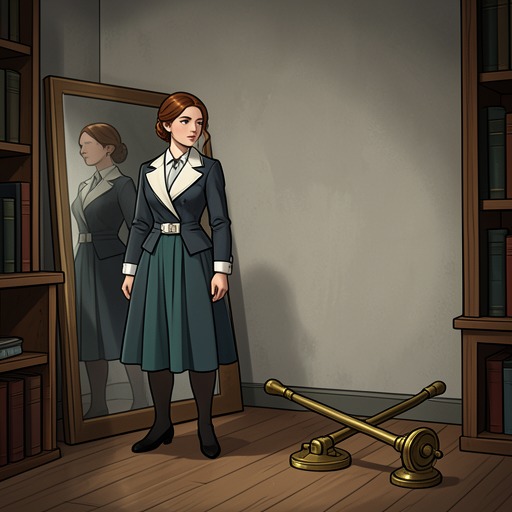
Ada and Sebastian's rebuilt marriage
The Wife He Threw Away: A Billionaire Secret Baby, Marriage-in-Crisis, Second-Chance Grovel RomanceAda and Sebastian's rebuilt marriage is the final transformation of a relationship once organized by unequal power, public humiliation, and concealed truth. Their reunion does not restore the marriage that failed at the Éternel launch; it establishes a different one, in which Ada retains her name, work, authority, and right to leave, while Sebastian must prove love through accountability rather than possession. The rebuilt marriage is therefore both a romantic reconciliation and a new ethical structure for their family.
From Betrayal to Conditional Reconciliation
Ada and Sebastian's original marriage was broken when Sebastian publicly presented Chloe Beaumont as the creator of Éternel and then told Ada, “You married up. Everyone knows it but you.” He chose the approval of the Vale board and the protection of the Vale name over his wife, even though he understood that Ada's work had been taken from her. Ada left soon afterward, carrying a secret pregnancy and refusing to use the joint accounts because they represented the same name Sebastian had used to diminish her. In Paris, she sold the jasmine earrings he had given her, accepted poverty on her own terms, and built Maison Cendre around the principle that her work would never again be credited to another person.
The distance between them was therefore material as well as emotional. Sebastian had once built the Éternel laboratory as Ada's “secret kingdom,” but the institution remained inside Vale Group's glittering machine, where his authority could determine whose name appeared in public. Ada's later refusal to touch his money, her adoption of the public name Adeline Rousseau, and her insistence that every Maison Cendre flacon and ledger carry “A composition by A. Rousseau” converted separation into independence. Estelle sheltered her above the atelier, while Delphine Cross handled buyers, press, and commercial negotiations so Ada could remain at the organ and create. The marriage could not be rebuilt until that independence became real rather than merely declared.
Sebastian's pursuit initially repeated the logic of acquisition. He arrived at Ada's atelier and acknowledged that she had told him he could not acquire her, then proposed that Maison Cendre and Vale Group might conduct business through distribution or an arm's-length house account. Ada allowed the possibility of commercial dealings but rejected the personal pressure surrounding them. The flowers, the bought-out restaurant, and his presence outside Theo's school had to stop. She defined the difference between a supplier relationship and a marital claim: business could be considered on paper, but “the wife is not on the table,” because Sebastian had already thrown that relationship away.
Accountability Before Romance
The emotional turning point came when Sebastian stopped treating remorse as a private feeling and accepted it as a public obligation. After discovering that Theo was his son, he understood that Ada had been five weeks pregnant when he humiliated her and that his silence had sent her into a four-year life he had never bothered to imagine. Theo's copper hair and grey eyes made the concealed relationship undeniable, but the child's fear made its consequence intimate: when Sebastian knelt before him, Theo stepped behind Ada's leg and went still. Sebastian recognized that stillness as the first true thing his son had communicated to him.
That recognition changed the meaning of the Éternel scandal. Sebastian had once called his conduct composure, but he later identified it as cowardice in a good suit. He released the forensic audit himself, despite advice to preserve deniability. Vale Group's communications office sent out the keycard logs, notarized formulation notes, and four-year provenance chain showing that the work originated with Ada's thumbprint and records, not Chloe Beaumont. The statement declared that Chloe Beaumont had never been the creator of Éternel, that Vale Group and its chief executive had known this, and that the correction was overdue. By signing it under the press epithet the Blade, Sebastian accepted that clearing Ada's name would also expose him as the husband who had allowed the theft.
His restitution was designed not to create a new debt. Sebastian transferred the fragrance house into the merged entity with Ada's creative and commercial control protected by independent governance. He removed the board mechanism through which eleven men could decide whose name belonged on whose work, preserved the founder's seat, and ensured that the authority would answer to no Vale. Most importantly, he drafted the arrangement without a contact provision, a condition of Ada's acceptance, a reserved board seat, or any device that could make his generosity demand gratitude or renewed intimacy. He understood that a gift with a string attached becomes a leash, and he made the restored authority hers whether she ever spoke to him again or not.
Terms of the New Marriage
When Ada finally allowed physical closeness, she made the decision explicitly hers: it would happen on her terms, not because Sebastian wanted her back, but because she had decided he was worth another chance. Her distinction preserved the central boundary of the rebuilt marriage. Sebastian could earn the right to hear her love, but he could not earn ownership of her. Ada told him, “I love you,” while immediately separating that declaration from surrender: he had earned the right to hear it, not Ada herself.
Ada then named the conditions under which reconciliation could continue. They would be equals, not a chief executive and a woman in a white coat, and not the Vale name standing above the person beside it. They would tell the truth even when it was ugly, especially because Sebastian had once chosen a comfortable lie over the truth of her. Theo would come first, before the board, Sebastian's name, Sebastian's pride, and even Ada if necessary. His future would not be built on attractive falsehoods about who made what; he would know whose hands created his life and his inheritance.
The terms also restored authorship as a marital principle. Ada insisted that Maison Cendre was hers, that her name would go first on the door, the bottle, and the story people believed, not because Sebastian permitted it but because it was true. Sebastian's continuing duty was not merely to love Ada privately but to become the man who told the truth about her publicly. The marriage thus tied emotional fidelity to institutional practice: he could not claim reconciliation while allowing the structures that erased her to remain intact.
The Second Proposal and Remarriage
Sebastian's second proposal deliberately returned to the Grasse jasmine field, the place where he had first knelt and promised a life he later failed to deserve. He brought no ring at first, only the offer itself. He told Ada that she could refuse and he would drive her home and love her across the world without conditions. The gesture mattered because it removed the usual pressure from a proposal: marriage was presented as a choice Ada could decline, not a reward Sebastian could purchase or a claim his family name could enforce.
Ada answered by distinguishing her second yes from her first. At twenty-one, she had said yes to being loved and had given Sebastian everything while keeping nothing for herself; now she was thirty, clear-eyed, and unwilling to repeat that arrangement. She required equality, truth, and Theo first. Her consent was not a recovery of the old promise but a new agreement made by a woman who had survived leaving the field and had rebuilt a life whose name and work belonged to her.
She accepted only on those terms, saying that she would marry Sebastian Vale again “on purpose” and “all the way through.” Sebastian placed the ring on her finger with unsteady hands, reversing the earlier image in which he had kissed another woman's knuckles while Ada's work and dignity were eclipsed. This time the ring was returned to the woman whose life had been displaced, and the gesture became true only because it followed her conditions rather than replacing them.
They married in the jasmine field outside Grasse during harvest, not in the grand atrium where Sebastian had launched his lie before six hundred strangers and forty cameras. Delphine Cross, Estelle, and Theo were present: Delphine in slate silk, Estelle with her cane planted in the earth, and Theo carrying the rings while waiting to remove his linen suit. The small, witnessed ceremony contrasted with the earlier spectacle. Their second marriage was public without being performative, intimate without being secret, and centered on the people who had actually helped build the life they were entering.
Equality in Family Life and Daily Practice
The rebuilt marriage is completed not by the ceremony alone but by the ordinary work that follows it. In their renewed intimacy, Ada and Sebastian are described as equal in a way they had never been in the old life: neither is credited to the other, neither owes the other a life, and both remain fully present rather than hidden behind a gala, a lie, or an imposed public role. Their physical reunion carries the same terms as their legal and commercial reconstruction. Desire is no longer a mechanism of possession; it becomes another form of mutual recognition.
Theo remains the center of the household's design. Sebastian's relationship with him cannot be repaired by biological revelation or a wedding ring. He must earn the child's trust through repeated, unphotographed actions, just as he must earn Ada's trust daily. When Theo struggles to draw a lion, Sebastian kneels beside him and teaches him how to bend the legs so the figure can carry weight. The scene turns fatherhood into patient labor rather than entitlement. Sebastian understands that his earlier promise to spend his life failing to deserve Ada was not merely a romantic phrase but a diagnosis of his failure; he now treats deserving as a debt paid through small acts no one sees.
The marriage therefore preserves Ada's capacity to choose rather than absorbing it into reconciliation. She does not claim that fear has vanished or that trust is complete; she chooses with her eyes open and continues to build trust “board by board,” like rebuilding a house after fire. Sebastian's role is not to be forgiven once and restored to his former position. It is to accept a permanent standard of truth, restraint, and service within a family whose center is no longer his name.
Significance
Ada and Sebastian's rebuilt marriage resolves the romance by rejecting the premise that love excuses hierarchy. Its decisive symbols are the laboratory, the stolen credit, the refused bank accounts, the independently governed fragrance house, the ring returned in the jasmine field, and Theo's place between his parents. Each symbol converts an earlier form of dependence into a chosen relationship: ownership becomes stewardship, publicity becomes truthful witness, apology becomes restitution, and marriage becomes equality with an exit still imaginable.
The ending also makes reconciliation inseparable from authorship. Ada's name remains first on her work, Maison Cendre remains grounded in the creative authority she built, and Sebastian's redemption depends on telling the truth about her rather than asking her to disappear into the Vale identity. Their second marriage is consequently not a restoration of the old household but a rebuilt structure in which love survives only because Ada retains the power to define its terms. The scent that closes the union carries the same architecture: sandalwood as foundation, jasmine as the heart, and a future made possible because neither partner is again asked to surrender the self that created it.