Audit of Éternel's True Creation
The Wife He Threw Away: A Billionaire Secret Baby, Marriage-in-Crisis, Second-Chance Grovel RomanceAudit of Éternel's True Creation is the forensic investigation Sebastian Vale orders after learning that the woman he abandoned, Adeline Hart, had been pregnant when she left and that the child he has just met is his son. The audit does more than clear Ada's name: it reconstructs the machinery by which Éternel was stolen, identifies Sebastian's own signatures within that machinery, and makes public correction inseparable from personal guilt. Its decisive significance lies in that refusal of easy absolution. Sebastian cannot restore Ada's authorship without admitting that he helped erase it.
Causes and Background
The audit begins as a direct consequence of Sebastian's re-reading of the Éternel launch. In the Vale Group atrium, forty thousand white roses, a suspended crystal ceiling, six hundred guests, and a three-storey banner had turned the product into a spectacle of corporate legitimacy. Sebastian had crowned Chloe Beaumont before the board and cameras, then found Ada in the gallery and told her, “You married up. Everyone knows it but you. Without the Vale name you’re a nose in a white coat.” He recognized the cruelty of the sentence even as he spoke it, briefly understood that he could retract it, and chose pride instead. Ada left without crying, carrying the consequences of that public humiliation into the four-year separation.
The audit is also driven by the discovery of Theo Hart. When Sebastian hears the boy's name, the chronology becomes unavoidable: Ada left in June, and she must have been five weeks pregnant when Sebastian dismissed her. The physical resemblance—the copper hair and Sebastian's grey eyes—confirms what the arithmetic has already established. Sebastian understands that Theo's wary stillness is his first son's answer to him, and that the same man who had allowed Ada's work to be taken has also lost four years with his child. He later describes the launch not as a moment of weakness but as an act in which he handed Chloe the knife. The investigation therefore addresses both an appropriated creation and the moral injury of having failed to stop its appropriation.
Sebastian first orders the immediate withdrawal of Vale Group's legal action against Maison Cendre, including the cease-and-desist and trademark challenge. When counsel warns that canceling the case may look like an admission, Sebastian answers that it reads as the truth. He then opens a second file: a full internal audit of every Éternel creation record, including laboratory access logs, twenty-second-floor keycard data, original formulation notes, and the entire provenance chain from concept to bottle. The demand for timestamped and notarized records is crucial because it seeks not merely a sympathetic retelling but an evidentiary chain that cannot later be altered.
What the Audit Reveals
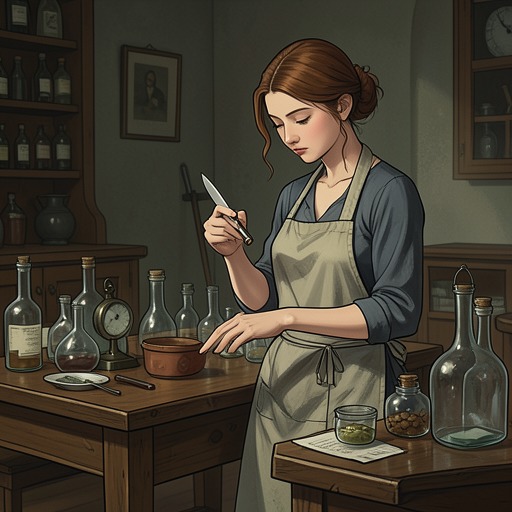
The report establishes that Éternel took twenty-six months to build and that, throughout that period, the laboratory's thumbprint reader recorded exactly one authorized print four hundred and eleven times: Adeline Vale. Chloe Beaumont's print appeared only once, two weeks before the gala, after an executive override provisioned it. That override was Sebastian's. He does not remember signing it, and the discovery forces him to confront a particularly damaging form of responsibility: he had not personally composed the fragrance, but he had signed away access to the room in which his wife's work was made.
The second documentary file proves that the false credit was not an improvisation at the launch. A draft run-of-show from eight months before Éternel was finished already named Chloe as its creator, even though Chloe had never entered the laboratory. Attached messages between Chloe and Vivienne Vale reach further back and reveal the campaign's method: Sebastian was to be persuaded through family, money, and pride, while Ada was cast as a social climber. The planned story preceded the public lie; the gala merely staged it. Sebastian's realization that Chloe would “let my mother pour it into me a spoonful at a time” destroys his last defense that he had simply been deceived.
Chloe confirms the strategy when Sebastian confronts her. She explains that the laboratory truth was commercially inconvenient: a woman in a lab coat who refused to stand for a photograph did not provide the scalable face the brand required. She says she gave Éternel a person consumers could love and admits that Vivienne wanted Ada gone before the first anniversary. Chloe had introduced the young perfumer to Sebastian at a gala in Nice because she saw Ada as brilliant and invisible, though she had not originally planned for the two to marry. Her account makes the fraud larger than a stolen formula. It is the deliberate conversion of Ada's technical labor into Chloe's marketable identity, supported by family power and the belief that Sebastian's pride could be used as a lever.
Public Correction and Consequences
Sebastian releases the audit himself rather than allowing it to leak. His communications office sends the forensic report to every desk that had presented Chloe's name as the face of Éternel. The release includes keycard logs, notarized formulation notes written in a hand that is not Chloe's, and the four-year provenance chain repeatedly opening under the single thumbprint that belongs to the woman the company erased. His accompanying statement identifies Adeline Hart as the creator and explicitly states that Vale Group and its chief executive knew the truth. He rejects the appearance of generosity, presenting the correction as overdue.
The disclosure destroys Chloe's public authorship in one news cycle. Interviews in which she had claimed lifelong devotion to the scent are broadcast beside laboratory records proving that she had never entered the room where Éternel was made. Her family's distribution arm distances itself from her, while the garden story, the muse narrative, and the magazine spreads collapse together. The audit thus corrects not only a line of credit but an entire commercial mythology: the supposed creator, the inherited romance of the product, and the media image that had allowed stolen labor to become an asset.
The public briefing makes Sebastian's complicity part of the correction. He answers that he knew at the launch and that his former wife was the sole creator. When asked whether he will resign, he leaves the decision to the board, but he does not evade the questions designed to expose him. He understands that clearing Ada's name necessarily indicts his own conduct: every article that restores her authorship will also identify him as the husband who allowed the theft. As the Vale Group's public representative, he gives the room the body it wants, accepting reputational damage rather than preserving the deniability that had protected the company.
Restitution Beyond Apology
The audit's consequence is not limited to disclosure. Sebastian transfers the entire fragrance house into the merger with Maison Cendre rather than retaining the diluted stake his counsel had designed to preserve the family's influence. The transfer strips the board's approval rights from the mechanism that had allowed eleven men to determine whose name appeared on whose work. Creative and commercial control, including the founder's seat, is placed in an independent authority answerable to no Vale.
The terms are deliberately unconditional. Sebastian ensures that Ada's authority does not depend on speaking to him, accepting his apology, resuming the marriage, or expressing gratitude. He removes any contact provision, any condition of acceptance, any board seat reserved for a reconciled Mrs. Vale, and any other thread by which the gift could become leverage. He has learned that when a man gives a woman something with a string attached, the gift becomes a leash. The restitution therefore returns not only ownership but the power to refuse the man who returns it.
Later, the industry correction identifies the creator as “Adeline Hart,” with her name placed first on the masthead shared by Maison Cendre and the new Vale fragrance line. The audit's truth becomes institutional rather than merely emotional. At Maison Cendre's atelier, a child's grey-crayon drawing of a lion signed Theo stands among the awards, making a private family recognition sit beside the restored professional credit. The contrast links authorship to inheritance in a new form: Theo's name is not a corporate claim but the credit Ada would have died to receive.
Narrative Significance
The audit functions as the story's reverse launch gala. The original ceremony used light, flowers, cameras, and a false name to manufacture legitimacy; the later release uses logs, notes, timestamps, and an accountable signature to dismantle it. Both are public rituals, but their meanings run in opposite directions. The first crowned Chloe and made Ada disappear. The second names Ada and makes Sebastian's responsibility visible. The documentary form is therefore a moral counter-ritual: evidence replaces spectacle, and authorship is returned through the same public machinery that once confiscated it.
Its emotional force comes from Sebastian's movement from self-protective shame to reparative action. He recognizes that he built an empire on reading rooms while failing to read the message conveyed by his son's body, and that his language of composure had concealed cowardice. The audit does not erase the four-year separation, the lost pregnancy years, or the launch-night humiliation. Instead, it gives those injuries a record and a consequence. Sebastian's later understanding that he had catastrophically failed to deserve Ada turns repentance into ongoing labor rather than a successful appeal for forgiveness.
The event also prepares the final reversal of the marriage story. Years after the theft, Ada and Sebastian marry in the jasmine fields outside Grasse, not in the Vale Group atrium. The correction has already placed her name before his, and the new ceremony can therefore be read as a choice made after authorship, control, and public identity have been restored. The audit makes that choice possible without making it obligatory: Ada does not return because Sebastian's power requires it, but because the truth has finally been made visible and the stolen work has been placed back in its creator's hands.