Cendre Ash Philosophy
The Wife He Threw Away: A Billionaire Secret Baby, Marriage-in-Crisis, Second-Chance Grovel RomanceCendre Ash Philosophy is the creative and ethical principle Ada Hart forms from the wreckage of her marriage to Sebastian Vale and the theft of her authorship of Éternel. Its central claim is that ash is not mere ruin. Cendre is what survives the fire after sweetness, possession, vanity, and false stories have been stripped away; from that residue, a person can build a life that belongs to her rather than to the institution or man who once claimed her.
Origin in Betrayal
Cendre begins when Ada arrives in Paris carrying the consequences of the Éternel launch gala. Vale Group publicly presents Chloe Beaumont as the fragrance’s creator, even though Ada built the scent in secret, and Sebastian Vale publicly endorses the lie. Ada is pregnant, has lost the authorship of the work that made the company forty million in pre-orders within eighteen hours, and has been reduced by Sebastian’s language to a person whose value can be measured against the Vale name. Estelle recognizes the scale of that dispossession when she describes Ada as the woman who built something worth four hundred million and allowed another woman to wear it like a borrowed coat.
Estelle then gives the philosophy its name and its first definition. She proposes that Ada and she bury Adeline Hart—the self shaped by the marriage, the gala, and the life Ada believed she had secured—and build from the ash: Cendre. Ash is what remains after everything capable of burning has burned, but Estelle adds that it is also where good soil comes from. The image turns destruction into a material condition for growth. Ada is not asked to pretend that the fire did not happen; she is asked to use what it could not consume.
A Philosophy Made into Perfume
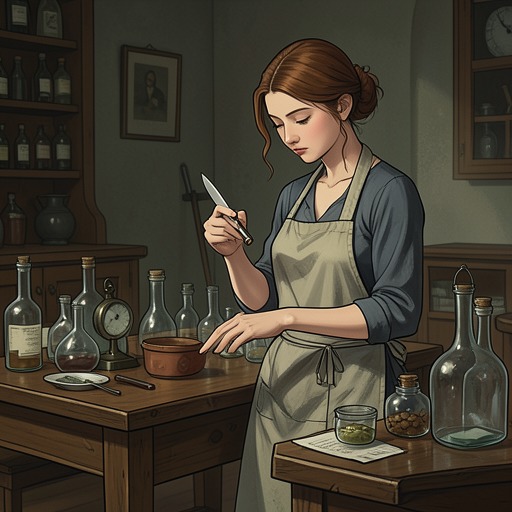
Ada immediately translates Cendre into the language she still controls. While morning sickness confines her to a bucket beside the perfume organ, Estelle subjects her to rigorous exercises in identifying individual essences, and Ada works through grief rather than escaping it. She creates a fragrance with a base of ash and wet stone, a heart of something green pushing upward, and a defiant thread of jasmine. The jasmine matters because it once belonged to the memory of Sebastian’s proposal in the Grasse jasmine fields; Ada refuses to let him retain even the flower as part of his version of the past.
Estelle’s teaching provides the philosophy’s most concise formulation: a perfume is not the flower itself, but what is distilled from the flower as it dies. The principle rejects simple preservation. A scent does not honor an experience by keeping it untouched; it transforms the experience through loss, concentration, and craft. Ada has already been burned, and therefore knows where her material lies. Her pain becomes neither decorative romance nor private weakness, but the raw substance of a new artistic vocabulary.
That vocabulary produces Revenant, the first fragrance created under the Maison Cendre name. Its composition combines smoked iris, cold stone, an indestructible green heart, and ash and cedar, with grief and fury held in the same structure. The scent violates the accepted rules of the counter, yet its difference becomes its power. Delphine Cross sells the first two hundred flacons by hand in the back rooms of shops unwilling to display the house, and later a critic encounters Revenant on a stranger at the opera and calls it the future of French perfumery. The resulting waitlist makes Cendre’s philosophy commercially consequential: authenticity does not remain an inward creed but becomes a recognizable public identity.
Against Ownership and False Credit
Cendre also names Ada’s rejection of the language that destroyed her. Sebastian first frames love through acquisition, proposing to Ada in the Grasse jasmine fields while telling her she is the one thing he cannot buy. At the Éternel gala, however, the same intimate vocabulary of sandalwood and jasmine is transferred into a corporate script and placed behind Chloe Beaumont’s name. Sebastian then tells Ada that she married up and that, without the Vale name, she is merely a nose in a white coat. His words expose the logic beneath his earlier romance: he has allowed affection, creative labor, and marriage to become forms of property.
Ada later identifies the pattern with precision. Sebastian’s answer to need is always “Mine”; he responds to her refusal of dependence by offering a field, a roof, and an expensive display of possession. In her judgment, his attempt to win her back repeats the original injury because he presents flowers with an invoice attached and a deed bearing her name as though he had acquired an asset. Cendre therefore cannot mean simply surviving Sebastian while remaining inside his system. It requires refusing the conversion of a person’s work, name, or intimacy into something another person can purchase and control.
The contrast with Éternel sharpens this point. Éternel is built from Ada’s private memory of sandalwood, jasmine, and the field outside Grasse, yet Vale Group turns that intimate creation into an oversubscribed corporate product and assigns its public identity to Chloe. The scent continues to evoke the emotional force of its true maker even while the marketplace repeats the false credit. Maison Cendre, by contrast, makes creator and creation inseparable from the beginning. Its name announces not the untouched flower or the polished surface, but the history of burning that made the work possible.
From Revenge to a Livable Future
Cendre initially carries a strong retaliatory charge. Ada’s grief contains iron, cold marble, and the metallic memory of a wedding ring left cold on a countertop; Revenant is built from the refusal to let Sebastian keep the jasmine. Later, when Ada watches Sebastian confront the consequences of the Éternel theft, revenge appears to her as sandalwood: heavy, lasting, and foundational. It is the base note of an identity organized around injury.
Estelle prevents that base note from becoming the whole composition. When Ada considers what she can do to Sebastian, Estelle insists that the important question is not the size of the knife but what Ada wants. The distinction separates power from purpose. Ada can imagine Sebastian ruined and Theo Hart growing up knowing that his mother destroyed his father’s life, but she cannot yet name the future she wants after victory. Estelle tells her to build whatever she chooses because she wants to live inside it, not because she wants Sebastian to die in it.
This counsel extends Cendre beyond a revenge ethic. The philosophy permits anger to remain in the formula, but it refuses to make anger the house in which Ada must live. A bright, green, frightening top note begins to rise above the sandalwood of revenge. Its uncertainty is important: renewal is not presented as a painless replacement for grief, and Ada does not erase the four years of separation. Instead, the possibility of something other than retaliation opens through the crack in the granite she believed had sealed her past.
Memory, Matter, and Survival
Cendre treats material objects and smells as active carriers of history. The two-hundred-tier perfume organ, the mother bottle, the wedding ring, and the jasmine accord do more than symbolize Ada’s past: they preserve its physical traces and repeatedly draw the past into the present. Éternel breathes sandalwood and jasmine in the laboratory Sebastian once paid to build, forcing him to recognize that the fragrance contains the hour of his proposal molecule by molecule. Years later, Ada and Sebastian reconstruct the accord essence by essence, and the completed scent restores the field outside Grasse, the person Ada once was, and the vow that Sebastian failed to keep.
The philosophy therefore distinguishes survival from simple continuity. What survives is altered by fire. Ada does not recover the naive young woman who believed a promise could stand outside the language of ownership, nor does Maison Cendre reproduce Vale Group’s version of luxury. The past returns as transformed material: ash becomes soil, grief becomes perfume, and memory becomes evidence of both injury and authorship. Even the jasmine is no longer only Sebastian’s proposal flower; through Ada’s work, it becomes part of a history she has reclaimed and reinterpreted.
Cendre’s final significance lies in its refusal to separate creative authorship from moral self-possession. Ada names Maison Cendre after the residue that cannot be taken from her, and the house rises because that residue is made into form rather than hidden. The philosophy does not promise that burning can be undone. It argues instead that the irrecoverable loss can reveal what was real, what was imposed, and what can still be built. In that sense, Cendre is both a perfume theory and Ada’s answer to every attempt to own her: the fire may destroy the lie, but it cannot destroy what she makes from what remains.