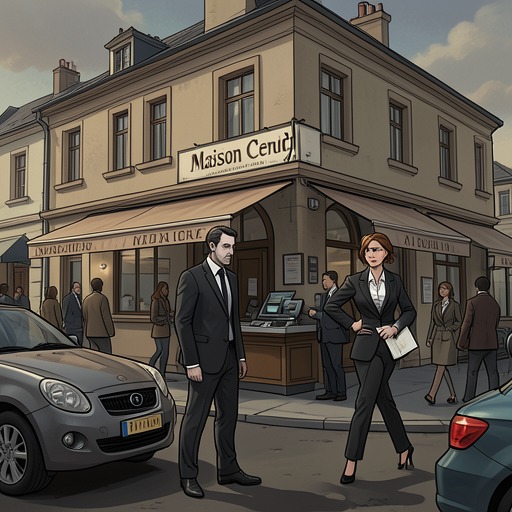
Sebastian and Ada Reunite at Maison Cendre
The Wife He Threw Away: A Billionaire Secret Baby, Marriage-in-Crisis, Second-Chance Grovel RomanceSebastian and Ada Reunite at Maison Cendre is the decisive confrontation between the estranged spouses after four years of separation. Sebastian comes to Ada’s Paris atelier as the head of an acquisitions effort aimed at buying Maison Cendre, expecting a commercial negotiation; instead, he finds Ada established as a founder in her own right and discovers that the life he tried to erase has continued without him. The meeting’s immediate value shift is from Sebastian’s confidence in purchase and authority to Ada’s recovery of dignity, leverage, and refusal. It is also the scene in which the past becomes physically present: Sebastian sees Ada again, hears the private name only he had once made gentle, and hears a child laughing upstairs before he understands that the child is his son, Theo Hart.
Causes and Background
The reunion is rooted in the public humiliation that destroyed the marriage. At the launch gala for Éternel, Sebastian crowned Chloe Beaumont before the board and forty cameras, while the work was in fact Ada’s. When Ada confronted him afterward, he told her that she had married up and that without the Vale name she was merely a chemist in a white coat. He recognized the cruelty of what he was saying and briefly saw the sentence that might have brought her home, but chose pride instead. Ada left without crying, carrying the consequences of his decision into a new life.
In Paris, Ada refused to use the joint accounts containing seven figures of Vale money. With only eleven hundred euros left, she rented a sixth-floor room in the Marais and sold the jasmine earrings Sebastian had given her after Grasse to pay the deposit. Her independence therefore begins not as a comfortable reinvention but as a material refusal of his name and resources. Maison Cendre grows out of that refusal: the house becomes the institutional form of a life she built without the wealth, protection, or authority Sebastian had once claimed to provide.
Sebastian does not initially approach the atelier as a repentant husband. He moves his meetings, circles Maison Cendre’s street on the rue de Poitou, watches from a distance, and tells himself that he wants only to determine whether Theo is his child. When a near encounter with the copper-haired boy confirms the resemblance, Sebastian responds through the mechanism he knows best: he buys. He brings ten thousand jasmine stems from Grasse to Paris and purchases the Maison Cendre building, transferring it to Adeline Rousseau for one euro. He calls the act protection, but its structure remains ownership. The reunion occurs after this attempt to convert care into acquisition has already begun to reveal its danger.
The Meeting at Maison Cendre
Ada is in her atelier when Sebastian arrives. She expects an acquisitions team, not the man himself; he enters in charcoal wool, taller than the doorway, with shorter black hair threaded with grey and the scar through his left brow. The physical details make the four-year interval visible without diminishing the familiarity between them. Ada’s body recognizes him before her mind permits recognition, while Sebastian is visibly undone by seeing the woman he had imagined, lost, and failed to find again.
He addresses her as “Adeline,” using the real name only he had once made soft. Ada answers by calling him “Mr. Vale” and returns the encounter to business. She opens the folder and tells him that he wants to buy Maison Cendre in its entirety, then places her terms before him and makes clear that they are not negotiable. She drives the negotiation through margins, exclusivity windows, and a precise price, inserting figures between them whenever his eyes seek a personal opening. The commercial language is not neutral: it is Ada’s defensive architecture, a way to keep Sebastian within a field she can read and control.
The emotional pressure breaks through when a child’s laugh drifts down the stairwell. Theo is upstairs, three years old, with copper hair, grey eyes matching Sebastian’s, a box of pencils, and a half-drawn lion whose mane Ada has promised to finish with him. Sebastian is seated only eleven feet from the staircase, close enough to the hidden child to make concealment impossible but not yet able to name what he is hearing. His request for Ada to say something real is interrupted by the sound, and the reunion changes from an encounter between former spouses into the threshold of a father-son revelation.
Recognition and Control
After the meeting, Sebastian follows the implications of what he has seen. In the corridor, he calls Ada “Rousseau,” identifies the name as her mother’s maiden name, and stops her flight toward the elevator by recognizing her hands. He reminds her that he once built her a laboratory and asks whether she thought he would not know her hands. The gesture joins memory to investigation: even after four years, her work remains legible to him, but his knowledge is now experienced by Ada as an intrusion rather than intimacy.
Ada gives him a narrow possible channel for future business. Maison Cendre and Vale Group may discuss distribution or a house account through contracts and lawyers, but the man, the flowers, the bought-out restaurant, and Sebastian’s presence outside Theo’s school must stop. She will consider being a supplier on paper and at arm’s length; the wife is not on the table. Her terms convert Sebastian’s pursuit into something observable and bounded. Commerce becomes surveillance in reverse: a contract can be monitored, while romantic or paternal access cannot simply be assumed.
Sebastian’s earlier acts show why those boundaries are necessary. He had used money to move across every obstacle—chartering a plane to Grasse, stripping the jasmine field before harvest, paying the growers four times the loss, sending the flowers through customs, and filling Maison Cendre with ten thousand stems. He then bought the building to remove the landlord as a threat. These actions are grand, costly, and ostensibly protective, but they reproduce the logic that harmed Ada: the belief that safety can be achieved by owning the surrounding world. The reunion forces that logic into the open without allowing its romantic appearance to conceal its controlling form.
Theo and the Ethical Consequences
Theo’s presence gives the reunion its most consequential secret. When Sebastian finally hears the name “Theo,” the arithmetic of the past completes itself: Ada had left in June, and the evidence indicates that she had been five weeks pregnant when Sebastian humiliated her at the Éternel gala. The boy’s hair and eyes confirm the relationship. Sebastian understands that he had not merely lost a wife; he had failed to recognize and protect his unborn son while choosing the Vale image over the truth in front of him.
The child’s reaction is equally important. When Sebastian kneels to Theo’s level in the corridor, Theo steps behind Ada’s leg and becomes still. Sebastian reads that stillness as fear. His skill at reading boardrooms and social power cannot help him here; his son’s body communicates the first truth Theo can offer, and it is not welcome or trust. The recognition therefore does not grant Sebastian instant fatherhood. It establishes a duty to become someone the child can safely approach.
Sebastian initially has lawyers prepare a custody strategy based on jurisdiction, Ada’s alias on the birth documents, and a manufactured pattern of instability. He has a ladder toward court in which the Vale name and money could acquire Theo and fold him into the family machine. After confronting what his actions would do to Ada and to the frightened child, he ends the engagement, orders the file closed, and demands that the workups on the mother be destroyed. The reunion thus produces a change in objective: Sebastian stops treating fatherhood as a right to be won and begins treating it as a condition of fitness that he must demonstrate.
From Reunion to Repair
The encounter does not itself reconcile the marriage. Ada’s resistance remains firm, and Sebastian’s later repair depends on actions that relinquish rather than extend his control. When Chloe Beaumont offers to recant her recantation and use Theo as leverage—claiming that she created Éternel unless Sebastian publicly supports her and abandons the custody question—Sebastian refuses to let his son become a bargaining instrument. He publicly releases the audit showing that Chloe was not the creator of Éternel and that Vale Group, including its chief executive, had known the truth.
He then transfers the entire fragrance house into an equal merged structure without preserving hidden Vale control. The governance language gives the founder full creative and commercial authority through an independent authority answerable to no Vale, and Sebastian excludes every possible string: no contact provision, no condition that Ada accept, no board seat for a reconciled Mrs. Vale, and no mechanism requiring gratitude. The gesture matters because it reverses the premise of the reunion’s opening. Sebastian first came to buy Maison Cendre; he ultimately gives up the power to make Ada’s future depend on him.
The long consequence is not a romantic restoration achieved by a single apology but a rebuilt relationship measured through repeated, unphotographed acts. Sebastian later understands his promise to spend the rest of his life failing to deserve Ada as a diagnosis rather than a poem. He acknowledges that he failed her catastrophically in front of six hundred people and forty cameras, and treats the failure as a debt to be worked off daily. The Maison Cendre reunion is therefore the hinge between possession and responsibility: it brings the lost family into one physical space, but only Ada’s boundaries, Theo’s fear, and Sebastian’s subsequent relinquishment of power make genuine repair possible.