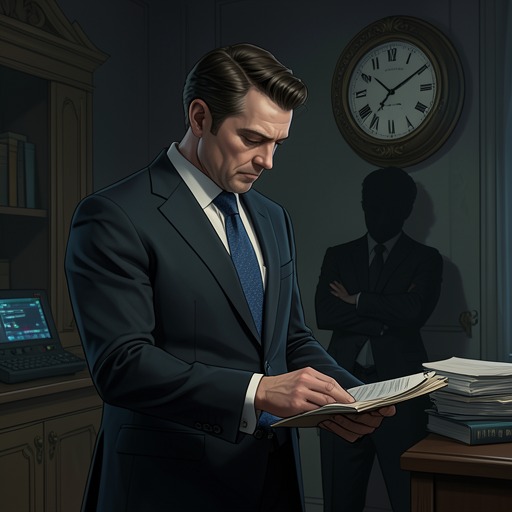
The Blade
The Wife He Threw Away: A Billionaire Secret Baby, Marriage-in-Crisis, Second-Chance Grovel RomanceThe Blade is Sebastian Vale’s public and private persona of ruthless decisiveness, a name that turns executive efficiency into an ideal of masculine self-command. It enables him to sever people and businesses without visible hesitation, but it also teaches him to treat love, authorship, marriage, and fatherhood as liabilities or assets to be managed. Its decisive significance is therefore paradoxical: the identity that makes Sebastian powerful is the same identity that helps him destroy Ada Hart’s life’s work, lose his family, and eventually recognize that intimacy cannot be acquired or commanded.
Definition and Formation
The name comes from Sebastian’s own description of his working method: “They call me the Blade because I cut.” He associates cutting with divisions, people, and entire product lines, and takes pride in never flinching when something dies under his hand. The press celebrates this quality, and the Vale Group board once admired it as well. The Blade is not merely a nickname for a sharp businessman; it is a governing ethic in which decisiveness is treated as virtue and hesitation as weakness.
That ethic is inseparable from the Vale family’s honor culture. At the Éternel launch gala, Sebastian allows his mother to lead him toward the stage because a Vale does not argue with his mother before six hundred people. He has begun to accept her judgment that Ada Hart is an unsuitable public face for the company, and he chooses the polished image of Chloe Beaumont over the chemist whose work created the fragrance. When he humiliates Ada in the gallery, he recognizes the cruelty of his own words and briefly sees that one honest sentence could still save their life together. He chooses pride instead, deliberately settling his face into the mask worn by his father. The Blade is thus formed not only by ambition but by inherited fear: Sebastian performs hardness because he has learned that a Vale man must never appear to yield.
Corporate Power and Emotional Evasion
After Ada leaves, the Blade becomes Sebastian’s method of refusing to experience the consequences of what he has done. He tells himself that her absence is a controlled punishment and that she will return once the silence has made its point. Rather than confront the possibility that the marriage has ended, he retreats to the Vale Group tower, where the company’s success offers a substitute for private certainty. Éternel has achieved forty million dollars in pre-orders during its first eighteen hours, and Sebastian chairs the morning meeting, approves a second production run, and behaves as the clean, decisive, untroubled executive the company expects.
The same performance allows Chloe Beaumont to occupy every vacant space around him. She prepares campaign proofs before he asks, settles a Milan retailer’s objections, completes his sentences in marketing meetings, and becomes difficult to distinguish from the fragrance house itself. Sebastian lets this happen because it is easier than examining the moral cost of the launch. The Blade does not simply cut; it clears away whatever might obstruct the corporate story, including Ada’s authorship and Sebastian’s own responsibility.
Four years later, the limits of that method become materially visible. Éternel, once the company’s crown jewel and a product that made Vale Group four hundred million dollars, can no longer be reproduced correctly. Its later batches retain sandalwood and jasmine but lose the elusive green-white quality that made the original extraordinary. The mother bottle sits in a climate-controlled vault on the twenty-second floor as a relic, while the company produces only a hollow imitation. The failed fragrance mirrors the failed narrative around its creation: every visible feature remains, but the living source has been removed.
The Blade in Crisis and Recognition
Sebastian’s encounter with Theo Hart begins to break the persona’s control. In a bare marble service corridor behind a gala, he goes to be no one, away from the assembled beauty and performance of the public room. The corridor’s concrete beneath its marble surface recalls the hidden structure beneath Vale Group’s glamour, while its separation from the party echoes the earlier moment when Ada walked out of his life. There, after allowing himself one unguarded instant of missing her, Sebastian hears wax scratching against stone and finds a boy drawing a lion.
The child looks up, and Sebastian sees steel-grey eyes in a freckled face: his father’s eyes and his own. The recognition destroys the secure distance on which the Blade depends. Theo is not a business problem to solve or an asset to possess; he is the concealed consequence of Sebastian’s lost marriage and the living person whom Sebastian has never known how to earn.
His first potentially decent act is therefore defined as a refusal to use power. Sebastian ends the planned engagement and tells his lawyer that he does not want to initiate custody action. He rejects the language of taking and ownership, saying that he wants to earn Ada and Theo rather than take his son as he takes companies. The decision marks a direct reversal of the Blade’s operating logic. He accepts that fatherhood must be built through patience and consent, not imposed through Vale money, legal leverage, or corporate authority.
Turning the Blade Against the Lie
The fullest transformation occurs when Sebastian releases the Éternel audit publicly. He refuses the safer strategy of allowing the forensic report to leak, because deniability is the mechanism that allowed the original theft to survive. Under his own signature, Vale Group sends the evidence to the press: keycard logs, notarized formulation notes written in someone else’s hand, and a four-year provenance chain repeatedly leading to a woman the company erased. His statement identifies Ada Hart as the true creator and acknowledges that Chloe Beaumont was never the creator of Éternel, while also admitting that Vale Group and its chief executive knew this.
This act turns the Blade inward. Sebastian understands that clearing Ada’s name necessarily indicts him, because he deliberately stood on the launch stage, kissed Chloe’s knuckles, and let the world believe that Ada’s work belonged to someone else. The audit strips away not only Chloe Beaumont’s creator fraud but Sebastian’s own protection. Every article restoring Ada’s authorship will also identify him as the husband who allowed the theft to happen. For a man who has spent thirteen years ensuring that no one sees him kneel, public correction becomes a self-inflicted cut.
The consequences are immediate and irreversible. The press destroys Chloe’s public story in a single news cycle, placing her claims about having dreamed of the scent beside laboratory records showing that she never entered the room where it was made. Her family’s distribution arm distances itself from her, and the cultivated images of the grandmother’s garden, the muse narrative, and the printed profiles collapse together. Sebastian does not intervene to preserve the woman he once loved as a boy or pitied as a man. He stops kneeling to sustain a lie, even though the exposure also destroys the version of himself that benefited from it.
Renunciation and Release
The Blade’s final test comes from Sebastian’s mother, who demands that he choose between the Vale name and Ada Hart, whom she calls a bastard’s mother in the same breath as she attempts to restore the old hierarchy. Sebastian answers by naming the people the family’s language has reduced to roles: Ada is Ada, and his son is Theo. He then declares that the day of meaning in being a Vale has ended for him. The response is calm rather than explosive, but its calm no longer signifies emotional suppression. It is controlled speech used to reject control.
The persona is finally undone not by a takeover, threat, or commercial loss, but by Theo’s ordinary use of the word “Papa.” In Maison Cendre, amid rain, iris, bread, eggs, and a green lion receiving a crown, Theo says it as though the name had always belonged to Sebastian. The domestic setting reverses the gala: no cameras, board, mother, or corporate stage confers legitimacy. A child’s unforced recognition does.
Sebastian places his head on the atelier table and weeps openly. The Blade of Vale Group is undone by a boy naming his lion, and Sebastian no longer cares who sees him. Ada Hart witnesses the scene, and her own tears arrive four years late but exactly when the emotional truth of the moment can be shared. The ending does not erase the damage caused by the Blade. Instead, it shows the persona losing its authority: hardness once protected Sebastian from shame, while vulnerability now permits a genuine father-son relationship and the possibility of rebuilding trust with Ada.
Narrative Significance
The Blade gives the novel a recurring image for the conflict between inherited power and earned love. In corporate life, cutting appears clean, decisive, and successful; Éternel’s forty-million-dollar opening and Vale Group’s expansion reward Sebastian for behaving as though every problem has a removable edge. In intimate life, however, the same method converts a wife into a branding obstacle, a son into a custody objective, and guilt into a market-logic story about being reasonable.
Its deepest irony is that Sebastian’s most honorable actions require him to violate the persona’s central rules. He must stop cutting away consequences, refuse to own Theo, expose his own complicity, reject the Vale name, and allow himself to kneel and cry. The Blade therefore survives only as a name for what Sebastian had to become in order to belong to Vale Group. By the ending, it is no longer his definition. The true measure of his change is not that he becomes less capable of decisive action, but that he learns when decisiveness is a form of violence and when truth requires surrender rather than control.