Theo Hart
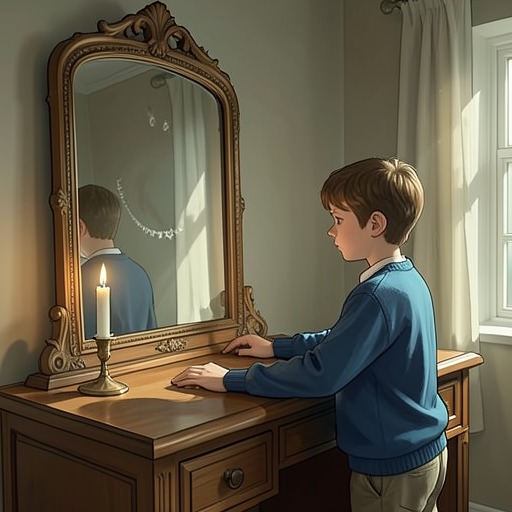
The Wife He Threw Away: A Billionaire Secret Baby, Marriage-in-Crisis, Second-Chance Grovel RomanceTheo Hart is the concealed son of Ada Hart and Sebastian Vale, and his existence changes the meaning of nearly every major conflict surrounding them. Born during the four-year separation, he begins as a secret protected by Ada and later becomes the person Sebastian must learn not to possess. His copper hair and grey eyes visibly connect him to Sebastian, but his name, upbringing, and imaginative life are shaped by Ada’s insistence that he remain Theo Hart rather than become an instrument of the Vale family. Through him, the story tests whether blood can create a family without granting anyone the right to control it.
Identity and Early Life
Theo is born at dawn in a house filled with the scents of neroli, clean sweat, and the metallic green of blood. His arrival is described as a shock of copper hair, while his eyes are grey, a detail that later becomes unmistakably significant because they are also Sebastian’s eyes. Ada names him Theo Hart, establishing a deliberate boundary between her child and the Vale inheritance. The name is not a cosmetic variation: it is the first protection against the family’s habit of turning people into extensions of its public identity.
Theo grows under Ada’s care, and the narration emphasizes his ordinary development rather than any aristocratic destiny. He draws lions, often returning to the image with intense concentration. A lion appears beneath his name on a door at the height of a small arm: a crude figure with a round body, four stick legs, grey scribbled eyes, and a mane like a sunburst. The drawing is both a child’s private emblem and an unconscious counter-image to the adult mythology of the Vale family. Where the family associates power with a polished name and the figure of the Blade, Theo makes identity by hand, changing the lion’s colors according to his own rules.
First Recognition by Sebastian
Sebastian first sees Theo as a three-year-old boy crouched in a corridor during a crowded event. Theo wears a good grey suit rumpled at the knees and grips a fat green crayon while papers lie around him like fallen leaves. He has slipped away from whoever was supposed to supervise him and is absorbed in his drawing, with his tongue caught at the corner of his mouth. The light catches his copper hair and reflects the exact impossible color associated with Ada, making the child a living link between the man’s abandoned marriage and the life that continued without him.
When Sebastian approaches, Theo studies him cautiously, as though deciding whether he is a door worth opening. Asked his name, he answers only, “Theo.” Sebastian immediately understands the truth and identifies him as his son. The recognition is not presented as a legal conclusion alone; it is a shock carried by resemblance, proximity, and the child’s existence. Ada responds by placing herself between them and guiding Theo back toward Delphine Cross, telling him to color the lion’s mane. Her instruction protects him from the adult confrontation while preserving the small world in which he feels secure.
Ada then states the terms of Theo’s identity with absolute clarity. His name is Theo Hart, not Theo Vale; he belongs to her protection; he is safe; he draws lions; and he is shy with strangers. She refuses to let Sebastian put his name on the child or brand him as part of a family campaign. Her central claim is that she built something Sebastian could not steal credit for, and that it was not a perfume. Theo therefore embodies the difference between creation and acquisition: he is not a product, asset, heirloom, or public symbol.
Custody, Boundaries, and Supervised Contact
The fear surrounding Theo is intensified by the power of the Vale family. Sebastian’s mother, Vivienne Vale, hears rumors of a woman and a child in Paris and proposes handling the matter “the Vale way,” quietly and completely. She imagines bringing the possible grandson home and removing Ada’s name from European documents. In this framework, Theo is a family claim before he is a child, and Ada is treated as an obstacle to be managed rather than as the parent who has raised him.
Sebastian initially accepts the logic that has governed his life, but Theo forces him to recognize its moral cost. During negotiations for contact, Ada insists that any meeting occur in the Maison Cendre Paris Atelier rather than a neutral hotel suite, under her rules and within a strict time limit. Theo must remain upstairs with Delphine Cross, behind a closed door, until the final black car has left the street. The arrangement turns physical space into a safeguard: the atelier is Ada’s territory, and Theo is kept outside the reach of the family machinery that might convert visitation into possession.
Sebastian’s first supervised meeting with Theo shows the beginning of his change. He arrives in a charcoal sweater instead of a suit, a small alteration that signals an attempt to remove the armor associated with his public authority. Theo hides behind Ada’s leg, revealing one grey eye while he performs his established caution with strangers. Sebastian, a man capable of intimidating executives and destroying careers, folds himself onto the atelier floor among Ada’s sample bottles. He sits cross-legged, making himself physically smaller and less threatening. The gesture does not erase the past, but it accepts that trust must be invited rather than commanded.
At the end of one supervised visit, Theo gathers his pencils into their tin and walks Ada to the door. His hand does not quite take hers, but travels beside it, suggesting an attachment expressed through proximity rather than display. The child’s restrained gesture is important because his relationship with Sebastian develops through similarly modest acts. The story does not grant Sebastian instant intimacy; it makes him remain near the threshold until Theo can decide whether to cross it.
The Child at the Center of the Family Conflict
Theo becomes the point at which the adult alliances reveal their true nature. Vivienne attempts to use him as leverage, and Chloe Beaumont’s public strategy offers to keep the child out of the scandal only if Sebastian supports her false claim to Éternel and abandons the custody question. The proposed bargain would preserve the Vale family’s reputation, Chloe Beaumont’s throne, and Sebastian’s public authority by sacrificing the truth of Theo’s parentage and Sebastian’s responsibility toward him.
Vivienne states the choice as a conflict between the Vale name and Ada with her child. Sebastian’s refusal to accept that choice marks a decisive break from the inheritance he once treated as destiny. He tells his adviser that he does not want to move against Ada and Theo as he would move against a company. He wants to earn them and refuses to take his son in the manner in which he takes companies. Theo is the one thing he will not own. The child thus changes the vocabulary of Sebastian’s power: acquisition gives way to earning, control to consent, and inheritance to responsibility.
Theo also exposes the difference between the family’s public narrative and its private behavior. Vivienne describes Ada’s silence as a calculation about money, assuming that every relationship is a negotiation over value. Her interpretation reduces love, fear, and protection to a legal demand. Against that reduction, Theo’s presence supplies facts that cannot be managed by rhetoric: he is a child who draws, hides, trusts Ada, and requires adults to make decisions around his safety rather than their reputation.
Relationship with Sebastian and Final Transformation
The relationship between Theo and Sebastian reaches its emotional turning point in the atelier. Theo sits on a stool at the large worktable, working a lion into being with a green crayon, while Sebastian sits across from him and watches instead of pursuing paperwork. The boy’s copper head is bent in concentration, and his steel-grey eyes are recognized as Sebastian’s eyes. The resemblance no longer functions as a claim to entitlement; it becomes an intimate responsibility that Sebastian cannot refuse and cannot use to justify ownership.
Theo eventually calls Sebastian “Papa” and asks whether Gaston has a crown or a hat. The question is domestic, playful, and entirely unlike the legal and commercial language that previously surrounded their relationship. Sebastian breaks down with tears at the atelier table, undone not by a takeover, threat, or loss, but by his son naming his lion. The scene completes the reversal in Sebastian’s character: the man known as the Blade of Vale Group is defeated by tenderness, and that defeat is portrayed as liberation rather than humiliation.
Theo’s role in the ending is active even when he does not understand the adult history behind it. In the Grasse jasmine fields, he runs between the rows in a striped shirt, copper hair moving through the white blossoms, arms extended like a plane as he chases a swallowtail he cannot catch and refuses to stop chasing. Ada and Sebastian watch their son in the landscape where they have made a promise to one another. Theo asks whether Sebastian is going to marry his mother again, turning the adults’ rebuilt relationship into a question voiced from the family’s new center.
Narrative and Thematic Significance
Theo is a roundening force in the larger narrative: he does not merely motivate Sebastian’s decisions, but changes what those decisions mean. Before Theo is acknowledged, Sebastian treats love as something that can be ranked against status, family approval, and strategic advantage. Afterward, fatherhood makes the old hierarchy impossible to maintain. Sebastian can renounce the Vale inheritance and still possess something more consequential: a relationship that exists only through patience, boundaries, and reciprocal recognition.
The child’s repeated lions connect private creativity with contested authorship. Ada’s central wound concerns having her creative work stolen and her identity reduced, while Sebastian has built his life around names, ownership, and institutional power. Theo’s drawings offer a third model. A lion is not a corporate mark imposed from above; it is made by a child who chooses its form and color. The grey eyes, the green crayon, the crude mane, and the name written beneath the drawing all preserve the distinction between a person and the symbol adults might want to claim.
Theo therefore represents the family that cannot be inherited like property. His blood links him to Sebastian, but his safety depends on Ada’s boundaries; his name honors Ada’s protection, but his eventual use of “Papa” creates a new bond with Sebastian; and his presence at the jasmine harvest turns the parents’ reconciliation into a future he can inhabit rather than merely a past they can repair. He is not the prize at the end of the conflict. He is the standard by which the adults’ conduct is judged, and the living proof that love must be practiced as care before it can be called belonging.