A perfume is not the flower
The Wife He Threw Away: A Billionaire Secret Baby, Marriage-in-Crisis, Second-Chance Grovel Romance“A perfume is not the flower” is the central formulation of Estelle’s teaching to Ada Hart, distinguishing a fragrance from the living material that inspires it. Its decisive significance extends beyond perfumery: the expression gives Ada a way to convert injury into knowledge, while the novel repeatedly returns to sandalwood, jasmine, and the field outside Grasse as the sensory form of love, rupture, memory, and renewal.
Origin and Meaning
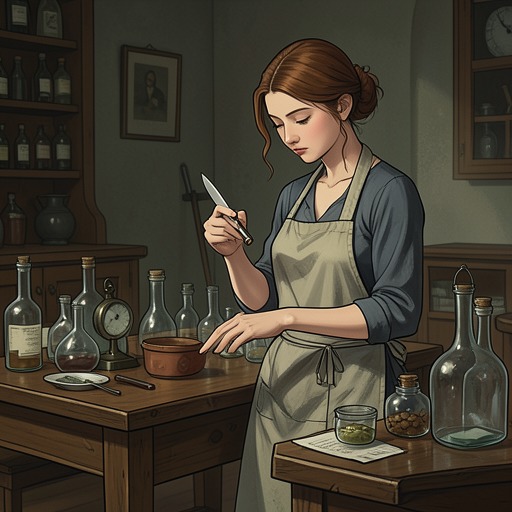
Estelle introduces the expression when she visits Ada in Paris after Ada has left Sebastian Vale and is raising six-week-old Theo Hart. Ada has entered Estelle’s atelier eight months pregnant, asking to be taught what she does not already know. Estelle sees both the exhausted new mother and the work she has produced, then tells her that she has made two things that year. The remark joins Ada’s child and her emerging creative life without reducing either to an object.
Before leaving, Estelle gives Ada a discontinued bottle of Sillage 1962, her own composition, and explains that “A perfume is not the flower, chérie. Any fool can bottle a flower while it lives. A perfume is what you distill from the flower as it dies.” The statement defines perfume as an act of transformation. It is not a literal container for beauty but the concentrated result of passing through change and loss. Estelle’s final instruction is for Ada to finish her work, and she reinforces it by giving Ada the old two-hundred-tier organ on which she built her early compositions.
The Expression as Memory
The phrase becomes inseparable from the accord that connects Ada and Sebastian. Years earlier, Sebastian had proposed to Ada on one knee in a field of night-blooming jasmine, telling her that she was the only thing in the world he could not buy. Later, while completing Éternel, Ada works with sandalwood, jasmine, and an impossible green-white sweetness; the scent carries her back to Grasse and to the field where their shared life began. She attributes the tears brought on by the memory to her pregnancy, but the fragrance has already made the past physically present.
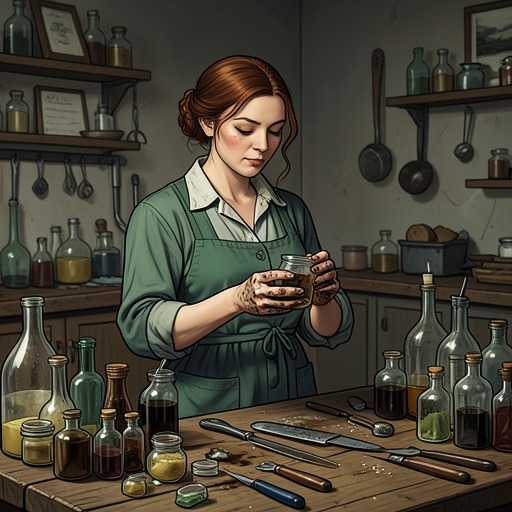
Sebastian encounters the same meaning when he enters Ada’s secret laboratory on the twenty-second floor. The two hundred bottles, her white coat, a discarded blotter, and the unstoppered mother bottle of Éternel preserve her presence in a room he had never visited. The fragrance recalls the field outside Grasse and reveals to him that Ada had bottled the best hour of his life molecule by molecule, while Chloe Beaumont stood before the public and claimed to have created it. In this form, Estelle’s lesson exposes the difference between origin and ownership: the visible launch can be staged, but the material history of the perfume remains attached to Ada’s labor and memory.
From Wound to Creation
The expression also describes Ada’s life after Sebastian’s public cruelty. At the Éternel launch, Sebastian tells her that she married up and that without the Vale name she is merely a nose in a white coat. He recognizes the words afterward as the deliberate choice of pride over truth. Ada leaves without crying, carrying the wound into a separate life in Paris, where she becomes a single mother and develops Maison Cendre with Estelle’s guidance and the inherited organ.
Estelle’s account of distillation gives that suffering a discipline rather than a sentimental justification. Ada is not told that the betrayal was harmless or that pain automatically produces art. She is told that having been burned gives her knowledge of her material. The expression therefore treats survival as labor: the damaged past must be worked, refined, and made into something that cannot be reduced to the person who caused it.
Repetition and Reconciliation
When Ada and Sebastian later rebuild Éternel essence by essence, the old accord rises from the blotter whole: sandalwood, jasmine, the green-white sweetness, the field outside Grasse, and the memory of a man promising to spend his life failing to deserve her. The recreation makes the fragrance a shared act of witnessing. Sebastian acknowledges that Ada made it and that nobody else could have done so. The accord does not erase the original theft; it makes the truth impossible to separate from the scent.
The same fragrance returns when Ada and Sebastian remarry in Grasse. Their farmhouse stands above the rows with its windows open, allowing the field’s green, white, and impossibly sweet accord into the night air. The scent that once preserved the beginning of their marriage now accompanies its deliberate reconstruction. Its recurrence is not simple nostalgia: the perfume carries the original promise, the public betrayal, the four-year separation, the discovery of Theo’s concealed parentage, and the work required before reconciliation can be accepted.
Ethical and Thematic Significance
The expression becomes an ethical contrast to Sebastian’s former habits of acquisition and control. He once treated people as possessions and allowed Vale Group to profit from Ada’s stolen authorship. After recognizing his responsibility, he releases the public audit of Éternel himself, exposing the keycard logs, notarized formulation notes, and four-year provenance chain that identify Ada as the erased creator. He accepts that clearing Ada’s name will indict him as the husband who allowed the theft.
He applies the same principle to Maison Cendre and the Vale fragrance business by transferring control without attaching a demand for Ada’s presence, gratitude, forgiveness, or return. He understands that a gift with a string becomes a leash, so he makes the arrangement unconditional and removes the family mechanism that once let a board decide whose name appeared on whose work. The distinction between flower and perfume thus becomes a distinction between possession and preservation: Sebastian’s old world seeks to own the source, while Ada’s creative world acknowledges transformation, authorship, and autonomy.
At the end, Sebastian interprets his promise to spend his life failing to deserve Ada not as a romantic flourish but as a diagnosis of his failure. He did not deserve her, and the cost was four years and nearly everything else; redemption lies not in claiming that the wound has vanished but in treating responsibility as a debt earned through daily, unphotographed actions. “A perfume is not the flower” therefore names the novel’s governing idea of renewal. What survives is not the untouched original, and neither Ada nor the marriage returns unchanged. Like a fragrance distilled as the flower dies, the rebuilt life is made from what endured transformation.