Ada Leaves Sebastian and Flees to Paris
The Wife He Threw Away: A Billionaire Secret Baby, Marriage-in-Crisis, Second-Chance Grovel RomanceAda Leaves Sebastian and Flees to Paris is the central break between Ada Hart and Sebastian Vale: a night in which professional erasure, marital possession, and the threat of inherited power become inseparable. Ada’s departure is not an impulsive disappearance but a carefully chosen refusal of the life Sebastian has arranged around her. By removing her wedding ring, abandoning the Vale name, and flying to Paris under her mother’s maiden name, she takes the first concrete steps toward an independent life, one eventually organized around her own formulas, her own credit, and the child Sebastian does not yet know exists.
Causes and Immediate Context
The rupture begins with betrayal at the Éternel launch. Sebastian had built the unmarked laboratory on the twenty-second floor during the first year of their marriage and presented it as Ada’s private kingdom, but the space exists inside the larger machinery of Vale Group. Ada has spent two years creating Éternel there, working at a tiered organ of two hundred essences and treating the finished perfume with the anxious care given to a sleeping child. On the night the world is meant to meet her creation, she is also carrying a positive pregnancy test hidden in her clutch. Her happiness is brief because the launch makes visible the structure in which her labor can be absorbed, renamed, and attributed to someone else.
Ada recognizes that the danger is larger than a stolen credit line. If she remains, Sebastian can fold the unborn child into the same system that has folded her into it: name it, brand it, and let another person receive public ownership of what Ada made. Her fear is therefore both maternal and professional. The possibility of becoming an invisible figure in the photographs of her own family repeats the erasure already imposed on Éternel. Her decision to leave joins these two forms of resistance: she will not allow either her work or her child to become another asset of the Vale inheritance.
The Departure from Sebastian
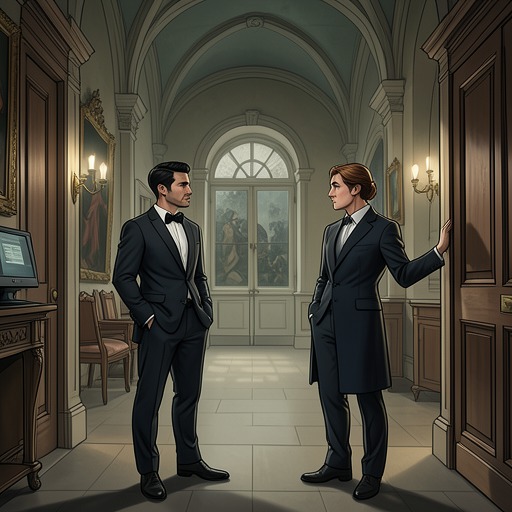
Ada’s final confrontation is marked by objects rather than spectacle. She takes her hand from the clutch, leaving the pregnancy test concealed, and accepts Sebastian’s assumption that she will become reasonable. She tells him that the Vale name was never hers, then slides the wedding ring from her finger. The ring comes away easily because she has lost weight without noticing, a physical detail that registers the strain already passing through her body. She places it on the stacked magnums, where it catches the light once before disappearing from it, and tells Sebastian to keep it for the next woman who photographs well.
She leaves through the service corridor rather than through the public theater of the gala. The route carries her past the twenty-second floor, the laboratory Sebastian built for her, and the mother bottle of Éternel breathing sandalwood and jasmine into an empty room. She does not cry until the car is three streets away, and by the time it reaches the airport she has stopped. The restraint matters: the scene does not present flight as helpless collapse, but as a controlled severing of the symbols and spaces that Sebastian believes he owns. Ada never cries over Sebastian Vale again in the immediate aftermath, making the airport not merely a place of escape but the boundary of her former emotional dependence.
Sebastian learns the practical facts only after he orders an investigation instead of calling his wife. The manifests reveal that Ada has flown commercial on the same night as the gala, taking a one-way red-eye to Paris in economy, in a middle seat in row 41 over the wing. She could have used a private jet and unlimited money, but she chooses the cheapest fare and places herself among strangers. More decisive still, the manifest does not name her as Ada Vale. It lists Adeline Rousseau, her mother’s maiden name, a name connected to the grave she has visited alone and untouched by Vale Group. To Sebastian, the discovery makes clear that she has not simply left the house; she has reached backward beyond him and recovered an identity that contains nothing of his.
Paris as an Act of Self-Ownership
Paris receives Ada without sentimentality. In the Marais, she is sick over a chipped sink, with nausea that has become a permanent tenant rather than an occasional symptom. She has only eleven hundred euros left and refuses to touch the joint accounts. When she checks them once in an internet café, seven figures of Vale money and a card capable of paying for a residence on the Île Saint-Louis appear beside one another on the screen. She closes the account and walks into the rain rather than spend money purchased with the name Sebastian has told her was never hers.
Her material choices make the break costly and therefore real. She rents a sixth-floor room without a lift, with a light-well window and a mattress that has already belonged to too many bodies. To pay the deposit, she sells the jasmine earrings Sebastian gave her after their time in Grasse. The pawnbroker on the rue de Turenne offers ninety euros for the tiny gold blossoms, and Ada accepts without allowing her voice to reveal what the sale costs. She walks away lighter by the last soft object she has permitted herself to keep, yet experiences the transaction as a form of winning because the loss has been chosen rather than imposed.
Estelle gives the escape a practical refuge without demanding immediate disclosure. Above the atelier is a cot that is cold in winter and filled with the smell of the workshop; the organ is available to Ada in the mornings before Estelle rises at six. Estelle does not force the truth from her. Instead, she recognizes that a nose like Ada’s comes from somewhere it had to leave and asks only who Ada is running from. The offer establishes the conditions under which flight becomes reconstruction: shelter, access to the instruments of creation, and a relationship not founded on confiscating Ada’s story.
Rebuilding Identity and Creative Authority
In Paris, Ada wears Adeline Rousseau publicly, using the name Sebastian discovers on the flight manifest. The assumed identity becomes a protective wall around her child. She avoids parties, photographs, and the public rituals attached to Maison Cendre’s success, allowing the press to invent her as reclusive, difficult, or ghostlike. The invented versions of Adeline serve a purpose: they draw attention toward a mystery and away from the copper-headed boy sleeping in the next room. Her secrecy is not shame about Theo Hart but a strategy for keeping him outside the reach of the world and the Vale dynasty.
Ada refuses, however, to conceal authorship of the work itself. Every flacon, ledger, and press line carries the credit “A composition by A. Rousseau.” The name is deliberately modest in form but absolute in function. It excludes the familiar image of a muse, the white-clad woman receiving applause, and the public transfer of Ada’s labor to someone else. She has learned the cost of allowing another woman’s name to occupy the place that belongs to her, and she would rather close Maison Cendre than repeat that exchange.
This principle becomes the foundation of Maison Cendre’s rise. Delphine Cross handles buyers, profiles, and the men who approach a house run by two women without a dynasty behind them, while Ada stays at Estelle’s organ and builds. Their partnership reverses the arrangement that failed Ada at Vale Group: Delphine takes the public world so Ada can retain control of the bench, the formulas, and the act of making. Maison Cendre grows quietly, and Theo grows alongside it. The child Ada protected through concealment becomes part of a life whose economic and creative center no longer belongs to Sebastian.
Sebastian’s Pursuit and the Boundaries of Return
Sebastian responds to the flight according to the habits that caused it. When he suspects that the copper-haired boy has his eyes, he moves meetings, delays people in Milan, and begins orbiting the Marais to watch Maison Cendre from a distance. His method is surveillance presented to himself as caution. After a near encounter with Theo, he returns to the familiar solution of purchase: he flies jasmine from Grasse, pays the growers four times the ruin he is causing them, bypasses customs, and fills Maison Cendre with ten thousand stems of the flower associated with his former promise to Ada. When flowers prove temporary, he buys the building and transfers its freehold to Adeline Rousseau for one euro, describing the act as protection. The gesture exposes the continuing confusion at the heart of his conduct: he tries to make Ada safe by owning whatever might threaten her.
Ada rejects the logic directly. She tells Sebastian that Maison Cendre and Vale Group might conduct business through distribution or a house account, but only through contracts and at arm’s length. The man must stop; the flowers, the purchased restaurant, and his presence outside Theo’s school must stop. The wife is not available for negotiation because Sebastian has already thrown her out. Her proposed commercial channel is not forgiveness. It is surveillance turned around: a contract gives her a narrow, legible form of contact through which his next move can be read and controlled. The escape therefore changes the balance of power even before any formal merger. Ada is no longer a hidden creator asking for recognition; she is an owner setting terms that Sebastian must either accept or lose everything.
Sebastian’s later legal pursuit confirms the stakes of the original flight. He has private counsel search for a route to custody, using jurisdiction, the alias on Theo’s birth documents, and a manufactured pattern of instability to construct a case against Adeline Rousseau. The proposed strategy would use the Vale name and money to acquire the child as the family machine has acquired other things. He ultimately ends the engagement and orders the file closed, but the threat shows why Ada’s disappearance was necessary: the power she fled can follow her across borders, through contracts, investigations, property, and custody law.
That danger returns when Chloe Beaumont’s lawyer offers Sebastian a bargain. Chloe is prepared to claim publicly that she created Éternel and that Adeline Rousseau is a fantasist who abandoned her son to pursue a founder’s myth. In exchange for Sebastian’s public support and his abandonment of the custody question, Theo would remain outside the dispute. Chloe has reached for the child as a hostage, proving that Ada’s fear of powerful adults turning Theo into an instrument is not imagined. Sebastian must choose whether to protect his inheritance and former alliance or refuse to let his son be used as furniture. The later possibility of a relationship between Ada and Sebastian can therefore exist only after the control that produced the flight is confronted, limited, and renounced.
Consequences and Significance
Ada’s flight converts a private marital breakdown into the founding condition of Maison Cendre and of her public identity as a creator. She leaves the laboratory Sebastian built, but carries its central knowledge with her: the organ, the nose, and the ability to compose. In Paris, she turns deprivation into autonomy, declining seven figures of shared money, selling the jasmine earrings, and protecting the one resource that cannot be taken from her without her consent—the credit attached to what she makes.
The event also establishes the novel’s recurring contrast between possession and authorship. Sebastian understands safety through acquisition: he buys flowers, buildings, legal expertise, and eventually imagines custody as another structure that can be secured. Ada understands safety as the power to refuse, to keep her name on her formulas, and to decide the terms under which another person may approach her. Her departure does not erase the marriage, the pregnancy, or the history of Éternel; it prevents those things from remaining entirely inside Sebastian’s system.
For that reason, Ada Leaves Sebastian and Flees to Paris is both an ending and a beginning. It ends the marriage as Sebastian knows it, removes Ada from the Vale Group hierarchy, and leaves the laboratory empty behind her. It begins the period in which Adeline Rousseau becomes a shield, Maison Cendre becomes an independent house, Theo Hart becomes the child whose safety governs Ada’s secrecy, and authorship becomes a non-negotiable condition of every future partnership. The flight’s decisive achievement is not escape alone. It is the creation of a life in which what Ada makes, what she is called, and whom she protects no longer belong to Sebastian Vale.