Estelle's Perfume Organ
The Wife He Threw Away: A Billionaire Secret Baby, Marriage-in-Crisis, Second-Chance Grovel RomanceEstelle's Perfume Organ is the central composing instrument of Estelle's atelier and the material inheritance through which Ada Hart's broken past becomes a new artistic and commercial life. First encountered among at least two hundred bottles in an atelier described as a cave of scent, the organ embodies a tradition of disciplined perception; when Estelle gives it to Ada Hart, it becomes the foundation of Maison Cendre and later the physical site where stolen authorship is recovered. Its significance lies in the way it makes creative identity tangible: formulas may be transferred, titles manipulated, and public stories falsified, but the organ preserves the trained hand and sensory grammar that produced the work.
Appearance and Sensory Function
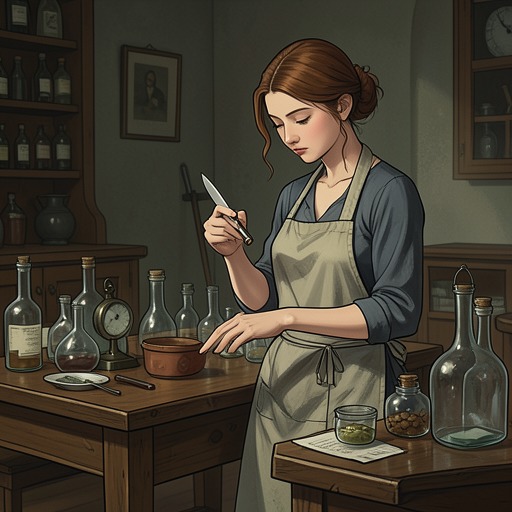
The organ stands at the center of Estelle's working world, surrounded by bottles ranked across a curved structure darkened by a century of hands. Estelle's atelier contains at least two hundred bottles, and the air above them forms a chord that Ada Hart can read blindfolded. The instrument therefore operates less like a passive cabinet than like a vocabulary arranged in physical space. Its essences are not merely stored; they are differentiated, remembered, and tested through the nose, the hand, and the sequence in which a perfumer reaches for them.
Estelle establishes the organ's standards through an examination of Ada Hart's perception. Before Ada Hart has finished her tea, Estelle asks her to identify the shop by smell rather than sight. Ada Hart distinguishes bergamot over the door, iris butter, real ambergris, beeswax, old civet in a distant cupboard, and galbanum beneath everything else. The test reveals that she can interpret the organ's environment as a structured composition, while Estelle recognizes in that accuracy a talent that could not have appeared from nowhere. The instrument thus becomes the setting in which Ada Hart's concealed identity is first acknowledged without being forcibly exposed.
Estelle's Gift and Maison Cendre
Estelle offers Ada Hart a cot above the atelier and morning access to the organ, allowing her to work without surrendering her anonymity. The arrangement makes the instrument an instrument of shelter as well as composition. Ada Hart arrives with no name Estelle can trust and no story Estelle can verify, but Estelle treats her nose as evidence of a life that had to leave somewhere. The organ gives that displaced ability a place to continue.
That relationship becomes decisive the following spring, when Estelle gives Ada Hart her old organ, the two-hundred-tier bench on which she built her early years. Estelle's instruction is deliberately spare: Ada Hart is told only to finish the work. Ada Hart does so, and the gift becomes the first concrete basis of her independence. She names the new house Maison Cendre, or Ash, defining ash as what the fire could not take. The organ's passage from Estelle to Ada Hart therefore carries a philosophy of survival: the instrument is not a relic of what has been lost, but the means by which what survived can be distilled into a new form.
The first scent Ada Hart creates under Maison Cendre is Revenant. The organ makes that transformation possible while preserving the distinction between inheritance and imitation. Ada Hart does not simply reproduce Estelle's career; she uses the gifted bench to build a house whose name, formulas, and authorship are publicly hers. The object becomes a counterweight to the earlier theft of Éternel, where Sebastian Vale allowed Chloe Beaumont to receive the credit for work Ada Hart had made molecule by molecule.
Expansion and Creative Ownership
Four years later, the organ has grown with Maison Cendre. In Ada Hart's Paris atelier, it runs the length of the north wall and holds three hundred essences, each keyed in her own hand rather than protected by a secret thumbprint lock. The change from two hundred tiers to three hundred essences records both technical development and a changed theory of ownership. Estelle's organ began as an inherited instrument of guarded knowledge; under Ada Hart, it becomes an openly named working system. Everything in the room bears Ada Hart's name where the world can read it, in direct contrast to the obscured authorship of Éternel.
The organ also explains why Maison Cendre cannot be reduced to a marketable face or transferable corporate asset. When Vale Group's fragrance arm declines by forty percent year over year and Maison Cendre sells out across three continents in a weekend, Sebastian Vale proposes acquiring the Paris house. The delegation comes to buy every accord and formula, remove Ada Hart's name from the door, and absorb the value of the instrument's creative output into Vale Group. Ada Hart receives them at the head of her own table, determined that the people attempting to purchase her work should experience her ownership rather than assume it.
The contrast is sharpened by the machinery that once normalized the theft of Éternel. Sebastian Vale had accepted the claim that Ada Hart was a chemist rather than the public face a four-hundred-million-dollar brand required; legal paperwork later named Chloe Beaumont creative director of Maison Éternel, and a standard spousal-disclosure form required Ada Hart's particulars while her actual authorship remained unacknowledged. Against those institutional substitutions, the organ offers a stubbornly physical record of who knows the materials, who can manipulate them, and whose hand has developed the formulas.
Reconstruction of Éternel
The organ becomes evidence during the audit of Éternel's true creation. In Maison Cendre's back laboratory, the proof is scattered across four years, two hundred essences, and a mother accord that exists nowhere on paper because Ada Hart never wrote it down. To prove that she created Éternel, Ada Hart must make it again. The organ provides the working surface for that reconstruction, while Sebastian Vale is the only other living person who watched the original composition happen.
Their collaboration restores an old creative shorthand. Sebastian Vale begins with Mysore sandalwood because Ada Hart always started with the ground and built the sky afterward. Ada Hart calls for Grasse jasmine, specifically the night-bloom absolute, and Sebastian Vale supplies the green note that keeps the jasmine from becoming soapy. He remembers her description of it as the leaf that remembers the flower. Their movements return to the habits of the good year: Ada Hart names essences, Sebastian Vale tracks their ledger; he warns that too much iris will drown the jasmine; she reaches for a bottle already in his hand. The organ therefore does not merely contain evidence. It prompts a shared sequence of skilled actions that a false public narrative cannot reproduce.
The reconstruction also gives the object a role in the legal and moral reversal of the story. Chloe Beaumont's claim depends on a name, a campaign, a gala, and institutional paperwork, while Ada Hart's claim can be demonstrated through the repeatable knowledge embedded in the accord. The organ makes authorship measurable without reducing it to a signature. It joins sensory memory to material procedure, turning private history into public proof.
Memory, Reconciliation, and Symbolic Meaning
At the later confrontation between Ada Hart and Sebastian Vale, the organ remains in the atelier that had served as Ada Hart's armor for four years and that no Vale had been allowed to enter. When Sebastian Vale is finally inside it, the instrument releases its notes into the space between them: sandalwood, orris, and crushed green leaf. These materials form the vocabulary Ada Hart built to express what she could not say directly, so the organ gives emotional memory a physical and almost verbal form.
Its repeated association with jasmine and sandalwood links the present to the launch of Éternel and to the earlier promise in the Grasse jasmine fields. The same creative materials that once appeared in a public lie return as instruments of truth. When Sebastian Vale repeats the proposal vow, the remembered words are not detached from the object-world of perfume: the crystal-lit launch, the jasmine field, the organ, and the reconstructed accord all become parts of one chain of memory. The organ helps shift the past from a private wound into evidence that can be tested, shared, and reinterpreted.
Estelle's Perfume Organ therefore stands at the meeting point of craft and agency. It is an inherited object, but not a static heirloom; it changes hands, expands from two hundred tiers to three hundred essences, carries Ada Hart from concealment into public authorship, and enables the recovery of Éternel's true creator. Its deepest force comes from refusing the separation between material practice and personal history. Every bottle reached for, every note balanced, and every remembered gesture makes the organ an active participant in the struggle over who may claim a life made by hand.