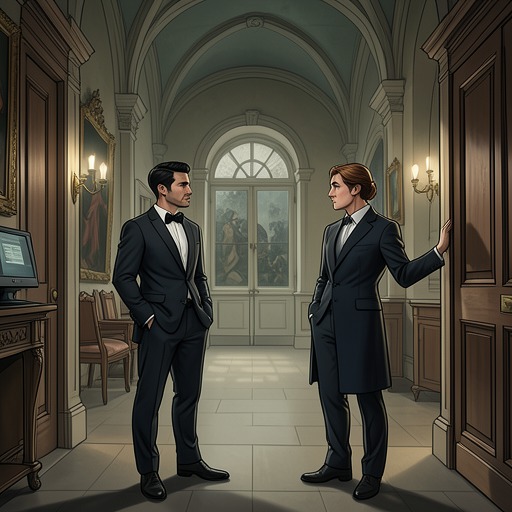
the four-year separation
The Wife He Threw Away: A Billionaire Secret Baby, Marriage-in-Crisis, Second-Chance Grovel Romancethe four-year separation is the decisive interval between Ada Hart’s departure from Sebastian Vale and the revelation that Theo Hart is Sebastian’s son. It is not merely an absence between spouses. During these four years, Ada converts humiliation into authorship, motherhood, and ownership, while Sebastian is forced to confront the fact that the marriage he believed he had controlled was destroyed by his own choice. The separation therefore functions as the story’s moral and material hinge: Ada leaves with almost nothing and builds Maison Cendre, while Sebastian keeps the Vale empire but loses access to his wife, his child, and the truth about what he helped destroy.
Origin in the Éternel Launch
The separation begins at the Éternel launch gala, where Sebastian publicly elevates Chloe Beaumont over Ada and then privately makes the insult that completes the rupture. Ada has spent two years creating Éternel in the secret laboratory Sebastian built for her on the twenty-second floor of Vale Group Headquarters, a room keyed to her thumbprint and filled with the two-hundred-essence organ on which she constructs her perfumes. The laboratory had once represented a rare space of trust within the marriage, but the launch turns her work into property that can be reassigned by men with institutional power.
Sebastian remembers the decisive exchange with unusual clarity. After Chloe’s public crowning, he tells Ada that she has married up and that, without the Vale name, she is merely a nose in a white coat. He recognizes that he could still retract the words and invite her home, but chooses pride instead. Ada does not cry. She leaves through the service corridor while carrying the secret of her pregnancy, and Sebastian does not understand that his dismissal has separated him not only from his wife but also from the child she is carrying.
The interval is intensified by deliberate silence. Sebastian later understands that Ada was five weeks pregnant when she stood before him with her hand inside her clutch, and that his coldness helped determine what happened next. He had called his public composure strength, but the four-year separation makes him recognize it as cowardice protected by status. His later remorse depends on this belated recognition: the separation is not presented as an accident or a misunderstanding alone, but as the consequence of a choice made in front of six hundred people and forty cameras.
Ada’s Exile and Reconstruction
Ada leaves with a portfolio, a thrown wedding ring, and no intention of using the financial resources available through the marriage. In Paris, she has eleven hundred euros left and refuses to touch the joint accounts, even after seeing seven figures of Vale money and a card capable of paying for an expensive home on Île Saint-Louis. The money is legally accessible, but to Ada it remains Sebastian’s money and Sebastian’s name. She chooses the more dangerous freedom of having less over the security that would preserve her dependence on the man who told her the Vale name was the source of her worth.
Her first room is on the sixth floor, without a lift, with a light-well window and a used mattress. Because she cannot afford the deposit, she sells the jasmine-stud earrings Sebastian gave her after their time in Grasse. The pawnbroker offers ninety euros, and Ada accepts without allowing her voice to reveal what the sale costs. This small transaction gives the separation a concrete economic dimension: independence is not an abstract declaration but a sequence of surrendered comforts, physical exhaustion, and decisions made without a safety net.
Estelle provides the first practical shelter that does not demand ownership in return. Above the atelier, she offers Ada a cot, access to the organ in the mornings, and a place within the workshop despite knowing that Ada will give her no reliable name or verifiable story. Estelle’s condition is limited to one true thing: she wants to know whom Ada is running from. The arrangement allows Ada to preserve both her secret and her craft. Her nose, as Estelle observes, has come from somewhere Ada had to leave, and the atelier becomes the place where the abandoned creator can work without surrendering the credit for what she makes.
Ada builds Maison Cendre under her mother’s maiden name, Adeline Rousseau, a public identity untouched by Vale Group. She avoids parties, photographs, and even the triumphs of the house, allowing the press to invent her as reclusive, difficult, or ghostlike. The concealment has a precise purpose: every invented version of Adeline becomes a wall protecting the copper-haired boy asleep nearby. Ada refuses to make Theo Hart visible before she can control the conditions of his safety.
Her refusal to surrender authorship becomes the governing principle of Maison Cendre. Every flacon, ledger, and press line carries the credit “A composition by A. Rousseau.” There is no substitute muse and no woman in white receiving Ada’s work beneath a spotlight. Delphine Cross handles buyers, profiles, and representatives of the fragrance trade, allowing Ada to remain at the bench with Estelle’s organ and create. Maison Cendre grows quietly, while Theo grows beside it, drawing lions on walls, flacon proofs, and even valuable contracts. His copper hair recalls Ada; his steel-grey eyes recall Sebastian, preserving the absent father in a feature Ada cannot compose away.
The Separation as a New Ground
Ada’s four years apart are defined by the creation of new ground. She describes leaving as a skill whose mastery costs the ground beneath one’s feet, yet she refuses to tear up the ground she has rebuilt merely because Sebastian has finally learned to recognize her hands. The statement captures the interval’s central reversal. At the gala, Sebastian treated the Vale name as the condition of Ada’s value; in Paris, Ada proves that her value can generate a house, a livelihood, a protected childhood, and a name that belongs to her work.
The new life is also deliberately full enough to conceal the absence of its missing parent. Theo is three when Maison Cendre reaches its fourth year. His world consists of Ada, Delphine, lions, and the smell of iris drifting up the stairs. Ada has built a life so complete that he has not yet felt the man-shaped absence within it. This protection is loving but precarious: the concealed parentage cannot remain separate from the commercial and familial world forever, especially once Vale Group comes to Paris to buy the one house it cannot defeat.
The approaching confrontation first appears as movement across distance. Nine hundred kilometers away, a Vale Group jet turns east toward Paris with Sebastian aboard rather than a deputy. He has learned that Maison Cendre is connected to the creator of Éternel and begins orbiting the Marais, watching the blue-doored street on Rue de Poitou from a distance. For three days he sees Delphine Cross, Ada at a window with a blotter at her nose, and the door opening onto a life sealed against him. The separation has made Ada’s ordinary domestic world something Sebastian can only observe from outside.
When Sebastian enters the atelier, Ada establishes the terms that the marriage once denied her. She allows that Maison Cendre and Vale Group might conduct business through distribution, house accounts, contracts, and lawyers, but she rejects any personal access disguised as commerce. He must stop the flowers, the purchased restaurant, and the presence outside Theo’s school. A supplier relationship may be considered on paper and at arm’s length; the wife is not available for negotiation. The four-year separation has changed the meaning of refusal: Ada now possesses alternatives, and Sebastian can no longer turn financial reach into emotional authority.
Recognition and Its Cost
The separation ends in stages, beginning with Sebastian’s recognition of Theo. When Ada says the boy’s name, the arithmetic completes itself: four years, a June departure, the empty ring on the stacked magnums, and Ada’s pregnancy at the gala. Sebastian sees the copper hair and his own grey eyes, and realizes that Theo is his son. The physical recognition is immediate even though the emotional understanding arrives with violence; Sebastian’s hands know before his mind can speak, and his desire to protect the wary child is inseparable from the devastating knowledge that Theo is afraid of him.
The revelation transforms Sebastian’s interpretation of the entire interval. He understands that Ada did not merely leave a husband; she took his unborn son into a life he had refused to learn for four years. In the hotel suite, he reconstructs the Grasse proposal, the gala, the public credit stolen from Ada, and the moment he deliberately showed her nothing while the board watched. The four-year absence becomes a delayed testimony against him. It exposes how his attachment to control, reputation, and the Vale mask converted intimacy into a hierarchy and made his own child’s first message to him a retreat behind Ada’s leg.
Sebastian’s response is not allowed to remain a private emotional awakening. He accepts supervised contact with Theo and must approach fatherhood through the child’s fear rather than through inherited authority. Later, while helping Theo draw a lion, he gets down on the floor and teaches him how to bend the legs so the figure can stand and carry weight. The gesture contrasts with the old Sebastian, who would have considered the floor beneath him. The four-year separation has made small, unphotographed acts the measure of responsibility, replacing the public performance of power that caused the rupture.
Repair, Ownership, and Significance
The interval also changes the economic and ethical terms of any possible reunion. Sebastian releases the Éternel audit himself, sending the forensic report through Vale Group’s communications office rather than arranging a deniable leak. The report identifies keycard logs, notarized formulation notes in handwriting that is not Chloe Beaumont’s, and a four-year provenance chain repeatedly opened through Ada’s thumbprint. It states that Chloe was never the creator of Éternel, that Vale Group knew it, and that the correction is overdue. By making the fraud public, Sebastian accepts that clearing Ada’s name will also identify him as the husband who allowed the theft.
Ada answers not by returning to the old structure but by proposing an equal merger between Maison Cendre and Vale Group’s fragrance division. Her formulas and name must appear publicly and permanently in the founding documents, and Chloe’s name must be removed from everything. She demands fifty-one percent control of the division bearing her perfumes, because she built it molecule by molecule while the men around her forgot she existed. The four-year separation thus produces a new institutional boundary: Ada can enter the Vale sphere only on terms that prevent another person from holding the key to a kingdom she made.
Sebastian’s contribution is meaningful because it is designed not to create dependence. He signs the entire fragrance house into the merged entity, removes the board’s approval mechanism, and establishes full creative and commercial control, the founder’s seat, and an independent authority answerable to no Vale. Most importantly, he excludes every hidden claim on Ada’s presence: there is no contact provision, no condition that she accept him, and no board seat reserved for a reconciled Mrs. Vale. He recognizes that a gift carrying a string becomes a leash, so he makes the transfer unconditional, even if Ada never speaks to him again.
The four-year separation therefore remains present after physical reunion. It is the period that gives Ada the power to refuse, gives Theo a history independent of Sebastian, and gives Sebastian a debt that cannot be discharged by a single apology or romantic gesture. Sebastian later admits that he had failed catastrophically and that the failure cost four years and nearly everything, but he changes the meaning of failure by treating it as a debt to be paid daily. The interval ends not when the past disappears, but when its consequences become the terms on which marriage, fatherhood, authorship, and business must be rebuilt.