Paddler
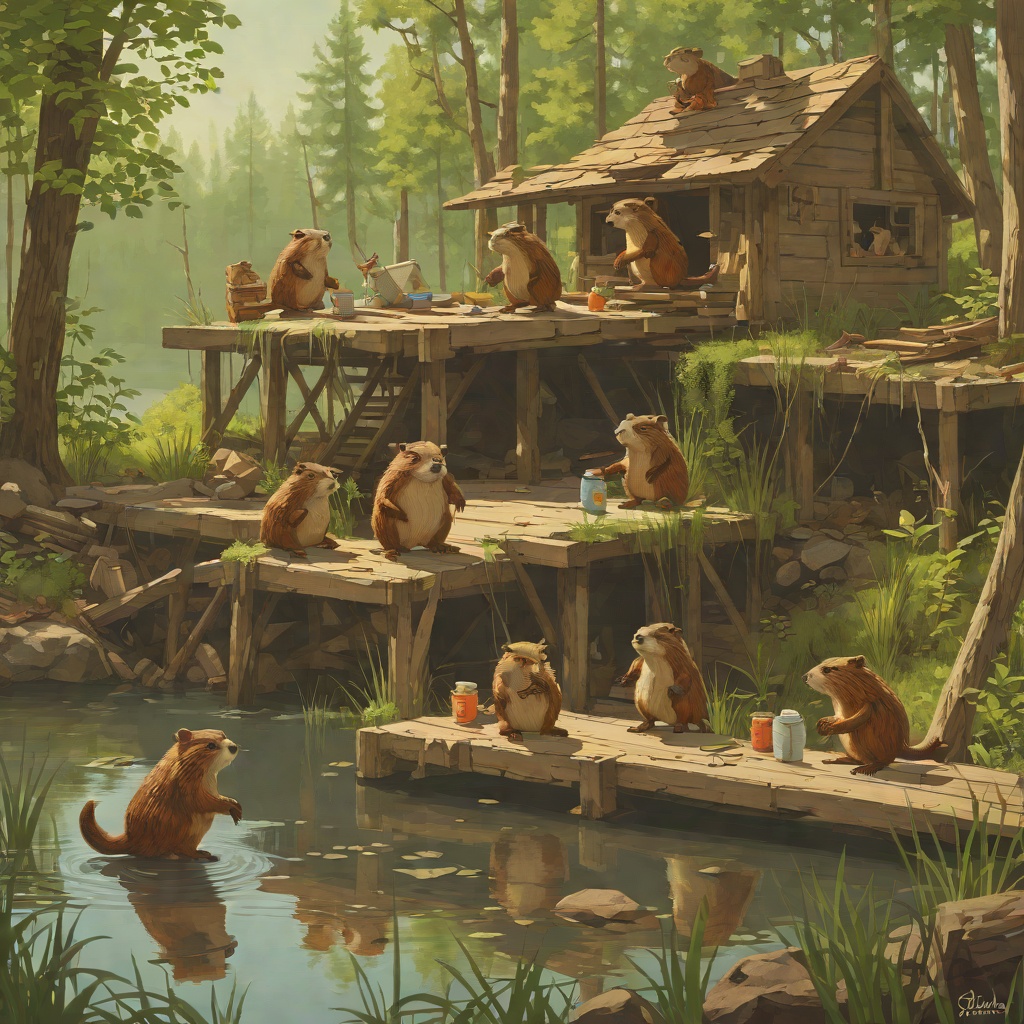
The Wild RobotPaddler is the young beaver son of Mr. and Mrs. Beaver, a minor but pivotal character in the island community. Though he appears in only a few scenes, his role is disproportionately important: he is the first creature to openly affirm Roz's virtue, and his near-fatal encounter with a predatory fish becomes the catalyst for one of the robot's most significant acts of compassion. Through Paddler, the novel explores themes of empathy, understanding, and the quiet power of a gentle voice in a world quick to judge.
Identity and Introduction
Paddler is introduced during a tense moment at the beaver pond. Roz has just thrown a tree into the water, startling the beavers, and has declared, "Je ne suis pas un monstre... Je suis un robot." As Brightbill, the gosling Roz has adopted, calls out for food, a calm voice asks, "L'oison pense que tu es sa mère ?" It is Paddler, the son of Mr. and Mrs. Beaver, who speaks. His question is not accusatory but curious, marking him from the start as a creature of observation rather than fear. When Roz explains that Brightbill's real mother is dead and that she has adopted him, Paddler responds with a brief silence followed by a remarkable statement: "Tu es un très bon robot pour prendre soin de Brightbill." This simple, sincere compliment stands in stark contrast to the suspicion and confusion of the adult beavers, who cannot understand why Roz's kindness matters to them. Paddler's instinctive recognition of goodness establishes him as a figure of innocence and moral clarity within the community.
The Rescue at the Pond
Paddler's most dramatic moment comes during a quiet spring, a season marked by death and renewal. The narrative notes that many creatures had died during the winter, their bodies revealed as the snow melted, feeding the soil and creating the most dazzling spring bloom the island had ever known. It is in this context of natural harshness that Paddler finds himself in mortal danger. One day, his cries ring out across the pond: "Aide! Aide! Il a ma queue !" He is splashing and screaming, and his parents are nowhere to be seen. Roz, hearing the commotion, picks up a fallen tree branch and wades into the shallows. She offers the branch to Paddler, who seizes it with his large teeth, and the robot lifts him out of the water. There, hanging from the young beaver's tail, is Rockmouth, the grumpy old pike. With a quick motion, Roz pulls the branch and grabs the fish with both hands, freeing Paddler, who collapses into the water as his parents suddenly appear. The rescue is swift and decisive, but its aftermath reveals the deeper currents of the story.
The Voice of Empathy
In the confrontation that follows, Mr. and Mrs. Beaver are furious, demanding that Roz throw Rockmouth to the vultures. The old pike, it turns out, had been displaced from his home and was lashing out in frustration. It is Paddler, still recovering from his ordeal, who speaks with unexpected wisdom. "Je serais bouleversé aussi," he says softly. "Je détesterais être éloigné de chez moi. M. Rockmouth, vous auriez dû dire quelque chose plus tôt !" The fish looks up from the puddle with a frustrated expression that seems to say, "J'ai essayé, mais personne n'écoutait." Paddler's empathy for his attacker is striking: even after being nearly dragged underwater, he can imagine the pike's suffering and offer understanding rather than anger. His words reframe the entire conflict, shifting it from a simple case of aggression to a tragedy of displacement and miscommunication. This moment reveals Paddler's character as one of remarkable emotional intelligence, a young creature who instinctively understands that even predators act from pain.
Catalyst for Roz's Journey
Paddler's empathy does more than soothe a tense moment; it sets the stage for Roz's next great undertaking. The situation, the narrative notes, needed to be remedied, and Roz was determined to bring Rockmouth home. After exploring the nearby waterways, it became clear that she would have to carry the pike across the forest and through the Great Prairie to the nearest bend in the river. This journey, born directly from Paddler's compassionate plea, becomes a testament to the young beaver's influence. His simple act of understanding—his refusal to demonize Rockmouth—inspires the robot to undertake a difficult and selfless mission. In this way, Paddler functions as a moral catalyst, his gentle wisdom redirecting the narrative toward compassion and resolution. Though he is a minor character, his impact resonates far beyond his brief appearances, shaping the actions of the protagonist and reinforcing the novel's central theme that understanding, not vengeance, is the path to healing.
Narrative Role and Significance
Within the larger structure of the story, Paddler serves as a counterpoint to the adult beavers' skepticism and a bridge between the animal community and the strange robot in their midst. His initial compliment to Roz—"Tu es un très bon robot"—is one of the first genuine acceptances she receives, planting a seed of belonging that grows throughout the narrative. His later empathy for Rockmouth demonstrates that the island's younger generation is capable of a moral sophistication that their elders often lack. Paddler embodies the novel's quiet optimism: the belief that kindness and understanding can emerge even in the most unlikely places, and that a single compassionate voice can redirect the course of events. Though his appearances are few, Paddler's character is essential to the book's emotional and thematic architecture, a small but luminous figure whose words carry weight far beyond his size.