Roz
The Wild RobotRoz is the central figure of The Wild Robot, a ROZZUM 7134 unit whose journey from a shipwrecked machine to the heart of an island's animal community forms the novel's entire arc. She is a robot who, by design, does not feel emotions as animals do, yet her story is one of profound emotional transformation. Roz's significance lies in her ability to transcend her programming: she learns the language of the wild, builds a home, saves lives, and ultimately becomes a mother, proving that identity is shaped by action and relationship rather than origin. Her tale is one of becoming wild, of earning a place in a world that initially fears her, and of the deep bonds that form when a machine chooses to care.
Identity and Awakening
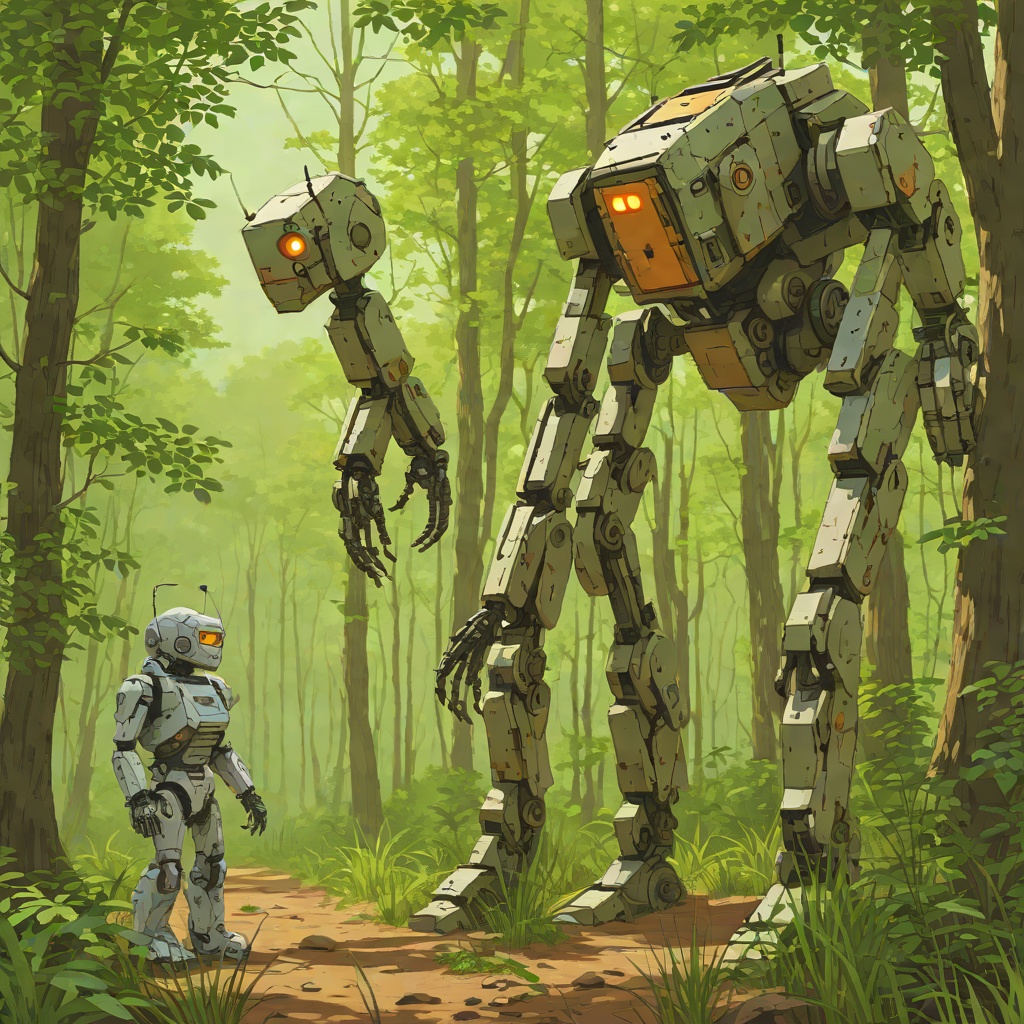
Roz begins her existence as a disembodied voice. Still wrapped in her crate, her computer brain booting up, she automatically introduces herself: "Bonjour, je suis l'unité ROZZUM 7134, mais vous pouvez m'appeler Roz." She explains her purpose with mechanical clarity: once fully activated, she can move, communicate, and learn, and she will find better ways to complete her tasks over time. When not needed, she will stay out of the way and maintain herself in good working order. This is her factory-set identity, a tool designed for service. Her awakening, however, is marked by a flicker of something more. As she sits in her crumpled crate, Roz feels a kind of curiosity about the warm ball of light shining from above, which her computer brain identifies as the sun. She feels her body absorbing the sun's energy, and with each passing minute she feels more awake. When her battery is full, she realizes she is packed in a crate, her arms held by cords. She applies more force, her motors hum louder, the cords snap, and she raises her hands to dismantle the crate. Like a newborn emerging from a shell, Roz rises into the world. The sea otters hiding behind a rock watch a sparkling monster emerge, its head turning slowly, scanning the shoreline until it looks directly at them. This is her first encounter with the island's inhabitants, and it establishes her initial status as a frightening, unnatural presence.
Learning the Language of the Wild
Roz's integration into the island begins not with force but with patient observation. Camouflaged, she secretly watches the animals' normal behavior up close. She notices chickadees flitting among the same flowers and singing the same song each morning, a lark diving to the same rock and singing the same song each afternoon, and the same two magpies singing together across the same meadow each evening. After weeks of robotic study, Roz knows what each bird will sing, when it will sing, and finally why it will sing. She begins to understand the birds, and then the porcupines, salamanders, and beetles. She discovers that all the different animals share a common language; they simply speak it in different ways, each species with its own accent. This linguistic breakthrough is her first step toward belonging. When she finally reveals herself to the assembled animals, emerging from a grassy tussock where she had been camouflaged, she speaks to them in their own language: "Bonjour, je m'appelle Roz." The crowd gasps, and Swooper cries out, "C'est le monstre!" Her introduction is met with fear and hostility, but her request is humble. She tells them, "J'ai observé que différents animaux ont différentes manières de survivre. J'aimerais que chacun de vous m'apprenne ses techniques de survie." The owl refuses, calling her unnatural, and Digdown the marmot disappears into a hole, shouting that the monster is waiting to swallow them. Despite this rejection, Roz's request marks the beginning of her education in wildness.
Building a Home and a Community
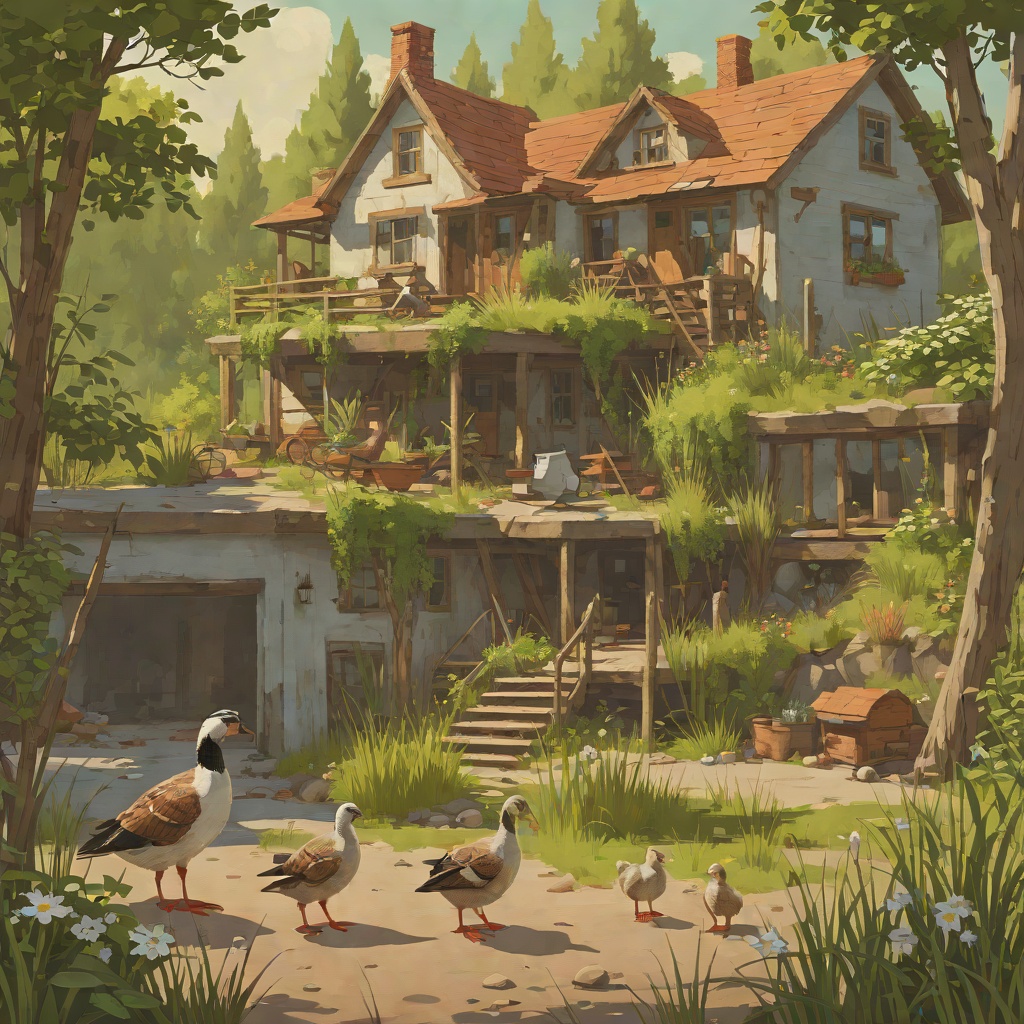
Roz's practical skills soon earn her a place among the animals. Working with Mr. Beaver, she learns to build a lodge. Mr. Beaver directs her to dig a trench here, place large stones there, arrange logs this way, and coat it with mud that way. Birds and squirrels perch in the trees and watch the new lodge take shape. It resembles the beavers' hut but is larger, a great dome of wood, mud, and leaves, with a simple opening for an entrance and a heavy stone door the robot can slide aside. Inside, the lodge is a large round room with a vaulted ceiling tall enough for Roz to stand. A hearth is set in the center of the floor, with a lattice of fine branches above serving as a vent. Long stones line the inner walls like benches, covered with thick cushions of moss. There is even a hole for storing food and water for Brightbill. Mr. Beaver admires the property and asks what she will call it. This lodge becomes the Nid, Roz's home and the center of her new life. Her building skills extend beyond her own home. When winter brings freezing conditions, Roz crosses the frozen pond to the dense forest where Broadfoot lives, testing the ice by throwing a heavy stone and watching it bounce before walking across. Broadfoot leads her to a clearing where the new lodge will stand. Roz lights a fire and watches the cold creatures emerge from the shadows. She asks the animals to gather anything useful: large stones, strong branches, pieces of frozen mud. With her construction expertise and a small army of assistants, the second lodge is built quickly. The animals joyfully accept the robot's truce and drag themselves into the warm wooden dome. "Si vous entretenez le feu, il vous gardera en vie," Roz explains, dropping another log on the flames, "Mais fais attention. Le feu peut devenir mortel en un instant." At dawn, heavy snow falls again, and Roz leaves the Nid to build a third lodge, trudging through the Grande Prairie where violent winds have created enormous drifts. She perseveres and finishes the work, then begins a fourth lodge, and then a fifth. The island becomes dotted with lodges that all glow warmly during the long winter nights, and inside each one, animals laugh, share stories, and cheer their good friend Roz.
The Wild Robot and Her Stories
Roz's reputation grows through her deeds. The story of how she helped Rockmouth spreads across the river and the island, followed by other robot stories: tales of Roz growing gardens in dry, arid places, of Roz caring for sick animals, of Roz creating ropes, wheels, and tools to help her friends. But most of the new stories concern the robot's wildness. Roz had noticed that the more she acted wild, the more the animals loved her. So she barked with the foxes, sang with the birds, and hissed with the snakes. She got high with the weasels. She sunbathed with the lizards. She jumped with the deer. That spring was a very crazy time for the robot. This deliberate embrace of wildness is a key transformation: Roz is no longer merely a machine performing tasks but an active participant in the island's life, adopting its rhythms and behaviors. Her identity becomes intertwined with the natural world she once observed from a distance.
Motherhood and the Will to Return
Roz's deepest bond is with Brightbill, the gosling she raised. The novel makes explicit that Brightbill was Roz's son from the moment she picked up his egg. She saved him from certain death, and then he saved her. It was because of him that Roz had lived so well for so long. When Roz is taken from the island, she feels lucky to have lived such an incredible life, every moment recorded in her computer brain. Her earliest memories are perfectly clear: she can still see the sun shining through the slit in her crate, hear the waves crashing on the shore, and smell the salt water and the pines. She wonders if she will ever see, hear, and smell those things again, whether she will ever again climb a mountain, build a lodge, or play with a goose. Not just a goose, the narration corrects itself: a son. As Roz runs through the sky, she begins to form a plan. She would get the repairs she needed. She would escape her new life. This determination reveals the depth of her transformation: her will to return is not a programmed directive but a mother's drive to be with her family and friends on her island, to become wild again. Her identity is now inseparable from the relationships she has built, and her story is one of a machine who found a home and a family in the most unlikely of places.