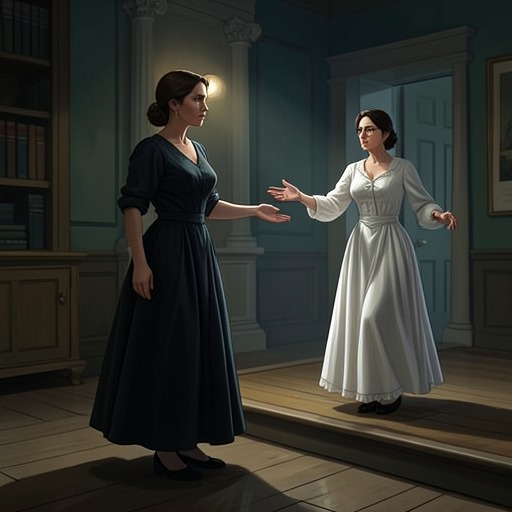
Anne Bullmer’s body is disposed of at sea
The Woman in Cabin 10Anne Bullmer’s body is smuggled aboard the Aurora Borealis in a suitcase and disposed of at sea by Carrie, who has been drawn into Richard Bullmer’s plan. The act is meant to erase the evidence of Anne’s death, but a damaged case and Carrie’s uncertainty about what she saw leave open a more terrible possibility: that Anne may have been alive when she was thrown overboard.
Background and Concealment
Richard tells Carrie that Anne is already dead and leaves her body in a suitcase. The disposal is part of a wider deception: Carrie impersonates Anne aboard the ship, while the real Anne’s body is moved into Cabin 10. Richard has also forbidden photographs of Anne, a restriction that prevents the voyage from producing images that might expose the substitution to her friends and family afterward.
The impersonation depends on the difference between Anne’s illness and the appearance Carrie can create. Laura Blacklock first sees Anne as gaunt and pale, wearing a scarf over her scalp; later, she recognizes the same dark eyes and high cheekbones beneath a transformed appearance, with dark hair and penciled eyebrows. Anne’s cancer treatment and visible signs of illness thus become part of the disguise’s logic: the person presented as Anne can look markedly different, while the people aboard have little prior basis for comparison.
The Transfer and Disposal
Carrie says she wheels the suitcase to Cabin 10 while the others are at dinner. Her task is to throw it overboard while Richard is playing poker. She insists that she did not kill Anne, but the distinction does not make her role incidental: she transports the body and carries out the disposal that Richard’s plan requires.
The suitcase proves difficult to handle. Carrie says it is extraordinarily heavy, perhaps because Richard weighted it, and that she bangs it against the doorframe while getting it into the suite. The impact makes the lid spring open. In the brief glimpse that follows, Anne’s face is bloody, and Carrie thinks she sees her eyelids flutter. She cannot tell whether this is a sign of life or an involuntary movement, and she shuts the case without resolving the doubt.
When Carrie throws the suitcase over the side, its catch bursts open. She sees Anne’s face in the water. The case’s failure turns a concealed act into an image she cannot put away: the body is no longer safely hidden inside the container, and the possibility that Anne was alive has become inseparable from the disposal itself.
Carrie’s Account and Its Consequences
Carrie recounts the episode to Laura in a cramped space, breaking down as she describes it. She says the blood felt cold when she touched Anne’s face and uses that sensation to explain why she believed Anne was dead. But it does not settle the question for her. She admits that she has not been able to sleep, imagining that Anne might have been alive when the suitcase went into the sea.
The confession therefore establishes both the mechanics of the disposal and the limits of what Carrie knows. Richard supplied the assurance that Anne was dead; Carrie handled and discarded the body, but cannot confidently interpret the movement she thought she saw. Her account implicates her in the concealment while preserving uncertainty about whether the act also disposed of Anne alive.
Narrative Significance
The disposal is the physical hinge between Richard and Carrie’s deception and its lasting human cost. A suitcase, a damaged catch, and one fleeting impression of fluttering eyelids carry more weight than a definitive account of Anne’s final moments: the object meant to contain and remove the evidence instead breaks open, leaving Carrie with an unresolved memory and Laura with a disturbing disclosure.
The event also sharpens the novel’s conflict over what can be known and believed. Laura’s own report has been challenged for lack of evidence, while Carrie’s confession supplies a concrete sequence but not certainty about Anne’s condition. The body’s disappearance at sea prevents the account from being cleanly verified at the moment it is told, and turns Carrie’s persistent fear into part of the mystery rather than a settled answer.