Aurora Borealis
The Woman in Cabin 10Aurora Borealis is the boutique super-luxury cruise liner at the center of the novel’s mystery. Introduced as a rare press opportunity on its maiden voyage through the Norwegian fjords, it promises escape, exclusivity, and contact with spectacular northern landscapes. Yet its small scale, windowless interior spaces, international itinerary, and unclear jurisdiction make the vessel more than a backdrop: it becomes an enclosed social system in which a disappearance can be dismissed, evidence can be erased, and a passenger can be isolated from the ordinary protections of land.
Design and First Impression
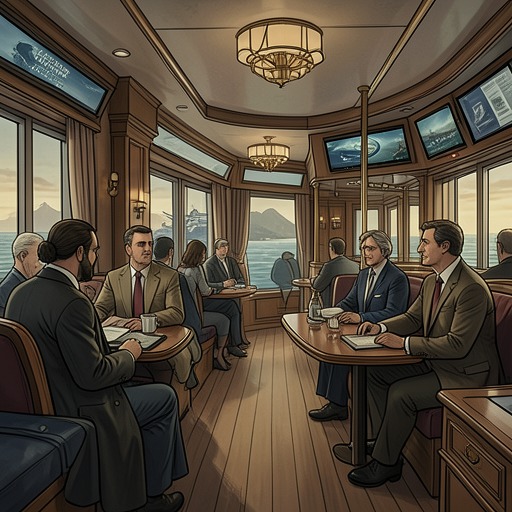
Aurora Borealis is presented as a luxury ship that is unexpectedly small. Its brochure shows enormous glass windows, immaculate white paint, and a flawless surface free of fingerprints and salt, but the physical vessel seems closer to a large yacht than to a conventional cruise liner. The contrast between its promotional image and its actual scale is important. The ship advertises abundance—a library, sunroom, spa, sauna, cocktail lounge, and other amenities—within a miniature structure whose limited space intensifies the proximity between passengers and crew.
The ship’s interiors combine elegance with disorientation. Laura Blacklock is assigned Cabin 9, the Linnaeus Suite, and Josef explains that the cabins are named after notable Scandinavian scientists. The route from the entrance into a thickly carpeted, beige, windowless corridor establishes the vessel’s divided character: refined surfaces and cultivated learning exist alongside passages without natural light, where direction and distance become difficult to judge. At the prow, suite 1, Nobel, is set apart from the other cabins, its solitary position and the blank corridor behind it marking it as especially privileged within the ship’s hierarchy.
The private verandas offer an apparent release from confinement. Cabin 9 has a glass barrier that allows occupants to imagine an unobstructed view of the ocean, with deck chairs and a small table for watching the midnight sun or the northern lights. The transparency of the glass, however, only simulates openness; the passenger remains inside a carefully bounded structure. Aurora Borealis repeatedly turns luxury’s promise of unrestricted leisure into a controlled experience of looking outward while remaining enclosed.
Voyage and Atmosphere
Laura’s arrival at Hull Harbour initially carries the emotional promise of departure. She associates ports with tar, sea air, gulls, and freedom, contrasting them with airports, which signify work, security checks, and delays. The harbor therefore frames Aurora Borealis as an escape route before the vessel has even left England. That expectation is reinforced when she watches ships moving in and out of the harbor, feels the salty wind, and senses the engines change from a discreet purr to a grinding turn away from the quay and toward open sea.
The maiden voyage is publicly framed as a celebration of Scandinavia and the northern lights. Richard Bullmer praises the warmth of Scandinavian people, its food, the Swedish archipelago, the forests of Finland, and the fjords of his wife’s native Norway before presenting the aurora borealis as the defining glory of the region’s winter skies. He raises a toast to the maiden voyage of Aurora Borealis and hopes that the beauty represented by the ship’s name will never fade. The ceremony converts the vessel into a carefully staged image of cultural sophistication and natural wonder, a symbolic brightness that later stands against the darkness of what happens aboard it.
The itinerary remains deliberately flexible. From international waters, the ship travels toward Trondheim, whose cathedral and attractive areas are secondary to the surrounding fjords. Because Trondheim lies farther north than Bergen, it may offer a better chance of seeing the aurora, although the ship might continue to Bodø or Tromsø if conditions require it. This uncertainty gives the voyage a sense of freedom and spontaneity, but it also makes the ship’s location difficult to fix. The same flexibility that serves tourism later complicates rescue, reporting, and the search for a clear authority.
Isolation and Legal Ambiguity
Aurora Borealis becomes dangerous partly because it is neither fully public nor fully private. It is too small to function like a floating city, yet it has the same contradictory legal status as larger cruise ships when crimes occur at sea. Once the vessel reaches international waters, an incident can fall into a gray area in which several national interests overlap without producing an immediately effective investigating authority.
The novel makes this problem explicit through Laura’s attempt to report the suspected crime. She wants to leave the ship at Trondheim and reach the nearest police station, but the response is delayed by uncertainty about the vessel’s registration. A staff member explains that Aurora Borealis may be registered in the Cayman Islands and must consult the captain about how that affects the situation. The ship’s flag, its route, the nationality of those aboard, and the port toward which it is traveling all become competing legal facts rather than a single clear chain of responsibility.
The absence of firm jurisdiction also protects the ship’s institutional image. Laura understands that disappearances on cruise ships are often brushed under the carpet because the investigation is left to onboard security services employed by the cruise company. Those services have an economic interest in avoiding scandal and cannot easily challenge the organization that pays them. Aurora Borealis therefore operates as both a luxury product and a self-contained authority, capable of treating a passenger’s account as a reputational problem before treating it as evidence.
The surrounding sea magnifies this vulnerability. On deck, Laura sees dark gray waves stretching to the horizon with no land or other ship in sight and realizes that there is no practical way to call for help. The ship is moving through a space where distance is not merely geographical. It separates Laura from police, family, communications, and witnesses who might confirm what she has seen. The polished vessel becomes a floating prison precisely because it can carry its occupants away from every ordinary point of intervention.
The Ship as a Site of Disappearance
The soundscape of Aurora Borealis foreshadows its concealment. While Laura reads, the engine and the slap of waves almost cover a soft sound, with the scrape of paper nearly drowning it out. The moment suggests how easily an important action can disappear into the ordinary noises of the ship. Engines, water, corridors, doors, and routine movement create a continuous acoustic cover in which evidence may be present but difficult to distinguish.
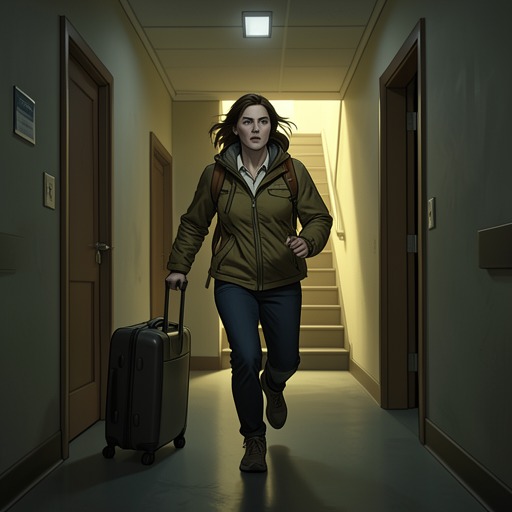
The vessel’s capacity to conceal is made literal through the Cabin 10 incident and the search for a missing woman among Aurora’s staff. Laura’s report of the suspected murder is treated within an environment that can absorb contradiction: staff explanations, missing records, altered appearances, and the absence of a body all compete with her testimony. The ship’s smallness does not make the truth easier to find. Instead, it concentrates the available spaces and relationships, allowing people with access to the vessel to control who is seen, where someone is believed to have been, and which traces remain.
The ship also becomes the setting for Laura’s own disappearance. A later report states that she has not been seen since a planned trip to Trondheim on Tuesday, September 22, after attempts to contact her failed. The company initially assumes that she has chosen to curtail her trip, turning a missing passenger into a matter of personal decision rather than immediate danger. The language of tourism—disembarkation, itinerary, independent travel—provides a convenient explanation for an event that requires investigation.
When passengers finally disembark, the mechanical process is heard from below as the gangway is lowered. For Laura, that sound marks the vessel’s changing status: the ship is no longer simply a route through the fjords but a temporary crime scene whose occupants are about to scatter. Her hope of reaching police is tied to this movement toward land, while the ship’s ability to release passengers also threatens to disperse testimony and conceal responsibility.
Confinement and Narrative Significance
Aurora Borealis gives physical form to the novel’s recurring tension between escape and entrapment. Laura first sees the port as freedom and the ship as a fortunate passage into Scandinavia, but the same passage carries her into international waters, where the horizon offers no immediate refuge. The private balcony appears to dissolve the barrier between passenger and ocean, while the windowless corridors and hidden compartments make the vessel’s interior feel sealed and directionless.
The most extreme version of this contradiction is Laura’s confinement in a windowless cell roughly four feet by six, below sea level and surrounded by the pressure of a thousand tons of water behind steel. The ship’s engineered strength, which should guarantee safety, becomes a source of terror: the hull protects the prisoner from the sea while also preventing escape from the person who controls the door. The interior architecture turns modern luxury into a system of bodily vulnerability.
Aurora Borealis is therefore both a setting of spectacle and an instrument of concealment. Its name evokes the northern lights, a natural phenomenon Richard Bullmer presents as pure beauty, but the ship’s actual narrative function is darker. It carries passengers toward Trondheim, Bodø, or Tromsø in pursuit of an uncertain view of the sky while burying violence below deck and moving witnesses across jurisdictions. The voyage’s promised freedom survives only as an image; the decisive reality is a closed social and legal environment in which survival depends on reaching land, finding credible help, and resisting the ship’s ability to define what happened aboard it.