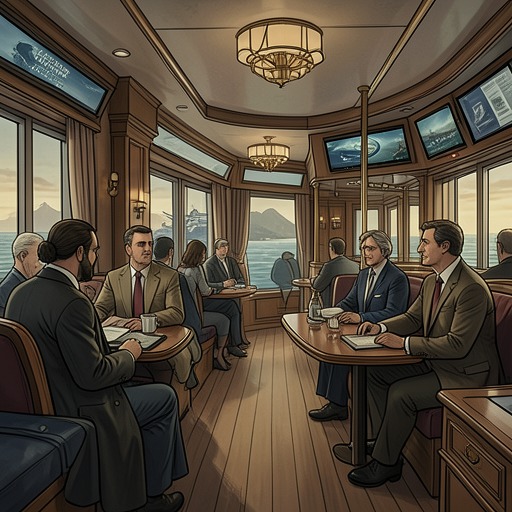
Aurora Borealis flexible itinerary policy
The Woman in Cabin 10The Aurora Borealis flexible itinerary policy allows the cruise ship to alter its route rather than follow a fixed schedule. Johann Nilsson describes the arrangement as a way to accommodate passengers’ wishes, while leaving room for the captain to account for conditions at sea. During Laura Blacklock’s voyage, the policy makes the ship’s changing destination more than a travel detail: it governs where the vessel is headed while Laura seeks help over a suspected disappearance in international waters.
How the Policy Works
When Laura asks where the ship is, Johann Nilsson says it is in international waters and heading for Trondheim. She had understood that Bergen would come first. Nilsson presents several possible reasons for the change, but none as confirmed: Richard Bullmer wants passengers to have a chance to see the northern lights; the captain may have climatic reasons for reversing the route; or someone at dinner may have expressed a particular wish to visit Trondheim. The policy permits these possibilities without establishing which one prompted the decision.
The route could also extend farther north. Nilsson describes Trondheim’s fjords and its position farther north than Bergen as reasons it may offer a better chance of seeing the aurora, while noting that the ship might need to continue to Bodø or Tromsø. At that time of year, he says, conditions remain uncertain. The itinerary is therefore presented as adaptable both to passenger interests and to the practical prospect of finding the northern lights.
The Route and Laura’s Request for Help
The flexible schedule becomes consequential when Laura asks Richard Bullmer whether the ship can stop somewhere closer so she can report the suspected incident to police. Bullmer says there may be a nearer option, but that the ship is expected in Trondheim early the next morning; a stop in the middle of the night might not provide access to an open police station. He says he will consult Captain Larsen about the appropriate course of action. This exchange shows that flexibility does not mean an immediate or effortless stop: the route, timing, and availability of authorities all bear on what can be done.
Bullmer also raises a separate complication: Norwegian police may lack authority if the incident occurred in British or international waters. He believes the ship is registered in the Cayman Islands and says he must ask the captain how that affects the situation. The voyage’s changing destination thus sits alongside a more difficult question of jurisdiction. A ship can alter its course, but that mobility does not by itself determine which police force can investigate an event aboard it.
Narrative and Practical Significance
The policy establishes the Aurora Borealis as a moving setting whose destination is not wholly settled in advance. For Laura, that uncertainty is immediate: her expectation of Bergen gives way to a course toward Trondheim, while she tries to turn her account into a formal report. Her concern is sharpened by the broader uncertainty surrounding crimes at sea, where investigations may fall to onboard security services and where responsibility can be unclear.
The policy is not presented as proof that the ship changes course to evade scrutiny, nor does the text confirm which passenger or navigational consideration caused the initial change. Its significance is more exact: it makes the ship’s movement responsive and contingent, while Laura’s need for police intervention depends on where and when that movement brings the vessel to port. The resulting contrast between a route that can be adjusted and an investigation whose jurisdiction remains unsettled gives the policy its force in the story.