Aurora Borealis maiden voyage
The Woman in Cabin 10The Aurora Borealis maiden voyage is the inaugural press cruise of the Aurora Borealis, a boutique vessel whose carefully staged luxury becomes the setting for a suspected death, competing accounts, and Laura Blacklock’s disappearance. What begins as a commercial showcase of immaculate design, privileged travel, and Scandinavian spectacle develops into a crisis in which the ship’s reputation, its employees’ livelihoods, and the authority of its management appear to matter as much as the safety of the people aboard.
Arrival and the Promise of Luxury
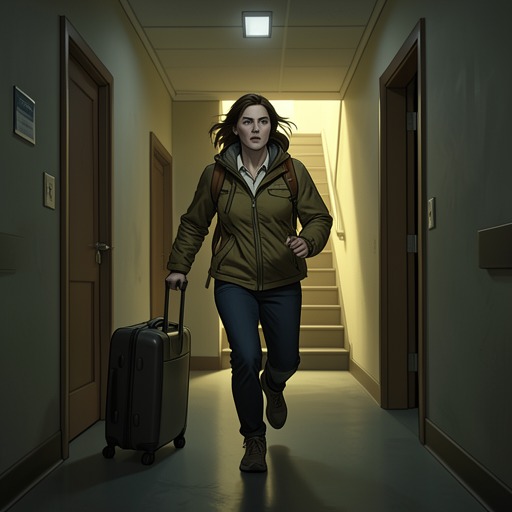
The voyage begins when Laura Blacklock reaches the port after a short, painful sleep in the car. The ship is smaller than the brochure suggested, more like a large yacht than a conventional cruise liner, but its gleaming white paint and spotless glass give it an almost toy-like perfection. Its small scale makes the promised facilities seem improbable: a library, sunroom, spa, sauna, cocktail lounge, and other amenities are supposedly contained within the miniature vessel. Crossing the narrow steel gangway above the oily harbor water, Laura experiences the Aurora as a ship imprisoned in a bottle—tiny, perfect, isolated, and unreal—and feels herself shrinking into its enclosed world.
The welcome is designed to erase uncertainty. Camilla Lidman, in charge of hospitality, greets Laura with exuberant warmth, addresses her by name, and has her luggage taken before she can object. Camilla introduces the ship’s hospitality structure and directs Josef to escort Laura to her cabin and show her the facilities. She also announces dinner and an evening presentation in the Lindgren Lounge about the vessel and the Norwegian fjords and Swedish archipelago islands. The choreography of this reception turns service into reassurance, while the very efficiency with which Laura is identified and absorbed into the ship reinforces the sense that the Aurora Borealis is a controlled environment.
The luxury is materially striking but socially unsettling. Laura estimates that a week aboard as a passenger would cost roughly eight thousand pounds, an amount that is obscene beside her salary and even Rowan Lonsdale’s. The experience gives her access to privileges she had previously encountered only through work-related reports about villas and yachts, yet it also makes visible the distance between such a life and that of an ordinary person. The ship offers comfort as a form of exclusion: its pleasures are available to those able to pay for them, while the labor that sustains them remains largely hidden below deck.
Departure and the Ship at Sea
From her private veranda, Laura watches the small ships moving in and out of Hull Harbour. The balcony’s glass barrier creates the illusion that nothing separates the passenger from the ocean, and it is presented as a place from which guests might enjoy the midnight sun or northern lights. The scene initially suggests effortless leisure, but the ship’s change of motion converts the balcony into a threshold. The engine rises from a discreet purr to a grinding roar, the Aurora Borealis turns away from the quay, and the vessel passes the green and red lights marking the safe channel.
Once beyond the harbor wall, the sheltered water gives way to the rolling swells of the North Sea. Hull recedes from buildings to ridges, then to a dark line on the horizon, while Laura’s phone loses the signal from the UK transmitters. Her unanswered hope for a message from Judah Lewis is folded into the departure: the ship does not merely carry her toward a holiday but removes her from ordinary contact and from the immediate reach of home. The sea therefore functions as both scenery and mechanism, transforming a press trip into an isolated jurisdiction where information can be delayed, disputed, or contained.
Ceremony, Branding, and Commercial Stakes
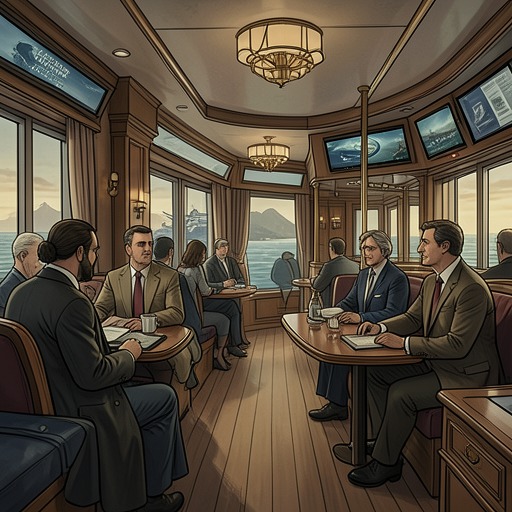
Richard Bullmer presents the maiden voyage as the realization of a hospitality ideal. At the welcome gathering, he introduces himself and Anne Bullmer and describes the aim of the ship as making it a “home away from home.” He promises that travel need not involve compromise and says that he and his staff want to hear any complaint. The language of domestic comfort disguises the fact that this home is also a commercial enterprise, dependent on the successful performance of perfection before journalists, photographers, and influential guests.
Richard’s speech links the Aurora Borealis to his passion for Scandinavia. He praises the warmth of its people, its food, the islands of the Swedish archipelago, and the Norwegian fjords associated with Anne’s native Norway. Yet he identifies the northern skies, rather than the land, as the defining feature of the region, culminating in the aurora borealis. He asks the guests to raise their glasses to the maiden voyage and hopes that the beauty of the ship’s namesake will never fade. The toast turns natural wonder into brand identity: the vessel promises not only transport and comfort but access to a spectacle that guests are told everyone should see before death.
The ceremony also establishes Richard’s personal authority. His warmth, polished public-school manner, and magnetic presence allow him to occupy the center of the room while Camilla retreats into the background. The ship’s hierarchy is visible even in the welcome: Richard embodies ownership and vision, Camilla manages hospitality, and the staff perform the service that makes the owner’s ideal appear natural. The formal presentation thus introduces the organizational structure that later shapes the response to danger.
Crisis Management and the Suppression of Alarm
The maiden voyage becomes vulnerable when Laura reports that a woman may have been thrown overboard. Johann Nilsson, the head of security, insists that there is no proof and argues against waking the other passengers. He proposes waiting until morning and searching among the staff for the woman Laura saw in the cabin. His response keeps the incident within an administrative framework rather than treating it as an emergency, while the suggestion that Laura may simply have misidentified a staff member places uncertainty around her testimony.
Nilsson’s position is complicated by the ship’s small scale. He says that only about a dozen staff members, excluding the sailing crew, work aboard the vessel and that the crew is close-knit enough for an absence to be noticed. The claim that no staff member is unaccounted for becomes an apparently reassuring fact, but it also narrows the acceptable explanations: if nobody is officially missing, Laura’s account must be mistaken, or the event must involve someone whose presence is not recognized by the ship’s records.
The organization’s concern is not limited to evidence. Laura understands that the Aurora Borealis is carrying journalists, photographers, and influential people on its first voyage, making any accident or unexplained death a public-relations disaster. A headline about a passenger drowning on a luxury press trip could end Nilsson’s career and damage the entire enterprise before it had properly launched. If the publicity sank the venture, everyone from the captain to Iwona, the cleaner, could lose a job. This logic spreads responsibility across the institution: the pressure to preserve the ship’s future can make silence appear protective, even when silence leaves the danger unresolved.
Class Division and Hidden Vulnerability
The contrast between the passenger decks and the crew quarters exposes the social architecture beneath the ship’s polished surface. Laura sees the crew cabins as cramped, dingy, and windowless, sharply unlike the light, airy rooms above. Nilsson defends them as better than accommodation on rival ships, but Laura recognizes that the issue is not simply size. The quarters provide a graphic illustration of the gap between those who purchase the Aurora’s pleasures and those who make them possible, a modern upstairs-downstairs arrangement contained within the same vessel.
That division helps explain why the voyage’s public image can become a collective stake. The staff are not merely servants in the background; they are workers whose employment depends on the ship surviving its first voyage without scandal. Their economic vulnerability coexists with the passengers’ insulation and creates unequal consequences for the same event. For wealthy guests, the cruise is an expensive experience that can be abandoned or explained away. For the crew, a failed launch may threaten their livelihoods. The maiden voyage therefore turns class difference into an operational pressure, not just a visual contrast.
Fractured Narratives and the Voyage’s Aftermath
The advertised itinerary repeatedly gives way to disruption. A planned presentation on the northern lights, to be delivered by Richard with photographs by Cole Lederer, is canceled because Richard has been called away to deal with an emergency and Cole has hurt his hand. The postponement, rescheduled for after the group returns from Trondheim, is another small alteration to the ship’s program, but in context it shows how the official schedule becomes a surface over concealed disorder.
At dinner, Owen White privately questions whether Richard’s business arrangement is sustainable, describing it as a niche investment area while noting that Richard has substantial resources of his own, or rather that Anne does. He regrets that Solberg could not attend because the matter would have suited Solberg’s expertise. At the same table, Anne appears haunted despite concealing the tears Laura saw earlier, while Alexander Belhomme describes her as the force behind Richard’s position and characterizes her public fragility as a covering for power. These observations complicate the ship’s presentation of a harmonious host couple and reveal financial uncertainty, strained relationships, and competing interpretations beneath the formal hospitality.
The voyage’s danger eventually extends beyond the suspected overboard incident. While imprisoned in a cramped hidden space, Laura understands that the people holding her know she has learned the truth about Anne: Anne is not as ill as she pretended, and those responsible cannot afford to let Laura leave and report a kidnapping, imprisonment, and physical assault. The inaugural cruise has thus changed from a showcase into a floating prison whose isolation protects the perpetrators and weakens the victim’s credibility.
Laura’s uncertainty about her own fate is mirrored by uncertainty about the public story. While she is absent, she wonders whether the passengers have raised the alarm or accepted a claim that she was detained in Trondheim or chose to return home unexpectedly. She doubts that Cole Lederer, Chloe Jenssen, or most of the other passengers would investigate, since they barely know her and lack her family’s contact details. Even Ben Howard’s concern is uncertain because Laura had accused him of complicity in a murder. The vessel’s controlled communications and social distance allow disappearance to be converted into an explanation before it becomes an alarm.
The maiden voyage ultimately exposes the instability behind the Aurora Borealis’s promise of a “home away from home.” Its spotless surfaces, elaborate welcome, northern-lights imagery, and carefully managed itinerary depend on a hierarchy that separates guests from workers and on an institution determined to protect its launch. The sea magnifies every weakness: it removes the shoreline, interrupts contact, complicates jurisdiction, and gives the ship’s official version of events room to prevail. What was meant to announce a new luxury experience instead becomes the setting in which hospitality, reputation, class, and survival collide.