Aurora Borealis staff quarters
The Woman in Cabin 10The Aurora Borealis staff quarters are the ship’s cramped below-deck accommodation and access zone, sharply separated from the airy passenger suites above. Their importance lies in this double function: they expose the material inequality sustaining the cruise’s luxury, while their corridors, coded doors, fire exit, and hidden rooms make them part of the ship’s covert geography during the investigation into the missing woman.
Definition and Physical Setting
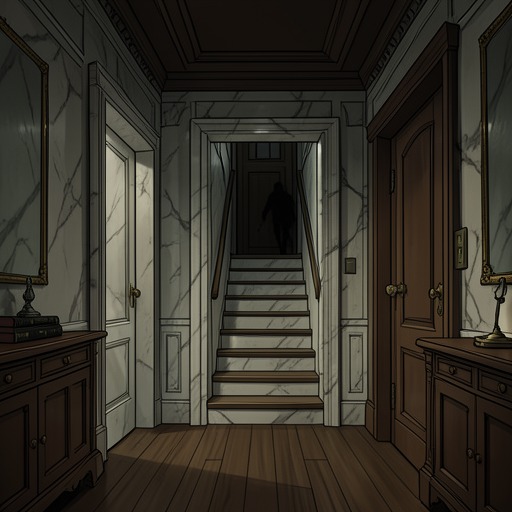
The staff quarters lie below the passenger areas and include the crew cabins as well as routes connected to the spa and lower decks. When Laura Blacklock passes the open cabin doors with Johann Nilsson, she is struck by the windowless, cramped rooms and by the prospect of spending weeks or months inside them. Nilsson explains that there are only about a dozen staff members, excluding the sailing crew, and therefore little accommodation is required; he also insists that these quarters are better than those on rival ships. The comparison does not remove the discomfort. What disturbs Laura is the visible contrast between the dim, confined rooms below and the light, spacious accommodations reserved for passengers above.
The quarters are also configured as a controlled passage rather than an ordinary domestic space. The spa has a concealed entrance known through a mirror, but its only alternative exit is a downstairs fire door opening into the staff quarters. That door opens outward only and is alarmed, so using it would trigger an evacuation. Its design makes the staff area a possible route of escape while simultaneously turning it into a monitored and dangerous boundary: access is physically possible, but not without consequences.
Class Structure and Labor
The staff quarters give architectural form to the social order of the Aurora Borealis. Above deck, Laura experiences a private veranda, sea views, luxury bathing facilities, and a suite costing roughly eight thousand pounds for the stay, an amount she regards as obscene beside her own salary and even Rowan Lonsdale’s. Below deck, staff live in windowless rooms whose relative adequacy is defended only by comparison with worse conditions elsewhere. The ship’s comfort is therefore not evenly distributed; it depends on workers whose own living conditions remain largely invisible to passengers.
Laura recognizes the quarters as a modern upstairs-downstairs system. The issue is not simply that the rooms are small, since she has travelled on ferries with equally poor or poorer accommodation. It is the graphic proximity of incompatible lives: the same vessel offers wealthy guests bright rooms open to the sea while employees occupy enclosed spaces beneath them. The staff quarters thus register class stratification as a daily operating principle rather than as an abstract social idea.
The economic pressure on the staff becomes explicit when Karla explains why she cannot openly support Laura’s account of the woman in Cabin 10. Karla has a young son, Erik, at home with her mother, and depends on the money she sends back. If the police conclude that something terrible happened on the ship, she fears that passengers will stop travelling with the company and that staff may struggle to find other work. The quarters are consequently tied to a wider economy of dependence: the people who maintain the ship’s luxury have the most to lose from exposing the danger beneath it.
Hidden Movement and Threat
The staff quarters become central to Laura’s pursuit of the hidden passenger. When she follows the woman toward the lower deck, the woman reaches the staff door before Laura catches it as it closes. Laura forces her way through, entering a dark stairwell where the bulb is burned out or may have been deliberately removed. In that darkness, an unseen attacker grabs her hair, twists her arm, and drives her head against the metal doorframe. The staff passage therefore changes from a possible investigative route into the point of Laura’s abduction.
Laura wakes in a windowless cell roughly four feet by six, well below sea level, with the weight of the sea only inches away beyond the steel hull. Although the precise room is not identified as part of the ordinary staff accommodation, its connection to the lower-deck spaces makes the quarters part of the ship’s hidden carceral structure. The contrast with the passenger decks becomes horrific: the same vessel that sells open views of the North Sea contains a space in which Laura cannot see outside, summon help, or establish how much time has passed.
The concealment is reinforced by the ship’s movement and access systems. While Laura is imprisoned, she hears a metallic grinding and realizes that the gangway is being lowered as passengers disembark. She screams that she is on the boat, but the plastic ceiling deadens the sound. The staff-side infrastructure thus allows the ship to continue its public routine while a captive remains unheard below it. Ordinary operations become evidence of institutional isolation.
Narrative Significance
The Aurora Borealis staff quarters connect physical confinement, class inequality, and the legal uncertainty of crime at sea. The ship is travelling through international waters toward Trondheim, and Laura knows that cruise-ship crime occupies a murky jurisdictional area in which onboard security may control investigations without wanting to damage the company’s reputation. The hidden lower decks make that uncertainty tangible: a person can disappear into the vessel’s structure while the ship continues toward its next port.
The quarters also mark the limits of visibility. Passenger life is designed for observation and display, with verandas opening toward the ocean; staff life is pushed into windowless rooms and restricted corridors. Doors require codes, exits are alarmed, and darkness can be created by removing a light. Control belongs to those who know the ship’s passages and can decide which spaces remain visible. Laura’s movement into the staff area is therefore both an attempt to recover evidence and a crossing into the part of the vessel where the ship’s hierarchy can be enforced physically.
By placing the crucial attack and the sounds of continued disembarkation within or beside this hidden zone, the narrative turns the staff quarters into a model of the Aurora Borealis itself. The ship’s polished luxury depends on concealed labor, its apparent safety depends on controlled information, and its freedom of movement conceals the vulnerability of anyone trapped below. The quarters are not merely background accommodation; they are the spatial underside of the cruise’s promise of comfort and the route through which that promise becomes a floating prison.