Cabin 10 woman's disappearance
The Woman in Cabin 10Cabin 10 woman's disappearance is the initiating mystery aboard the Aurora Borealis: Laura Blacklock meets a woman assigned to Cabin 10, hears what appears to be her violent disappearance overboard, and then finds no trace that the woman ever occupied the cabin. The event matters not only because it suggests murder at sea, but because its apparent erasure leaves Laura isolated between direct perception and officially verifiable evidence. The ship becomes a moving crime scene, and the uncertainty surrounding its location and legal authority gives the disappearance room to be denied, contained, and transformed into a question about Laura herself.
The Woman in Cabin 10
Laura encounters the woman after realizing that her mascara has been stolen along with the rest of her belongings. The adjacent cabin bears the plaque “10. PALMGREN,” and Laura knocks, first hesitantly and then with three sharp knocks followed by a louder strike. The door opens immediately, as though its occupant has been waiting on the other side. A young woman with long dark hair confronts her, wearing a worn Pink Floyd T-shirt with holes. Her startled hostility changes into a practical exchange when Laura explains that she is the neighbor, introduces herself as Laura Blacklock, or Lo, and asks to borrow mascara. Tubes and creams are visible on the dressing table, and the woman is wearing substantial makeup herself, making her seem like a plausible, ordinary passenger rather than an apparition or an invented stranger.
The encounter establishes the woman through concrete details that later become dangerously unverifiable. Laura has seen her face, spoken with her, and associated her with a particular cabin, appearance, and personal style. Yet the scene also occurs against Laura's exhaustion and mounting anxiety. She is forcing down yawns, struggling to sleep, and increasingly uncertain whether her own perceptions can be trusted. The mystery therefore begins with a seemingly trivial social request, allowing the later disappearance to turn an everyday act of neighborly contact into the only surviving human evidence that Cabin 10 had an occupant.
The Overboard Incident
During the night, Laura wakes with the conviction that something has disturbed her. She recognizes that her unease is not merely paranoia and keeps returning mentally to the possibility of a scream. While reading, she hears the veranda door in the next cabin slide gently open. The sound is nearly lost beneath the engine and waves, but then comes a splash, followed by a larger splash that cannot easily be dismissed as an ordinary disturbance.
Laura runs to her veranda, throws open the French windows, and searches the shifting darkness. Reflected light from the ship makes the waves difficult to read, but she thinks she sees a pale, swirling shape beneath a black crest, trailing downward like a woman's hand. When she looks toward the neighboring veranda, she sees a dark, oily smear on the glass safety barrier, resembling blood. The physical mark intensifies the uncertainty: the body is unseen and unrecovered, but the smear appears to support Laura's account of a struggle or disposal.
The event also makes Laura a potential witness in immediate danger. She realizes that whoever stood on the neighboring veranda and threw the body overboard may have seen her rush outside, heard her door crash open, and recognized her face. She retreats, locks her cabin door twice, and fastens the chain. The disappearance thus has two simultaneous dimensions: a woman may have been killed, and Laura may have become the only person aboard who can connect the suspected killing to Cabin 10.
Erasure and Disbelief
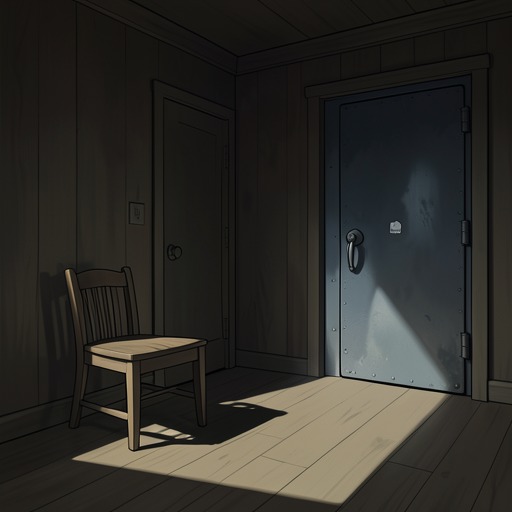
When Laura brings Johann Nilsson to the cabin, he opens the door with a passkey after a knock receives no response. The room is not merely unoccupied; it is stripped of every ordinary sign of residence. There are no suitcases, clothes, cosmetics, or even an unmade bed, only the mattress. The absence is so complete that it seems to answer the mystery by abolishing its premise. Laura insists that a girl was there, that she spoke to her, and that the woman occupied the room, but Nilsson finds no visible confirmation. The glass barrier is likewise clean apart from ocean mist and spray.
Nilsson finally tells Laura that the cabin has always been empty and that there was never a guest there. His gentle tone makes the denial more destabilizing rather than less. Laura is not confronted with an obvious lie or a dramatic accusation; she is offered a calm institutional version of reality in which the central person in her story never existed. The disappearance therefore becomes a contest between testimony and records, memory and a cleaned physical space, with Laura's exhaustion and anxiety making it easier for others to treat her account as a symptom rather than as evidence.
The ship's organization reinforces this erasure. Ben Howard acknowledges that Laura is not known for imagining things and admits that crime aboard cruise ships occupies a legally murky area. The Aurora Borealis is operating in international waters, where responsibility can be divided among the vessel's registration, the waters in which an incident occurs, the next port, and the nationalities of those involved. Laura understands that cruise operators may handle disappearances internally because onboard security services are employed by the liner and have little institutional incentive to create scandal. A vanished passenger without a recoverable body can consequently be reduced to an inconvenient allegation.
Jurisdiction and Confinement
Laura's report is made while the Aurora Borealis is leaving Hull and entering the North Sea. She watches the harbor recede as the ship passes the lights marking the safe passage, leaves the protection of the harbor wall, and moves into deep rolling water. Later, Nilsson tells her that the ship is in international waters and heading toward Trondheim, although Laura had expected Bergen. The changing destination makes the disappearance harder to localize and places increasing distance between the alleged crime and the authorities Laura hopes will investigate it.
Richard Bullmer appears more receptive than Nilsson and discusses whether the vessel could stop somewhere closer than Trondheim. He also explains that Norwegian police might be unable to act if the incident occurred in British or international waters, and that the situation may be affected by the fact that the boat is registered in the Cayman Islands. The legal uncertainty is not abstract for Laura: it determines whether anyone can board, preserve evidence, question the crew, or treat the disappearance as a crime. The ship's mobility turns geography into a mechanism of delay.
The same isolation later becomes physical confinement. Laura looks out over a gray sea with no land or other ship in sight and realizes that there is no practical way to call for help. After being trapped below deck, she finds herself in a windowless cell roughly four feet by six, below sea level and separated from the surrounding water by only the ship's steel hull. She cannot force the bolted door, and the vessel's structure absorbs her cries. When the gangway begins to lower and passengers disembark, she understands that the ship is emptying while her calls for help remain trapped inside it. The original disappearance has expanded into a system in which enclosed architecture, sleep deprivation, distance, and organizational control can make a living witness as inaccessible as a missing body.
Bodies, Misidentification, and Revelation
The disappearance initially produces no body, and that absence permits every competing explanation: accident, murder, hallucination, or deliberate concealment. The eventual discovery of two bodies at sea changes the evidentiary landscape. One body is dredged up by a fishing boat in the early hours of Monday morning; the second is recovered later that day by police divers. The discoveries confirm that the sea has preserved a material answer even while the ship's interior appeared to have erased its passenger.
The later identification reveals that the woman from Cabin 10 was Anne Bullmer, wife of Richard Bullmer and heiress to the Lyngstad fortune. Her death is identified as drowning. Richard Bullmer is also found dead, but his death is attributed to a gunshot wound to the temple rather than suicide; the wound is declared not self-inflicted. A gun recovered beside his body is wrapped in clothing belonging to Laura Blacklock, causing initial allegations that his death is connected to Laura's disappearance and making the missing witness appear potentially implicated in the very deaths she tried to report.
The confusion becomes more severe when Laura is herself believed for several days to have died, after her clothing is associated with the recovered body. She is later found alive and is not treated as a suspect by Norwegian police, but the episode exposes how quickly incomplete evidence can invert the case: the missing woman is first treated as nonexistent, the witness becomes missing, and the recovered evidence points suspicion toward the survivor. The Cabin 10 woman's disappearance is therefore resolved not by a single clean revelation but through successive corrections to identities, causes of death, and the assumed direction of culpability.