Carrie's impersonation of Anne Bullmer
The Woman in Cabin 10Carrie’s impersonation of Anne Bullmer turns a passenger’s apparent illness into a carefully managed false identity. On the Aurora Borealis, Carrie presents herself as Richard Bullmer’s cancer-stricken wife while the real Anne is already dead. The performance conceals a murder, helps manufacture a false account of who has left the ship, and places Laura Blacklock in danger once she understands the substitution. Its force comes from more than resemblance: clothing, hair, make-up, restricted photographs, and the passengers’ assumptions all help make the false Anne legible as the real one.
Identity and preparation
Carrie met Richard at The Magellan, where she worked as a waitress while trying to become an actress. In her account to Laura, she describes being swept into an affair with a wealthy married man and believing that his marriage to Anne was effectively over. Richard had told her he could not leave Anne while she was dying, and promised that the two of them could be together afterward. Carrie’s willingness to take Anne’s place grew out of that relationship and the future she believed Richard had promised her.
The impersonation required practical preparation as well as romantic persuasion. Richard arranged for another guest not to arrive, leaving an empty cabin for Carrie, and told her she would need to cut her hair to make the disguise convincing. She was meant to spend part of the voyage as Anne, then change into her own clothes on the final day and go home as herself. The plan depended on keeping her presence aboard and her actual identity hidden from the other passengers.
On the day the ship sailed, Carrie was preparing to change into Anne when Laura unexpectedly appeared at the cabin. A silk robe lay on the bed; make-up and Veet waxing strips were in the bathroom. Carrie had been removing her body hair in preparation for playing a woman undergoing cancer treatment. Laura’s accidental arrival interrupted the planned exchange with Richard and became a near-discovery: Carrie had to dismiss her without provoking the kind of suspicion that might lead her to tell the others about a strange woman in the cabin.
Performing illness and likeness
As Anne, Carrie adopted visible signs that passengers already associated with illness. Laura first sees the supposed Anne in a shapeless gray silk wrap and a scarf wound around her scalp; her skin appears waxy and pale, and the absence of eyebrows makes her face seem gaunt and skull-like. At dinner, Carrie speaks of fatigue, says she has finished her latest round of chemotherapy, and anticipates radiotherapy after the voyage. On another occasion, a bruise on her collarbone is explained as an effect of chemotherapy and her tendency to bruise easily. These details make illness part of the disguise’s public credibility, not simply a private fact about the woman wearing it.
The performance also exploited how little the passengers knew the real Anne. Laura recognizes that the disguised woman shares Anne’s height, weight, and prominent cheekbones, while their eyes differ. Richard had instructed Cole Lederer not to photograph Anne. The restriction prevents compromising images from being examined later, but it also helps the deception because the guests have few images against which to test their memories. In Laura’s view, no one aboard knew Anne before the trip well enough to notice the substitution at once.
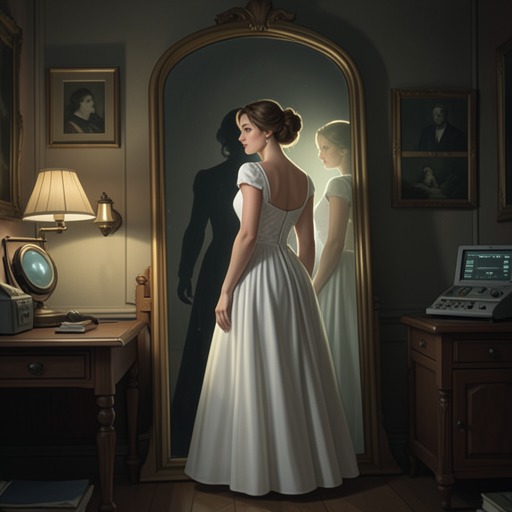
The contrast between Carrie’s two appearances makes the disguise’s dependence on styling clear. Laura later recognizes the eyes and jutting cheekbones, but is astonished by how much hair and carefully drawn eyebrows change the face. Without them, the pale scalp, exposed bones, and absent brows suggest illness and age; with dark hair and sleek black brows, the same face appears young and healthy. The transformation is not a perfect physical match so much as a coordinated set of cues that encourages observers to see the identity they expect.
The substitution and its cover story
Laura eventually realizes that there were two women occupying the identity of Anne: the real Anne is dead, while Carrie is alive and has been impersonating her. The revelation changes the meaning of the illness Laura had witnessed. The scarf, the hair loss, and the treatment account were not reliable evidence of Anne’s condition; they formed part of Carrie’s performance. Laura also understands why Richard wanted no photographs: the ban protected the impersonation from later comparison by Anne’s friends and family.
Carrie’s account places the real Anne’s death on the first night. She tells Laura that Richard arrived while she was changing into Anne’s clothes and said that Anne had discovered the affair, lashed out, and struck her head on a coffee table when Richard pushed her away. He said he could not revive her. Carrie says he then persuaded her that they should dispose of Anne’s body at sea and continue the plan, arguing that an investigation would expose Carrie’s presence and the impersonation. This is Carrie’s explanation of what happened, rather than an independent account of the killing. Laura notices that its logistics do not make sense: the ship had not yet reached Norway, and Anne could not simply have left without her passport or the crew noticing. The discrepancy leads Laura to suspect that Richard had never intended for Anne to leave the ship alive.
Carrie describes a planned disappearance that depended on exchanging identities at Trondheim. She would leave the vessel as Anne, then change her clothes, put on a wig, draw on eyebrows, and vanish into the crowd as an anonymous backpacker. After the disappearance had settled, she and Richard would meet publicly, fall in love again for the cameras, and begin their relationship afresh. Instead, Carrie explains, she put her wig back on and left the ship with Laura’s passport during breakfast preparations, when a sailing-crew member was at the gangway. She then rejoined the Aurora Borealis as Anne. The false departure created a paper trail suggesting that Laura had left and never returned, helping explain why the ship was not searched for her.
Exposure, dependence, and escape
Once Laura is imprisoned, knowing that Anne’s illness has been exaggerated and that Carrie has assumed her identity makes Laura more dangerous to the people controlling her. She fears that they will kill her rather than let her tell a story of kidnapping and confinement that others might not believe. The disguise therefore extends beyond concealing Anne’s death: it also helps isolate Laura, because her account challenges a version of events already supported by the ship’s apparent records and public performance.
Laura tries to make Carrie consider what will happen when Richard gets Anne’s money, warning that he may then seek to protect himself by eliminating Carrie as well. Carrie rejects the warning and insists that Richard loves her. Her response reveals the emotional dependence sustaining her participation: she has accepted Richard’s account of the marriage, the killing, and the danger of discovery, even as the arrangement leaves her exposed to his power. Laura’s challenge does not immediately dissolve that belief, but it brings the impersonation’s cost into focus. Carrie has taken on Anne’s outward identity for Richard while remaining vulnerable to the future he controls.
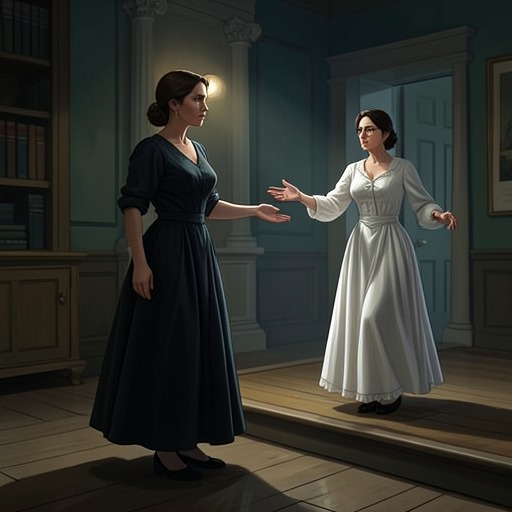
At the eventual handoff, Carrie gives Laura her own passport, removes the headscarf to reveal a shaved head with stubble regrowing, and strips off her clothes. She tells Laura to leave the ship as Anne and board a plane as Carrie. Carrie says she cannot simply leave alongside Laura: she does not know whether the crew can be trusted, and revealing that a supposed friend had been hidden in the hold would be dangerous. Instead, she gives Laura a bundle of silk clothes and asks for Laura’s in exchange. The disguise that had served Richard’s plot is thus turned into a means of escape for the person who exposed it. Carrie’s impersonation is both a criminal instrument and, at the end of this exchange, the identity Laura must borrow to survive.