Class stratification
The Woman in Cabin 10Class stratification is rendered aboard the Aurora Borealis as a physical arrangement as much as an economic one: the ship offers passengers glass-fronted balconies and costly suites above, while its workers live in cramped, windowless cabins below. Through Laura Blacklock’s movement between those decks, the novel makes luxury and labor part of the same structure, then shows how wealth and employment can influence whose claims are heard and who bears the risk of speaking.
Luxury and the price of access
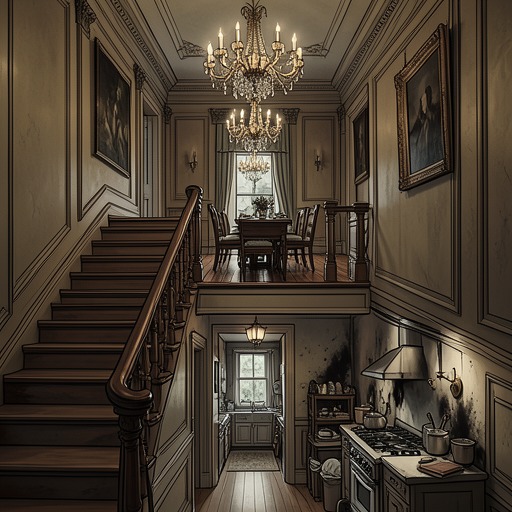
The disparity first comes into focus through Laura’s experience of the passenger suite. Its private veranda has a glass barrier, deck chairs, and a small table, with the sea and sky framed as a view to be enjoyed in comfort. The bathroom’s powerful shower jets turn washing into another indulgence. Yet Laura measures that comfort against ordinary earnings: the accommodation costs around eight thousand pounds, an amount she regards as excessive beside her own salary and even Rowan Lonsdale’s. The ship’s luxury is not an abstract setting; its price separates those who can purchase a week aboard from those who can only aspire to such access.
Laura has spent years reading the reports Rowan sends from expensive holidays, waiting until she is senior enough to receive similar professional perks. Once she gets a taste of the life, however, she wonders how Rowan endures repeated glimpses of a world most people cannot afford. The promotion that grants Laura temporary access does not erase the underlying divide. It makes her newly aware of it: the comforts are available to her as a work-related privilege, not as an ordinary extension of her means.
The ship’s departure from Hull Harbour gives that privilege a further edge. From the balcony, Laura watches the vessel turn away from the quay and pass the lights marking the safe passage, while the shoreline dwindles behind her. Her phone is heavy in her pocket as she hopes for a message from Judah Lewis before the ship leaves the reach of UK transmitters. The scene places a private, expensive voyage beside a narrowing connection to life ashore: the passenger can enjoy the view, but departure also carries her beyond familiar forms of contact and help.
The passenger deck and the workers’ quarters
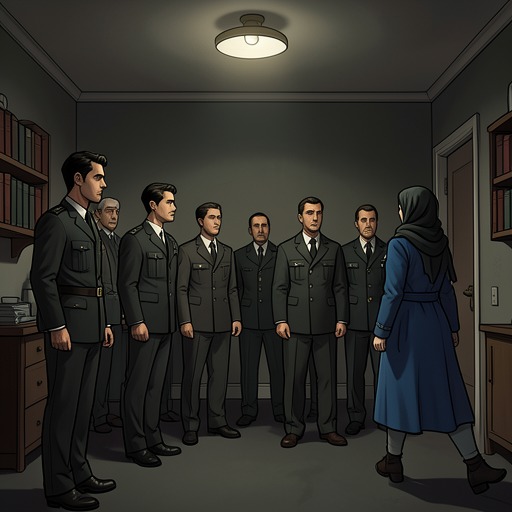
When Johann Nilsson takes Laura below deck to check whether the woman she saw is among the staff, the ship’s social hierarchy becomes an architecture. A keypad secures the service entrance. Beyond it, narrow stairs lead toward the depths of the vessel, and the passenger-facing atmosphere gives way to low ceilings, hotter air, close walls, and dim fluorescent lights. Laura feels claustrophobic in the corridor, where eight or ten cabins occupy roughly the space taken by two cabins above.
An open door briefly exposes a shared bunk room. A worker is getting dressed beneath the bunk above; when she notices Laura, she kicks the door shut with a startling bang. Laura blushes at having intruded and hurries after Nilsson. The moment is not simply an illustration of poor accommodation: it marks the boundary between the people who move through the ship as guests and those whose private space is compressed into its service levels. The staff mess offers somewhat more room, but its low ceiling, lack of windows, Formica tables, steel grab rails, and institutional cooking still distinguish it sharply from the airy passenger spaces.
On the return passage, Laura sees again how cramped and dingy the crew’s cabins are. Nilsson explains that the ship has only about a dozen staff, excluding the sailing crew, and that their quarters are better than those on many rival ships. His comparison places the conditions within an industry, but does not remove the contrast Laura finds disturbing. She recognizes that the cabins are not necessarily worse than every ferry she has used; what unsettles her is the difference between these rooms and the bright accommodation above. She understands the ship as an active upstairs-downstairs system, in which comfort is distributed unevenly across the same vessel.
Rank, work, and economic dependence
The hierarchy is also differentiated within the workforce. When Laura asks whether everyone shares, Nilsson tells her that junior workers—including cleaners and younger stewards—share cabins, while senior staff have rooms of their own. The distinction makes status visible below deck as well as between workers and guests. Sharing, privacy, and space follow a rank order; the ship does not treat its employees as a single undivided group.
The passenger dining room displays another side of the same economic structure. Owen White discusses an investment arrangement with Tina West, admitting uncertainty about whether the niche project is sustainable. He nevertheless assumes Richard Bullmer can attract interest elsewhere, since Richard has substantial resources of his own—or, as Owen corrects himself, Anne Bullmer does. The exchange locates power in access to capital: uncertainty may complicate a business proposal, but wealth gives the people behind it the capacity to wait for another investor. The guests’ polished setting thus contains not only consumption but conversations about who can finance, delay, and direct commercial decisions.
Wealth, credibility, and the cost of speaking
The divide becomes consequential when Laura tries to establish what happened aboard the ship. She knows that crimes at sea can occupy a murky jurisdictional space: in international waters, unclear police authority can leave investigations to shipboard security employed by the cruise line. Her account therefore faces more than a question of evidence. The institution tasked with responding is also part of the enterprise whose reputation may be affected. The novel connects the ship’s controlled passenger environment to a wider imbalance in which those with organizational power can shape how a crisis is handled.
Laura’s confinement makes that imbalance bodily. In a windowless room roughly four feet by six, below sea level and surrounded by the pressure of the ocean, she has no useful object with which to force the door. Later, as passengers disembark and the gangway is lowered, she hears the hull grind and understands that the ship is continuing its ordinary movement while she remains trapped inside it. The contrast is stark: the vessel’s itinerary proceeds, but her access to the people and institutions outside it has been cut off.
Her captors’ control of the story also depends on the likelihood that she will not be believed. Laura knows that she has learned too much about Anne and fears that those holding her cannot afford to let her speak. When Carrie considers what she could tell others, she points out that Richard is their employer and that she cannot know whether anyone will trust her. Her hesitation gives economic dependence an immediate human consequence: exposure may mean challenging the person who controls one’s livelihood and position aboard the ship.
Carrie’s earlier circumstances sharpen that tension. She describes meeting Richard at the Magellan while she worked as a waitress and tried to establish herself as an actress. She presents the relationship as an entry into a life she had never imagined, while also describing secrecy: because Richard was married, they could not be seen together publicly. Her account connects class and gendered dependence without making her experience identical to the workers’ quarters. Access to Richard’s wealth offers Carrie a route toward comfort, but it also binds her to a concealed relationship in which he holds greater social and economic power.
Narrative significance
The Aurora Borealis concentrates class difference into a single, legible structure. The same ship that sells costly privacy above deck depends on the service of employees whose rooms are hot, dim, and tightly packed below. Laura’s passage between those spaces turns her from a temporary beneficiary of luxury into an observer of its material conditions. The change in viewpoint matters: the divide is not just a matter of taste or expense, but of who gets space, who performs the work, and who controls the channels through which a complaint might travel.
The novel also resists treating class as a simple division between rich passengers and poor staff. Rank separates junior from senior workers; professional access gives Laura a brief taste of privilege without making it permanent; and the Bullmers’ wealth shapes investment conversations as well as personal relationships. Across these distinctions, money and institutional position repeatedly affect the costs of action. The ship’s decks become a compact social map: those above can purchase distance from ordinary constraints, while those below—and those trapped within the vessel’s systems—have fewer ways to make themselves heard.