Home invasion
The Woman in Cabin 10Home invasion in the novel is not simply the theft of possessions: it is an attack on Laura Blacklock’s sense of safety that leaves her injured, trapped, and later struggling to have her experience taken seriously. The intruder’s preparation, his assault on the bedroom door, and the deliberate disabling of its latch turn a break-in into a close encounter with the possibility of further violence.
The Intrusion and Immediate Threat
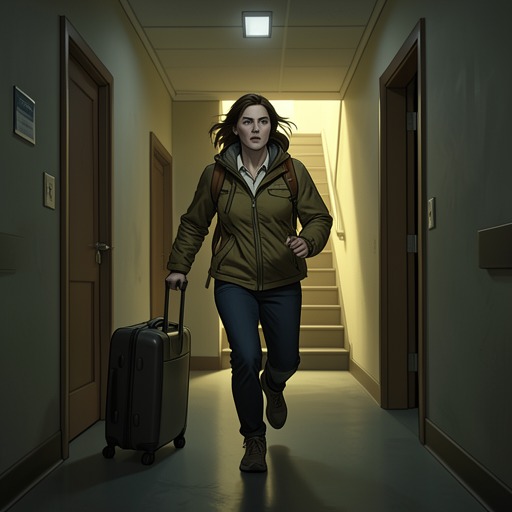
Laura encounters the intruder when she opens her bedroom door. His face is concealed by a hoodie and bandanna, and the rest of him is obscured by shadow; his latex-gloved hands are the one detail she can clearly recall. The gloves make the threat feel purposeful: they suggest someone who has come prepared, though Laura cannot identify him or establish what he intends. Her fear is sharpened by the knowledge that she is alone and cannot immediately find her phone.
When the intruder moves toward her, Laura tries to speak, but he slams the bedroom door into her face before she can finish. The door’s molding cuts her cheek. She freezes, then braces herself against it as she hears him ransacking the flat and breaking glass in the hallway. Still in her dressing gown, she crouches with her knees drawn up and muffles her sobs, hoping her cat, Delilah, has escaped into the garden. She remains gripping the door handle even after hearing the front door open and close, afraid to assume that the intruder has gone.
The danger continues after the sounds of the break-in stop. Laura discovers that the door handle turns without moving the latch: the intruder has removed the spindle from the other side and left her locked inside her bedroom. With no landline and security bars over the window, she has no immediate way to call for help or escape that way. It takes her two hours to force the door open, using a nail file against the latch; only then can she check the small flat room by room and seek help from her neighbor.
Aftermath and the Loss of Safety
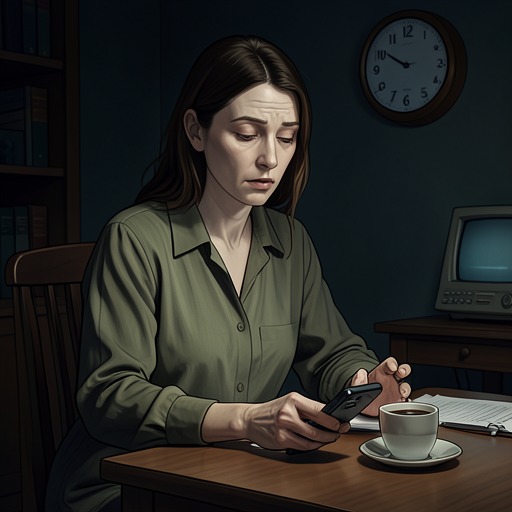
The break-in continues to occupy Laura after the intruder has left. She paces through the flat, describing its violated, soiled feeling by comparison with Delilah’s need to reclaim the rooms after another cat has entered. The damage is not limited to the forced lock: the stolen bag contained money, her mobile phone, driving licence, medication, mascara, and travel card—practical tools of ordinary independence gathered into a single loss. Explaining the event to the police is itself an ordeal, especially because she can report the intruder’s presence but cannot describe his face.
When Laura returns, the basement entrance is still shadowed, and splintered wood marks where the lock was forced. She had earlier thought about installing a security light; now the darkness also means she cannot easily see her keys. A new deadlock gives her some reassurance as it clicks shut, but the relief is incomplete. In the bathroom, she stops while undressing: she usually leaves its door open because the below-ground room feels small when the blinds are down, and enclosed spaces trouble her. The invasion has therefore altered how she experiences even familiar rooms, making privacy and safety feel conditional rather than given.
That earlier trauma later becomes part of the argument against Laura’s credibility. During the investigation aboard the Aurora Borealis, Johann Nilsson asks how much she drank and argues that her account of a woman and a splash may be a conclusion shaped by the recent break-in. Laura rejects the implication that anxiety medication, sleeplessness, or drinking means she cannot distinguish fact from fiction. The home invasion thus has a double consequence: it leaves her with a real experience of violated security, while also furnishing an authority with grounds to treat her later testimony as a projection of that experience.
The Break-In as a Test of Credibility
The effects of the home invasion continue in the way Laura Blacklock’s later testimony is evaluated. Johann Nilsson reduces her account to seeing a girl—one of many aboard the ship—and hearing a splash much later, then treats the break-in as a traumatic experience that has supplied a misleading pattern. Laura insists that anxiety medication, sleeplessness, and drinking do not make what she saw unreal. The dispute is not simply about missing evidence: it is also about whether her frightened state becomes a reason to discount her account, even as the intruder’s identity and purpose remain unknown.
That credibility struggle travels into public discussion. On a Whodunnit forum, an anonymous poster invokes Laura’s medication and labels her unstable, while other users speculate about suicide and question the people close to her. Judah Lewis corrects the claim that Laura’s medication is for depression, says it is for anxiety, and objects to treating medication as proof of instability or suicidality. The forum’s speculation does not establish what happened in the flat; instead, it shows how personal vulnerability can be turned into a ready-made explanation for a missing person’s case.
The mistaken certainty surrounding Laura’s reported death gives that public narrative a grim consequence. Judah tells family and friends that he identified photographs of clothing sent by the Norwegian police, recognizing Laura’s distinctive vintage boots; the body itself remains in Norway and has not been identified as hers. Later reporting confirms that Laura was found alive and that the body was Anne Bullmer’s, while acknowledging that the clothing discovery was poorly communicated to her family. Against that background, the home invasion stands as a real violation that Laura survived, but also as part of the wider struggle over who gets to define her experience—and how quickly uncertainty about her can harden into a story about her supposed instability.
The Threshold and the Limits of Recall
The scene begins in the unsettled aftermath of Laura Blacklock’s night out: her journey home from the tube station is a blur, a headache is returning, and she supposes Delilah may have been shut under the bed when she closed the bedroom door. Opening that door to release the cat instead brings her face to face with the intruder. The mistaken expectation makes the bedroom threshold a sudden divide between the familiar home and a threat already inside it. Laura can recall the hoodie, bandanna, shadow, and latex gloves, but not a face; her account is vivid in particular details while incomplete in others. That unevenness matters to the story’s later treatment of her testimony: the break-in is a concrete danger she experiences, yet the confusion surrounding its circumstances becomes part of the context in which others question what she can know and remember.