Insomnia and sleep deprivation
The Woman in Cabin 10Insomnia and sleep deprivation are persistent forces in Laura Blacklock’s story, not a brief inconvenience between crises. They erode her concentration and sense of safety, push her toward alcohol as a substitute for rest, and leave her trying to interpret danger while exhausted. The novel places this private bodily strain alongside the hazards of the Aurora Borealis: an enclosed ship at sea, where uncertainty and limited access to help make fatigue consequential rather than merely uncomfortable.
Sleeplessness at Home
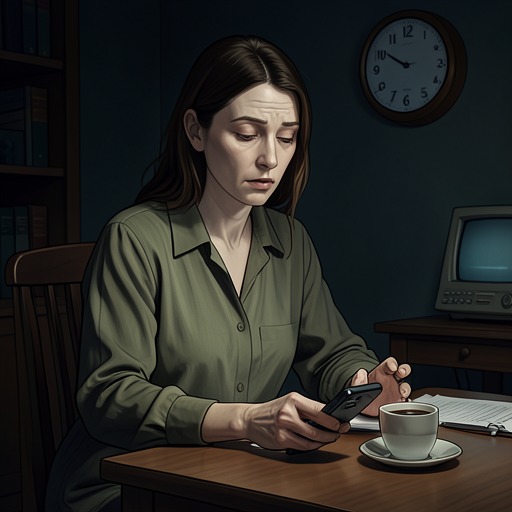
After a burglary, Laura tries to make the night manageable through routines: she checks the doors and window locks repeatedly, charges her pay-as-you-go phone beside the bed, makes chamomile tea, and takes her work materials to the bedroom. Although she is exhausted and has not eaten supper, she cannot sleep. Reading the Aurora Borealis press pack offers no relief; its details, from the ten cabins and twenty-passenger maximum to the vessel’s technical specifications, keep her awake in a state she describes as both shattered and wired. The contrast captures the central difficulty of her insomnia: physical exhaustion does not produce the rest she needs.
Work intensifies the pressure. Laura regards the cruise as an unusually important chance to prove herself after years of routine journalism, make professional contacts, and help secure valuable attention for Velocity. Sleep becomes something she feels she cannot afford to pursue if it might make her miss an opportunity. Yet the practical tasks she must complete, including replacing bank cards and transferring her mobile number to a new phone, consume much of Saturday while leaving her increasingly tired.
Her attempt to force sleep turns into a long, measurable vigil. At 3:35 a.m. she drinks two strong gin and tonics, treating them like medicine, and waits for their effect while watching the clock. She remembers neither the moment she falls asleep nor a full night of rest: at 6:04 a.m. she is awake again, after less than an hour and a half. The partly full bedside drink, made mostly of gin, makes the expedient visible as well as ineffective. She compares her disorientation to an earlier sequence of overnight flights from Thailand via Los Angeles, after which she slept for twenty-two hours; this time, however, bed no longer feels like a refuge.
Exhaustion Meets Ambition on the Voyage
The sleeplessness follows Laura onto the ship. On arriving at her cabin, she is overwhelmed by the bed and longs to sleep for thirty or forty hours, but believes she must attend the first-night dinner and presentation to network. She therefore stays awake and watches the Aurora Borealis leave Hull Harbour, cross beyond the harbour wall, and enter the North Sea. The departure gives the loss of rest a physical setting: the shoreline recedes while the possibility of returning to ordinary routines recedes with it.
Laura continues to treat alcohol as a way to guarantee sleep. After an evening of champagne, wine, and aquavit, she recognizes that she has drunk because she cannot face another broken night. Later, after waking in a state of acute alarm, she rules out relying on alcohol every night, fearing that it will damage her career and prospects at Velocity. Sleeping pills and meditation appear as possible alternatives, but the passage offers no simple remedy. At 3:04 a.m., with no email from Judah Lewis, she is too alert to return to sleep and tries to read instead.
This pattern is not a simple progression from tiredness to sleep. After drinking whiskey, Laura does fall into a very deep sleep, but she wakes abruptly with her heart racing and her body rigid with fear. She deliberately relaxes her clenched hands and regulates her breathing until her heartbeat slows. The ship’s waves and engine are the only sounds she can distinguish. Her exhaustion is thus bound to vigilance: even when sleep arrives, it does not restore an uncomplicated feeling of safety.
Fatigue, Perception, and Danger at Sea
The novel makes Laura’s tiredness part of the conditions under which she must judge what has happened around her. After the scream and possible splash, she insists to herself that she could not have imagined the blood. On deck, she asks where the ship is and learns that it is in international waters and heading toward Trondheim, rather than the Bergen stop she expected. Her questions and uncertainty occur in a setting where movement, geography, and legal responsibility are difficult to keep firmly in view.
Laura also understands that crimes aboard ships occupy a jurisdictional gray area. The Aurora Borealis is smaller than a floating city, but its position in international waters still complicates who can take charge of an investigation. She knows that disappearances at sea can be brushed aside and that inquiries may be left to security services employed by the cruise line. This is not a symptom of insomnia; it is a structural danger that compounds her isolation. Fatigue and uncertainty make her vulnerable within a situation whose institutional protections are themselves unclear.
That vulnerability becomes literal when Laura is trapped in a windowless compartment below sea level. The doors resist her attempts to force them, and the fixtures are bolted down or made of fabric, leaving her nothing to use as a lever. She tries to estimate the day from her thirst and stiffness, reasoning that it is probably still Tuesday, September 22, and wonders whether Ben Howard will come looking for her because he knows she planned to go ashore at Trondheim. The scene converts the exhaustion and disorientation established earlier into a problem of survival: she has to reason about time, rescue, and her own physical condition in a confined space without reliable external cues.
When the ship’s side shudders and Laura hears metallic grinding, she realizes that the gangway is being lowered and the passengers are disembarking. She bangs and screams for help, but the plastic ceiling absorbs the sound. The moment sharply contrasts the passengers’ departure with her continued confinement: the ship is changing state around her while she remains unheard. Sleep deprivation does not explain the trap, but the novel has already shown how little reserve Laura has for enduring fear, uncertainty, and physical confinement.
Public Suspicion and the Meaning of Fatigue
The story also distinguishes Laura’s actual mental-health history from the assumptions others make about her. In an online discussion of her disappearance, a poster describes her medication as treatment for depression and calls her unstable, then speculates about suicide. Judah Lewis corrects the claim: Laura takes medication for anxiety, and he rejects the inference that medication makes her unstable or suicidal. The exchange does not establish insomnia as the cause of public suspicion. Instead, it shows how distress, medication, and a missing-person case are collapsed into a stigmatizing story about the missing woman.
The forum discussion is especially consequential because it takes place while Laura is still trapped and her whereabouts are unknown. Other users scrutinize Judah’s account and speculate about his possible involvement; he responds that he was working in Russia and that the recovered body has not been identified as Laura. The thread is closed after the discussion turns into harmful speculation. Later, an email from Judah to Laura’s family reports that he recognized her distinctive clothes in photographs sent by Norwegian police, although the body has not yet been made available to the family for identification. That news intensifies the gap between Laura’s lived reality and what people outside the ship believe has happened.
The broader narrative effect is to make sleep deprivation both intimate and social. At the bodily level, it produces exhaustion, failed attempts at rest, and heightened alarm; at sea, those conditions meet confinement, uncertain jurisdiction, and the difficulty of calling for help. Outside the ship, other people interpret Laura through fragmentary reports and assumptions about her medication. The novel does not ask the reader to treat tiredness as proof that her perceptions are false. Rather, it shows how real danger and impaired reserves can coexist, while public speculation risks turning a vulnerable person’s distress into a reason to doubt her.