Laura Blacklock and Ben Howard relationship
The Woman in Cabin 10Laura Blacklock and Ben Howard’s relationship is a post-breakup entanglement in which familiarity repeatedly gives way to conflict. Once colleagues at Velocity and formerly a couple, they meet again aboard the Aurora Borealis with the breakup still shaping what they can say to each other. Ben’s attention moves between teasing, sexual entitlement, remorse, and an apparent attempt to reopen their emotional history; Laura, meanwhile, wants the past acknowledged without being drawn back into it. The relationship’s decisive rupture on the voyage is not merely their old separation but Ben’s assault on Laura, after which any renewed closeness has to be weighed against the harm he has done.
Shared History and Reunion
Ben and Laura had worked together at Velocity, and by the time they meet aboard the ship Ben is writing for another publication. Their shared professional past gives their reunion an ease that Laura’s shock at seeing him does not immediately dispel. Ben appears with a new, thick beard, and he greets her with a familiar, teasing manner. Their conversation also establishes that Laura is now involved with Judah Lewis. When Ben asks about that relationship, Laura answers that she is still unavailable, but her sour delivery suggests that the subject is not uncomplicated for her.
Ben’s jokes quickly test the limits of that familiarity. He comments on Laura’s appearance and asks whether she has been cage fighting, referring to the bruise on her cheek. The mark has a far more disturbing significance for Laura: it brings back the intruder who attacked her in her flat, and her reaction is physical as well as emotional. Her heart pounds, her chest tightens, and she struggles to answer. Ben does not know what the bruise recalls, but the exchange shows how easily his banter meets a vulnerability he cannot see.
Their flirtatious shorthand resurfaces when Ben asks whether Laura is still with Judah and suggests that the fjords might permit a lapse in fidelity. Laura rebukes him sharply. The exchange conveys both their old familiarity and the boundary Laura is trying to maintain: she can respond with the sharpness of someone who knows his manner well, but she does not welcome his presumption. Their history makes the teasing legible; it does not make it harmless.
Assault and Disclosure
Later, after drinking because she hopes to sleep through another night of anxiety, Laura struggles to retrieve her cabin key. Ben approaches and offers help, then leans over her and makes a sexualized remark about her dress. Before she can respond, he shoves his hand down the front of it and squeezes her breast. Laura instinctively drives her knee into his groin. The assault ends with Ben on the floor and Laura in tears; her resistance is immediate, but it does not protect her from the shock of what he has done.
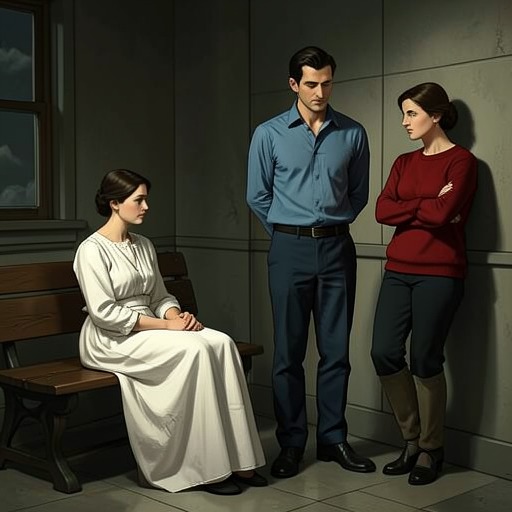
About twenty minutes later, Laura is sitting on her bed, still sobbing and wiping borrowed mascara from her cheeks. Ben is beside her, holding ice against his crotch and apologizing. He acknowledges that he behaved like a complete fool and deserved her response. Laura tells him that the breakdown is not simply about him: since the burglary at her flat, she has felt unable to cope and fears she may be going mad. She then tells him what she had not told Judah, describing the terror of waking to an intruder and realizing that nobody would hear her, that she could not summon help, and that she could not fight him off. The disclosure is an important moment of intimacy, but it follows a violation rather than repairing it. Ben becomes the listener to a fear she has kept from her current partner, even as his own conduct has just made her less safe.
The Breakup and Laura’s Boundary
Ben appears ready to say something more about their former relationship, but Laura stops him. She does not want him to make a confession or declaration she cannot manage while they are confined on the same ship for another five days. She reminds him that the relationship ended a long time ago and that he was the one who wanted out. That fact makes his apparent effort to speak emotionally feel belated, but the scene does not establish exactly what he intends to say; Laura prevents the words from being spoken.
Laura tries to soften the confrontation by saying that she was not always easy either, then calls them friends, while recognizing that this overstates their closeness. Her qualification matters: she is willing to offer a limited, workable definition of their connection, not to declare that the old relationship has been restored. She explicitly asks Ben not to make the situation worse. He accepts the boundary, and their exchange turns briefly to practical damage: his dinner jacket and her ripped silk dress. The mundane joke allows them to leave the immediate crisis without resolving the history beneath it.
Continued Distance
At a later dinner, Ben gestures for Laura to sit beside him, opposite Archer Fenland. Laura pretends not to notice and takes the nearest available chair beside Owen White instead. The small choice contrasts with the earlier private disclosure: although she has let Ben hear about her fear, she does not seek his company in public. The text offers no reconciliation or renewed commitment. Their relationship remains an uneasy mixture of shared history, intermittent familiarity, his apology, and Laura’s deliberate distance.
The relationship’s significance lies in that unresolved contrast. Ben can recognize his wrongdoing and offer comfort, yet his remorse does not cancel the assault or entitle him to Laura’s confidence. Laura’s willingness to speak to him about the burglary is real, but so is her insistence that the breakup is over and her refusal to accept his dinner invitation. The scenes keep emotional access distinct from romantic access: she can disclose pain, negotiate a fragile friendship, and still decline the intimacy Ben seems to seek.