Laura Blacklock's captivity
The Woman in Cabin 10Laura Blacklock’s captivity aboard the Aurora Borealis is the point at which her search for the truth about Anne Bullmer becomes a fight for survival. A violent assault leaves her locked in a windowless room below deck, cut off from the ship’s passengers and unsure whether anyone will come looking. Her confinement is maintained not only by doors and codes but by uncertainty: Laura cannot know what Richard Bullmer has told the others, whether Ben Howard will notice her absence, or whether the woman controlling her will help her escape or kill her.
Capture and Isolation
By the time Laura is trapped, the ship has left Hull Harbour behind and entered the North Sea. She has been watching the vessel depart from the harbor, its movement changing as it passes the harbor wall and meets the open sea. Later, she learns that the ship is in international waters and bound for Trondheim. That setting intensifies her isolation: she is confined aboard a moving vessel, far from shore, while the passengers around her may not know she is missing.
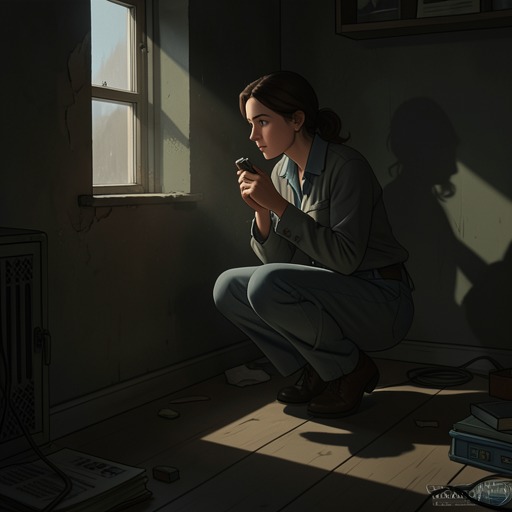
The immediate assault follows Laura into a staff entrance. She catches the door as it is closing and forces her way through, only to find the stairwell dark; the bulb above the steps is out, or may have been deliberately removed. Someone grabs her hair, twists her arm, and drives her head against the metal doorframe. She loses consciousness. When she wakes on a bunk beneath a thin blanket, her head is throbbing and the lights seem to shimmer. A curtain that might suggest a window conceals only a blank, cream-colored wall. The room offers no view, no daylight, and no reliable way to judge how much time has passed.
The Conditions of Confinement
The space is small enough to make Laura’s fear physical. One door is locked; the other opens only into a tiny en suite, where a dead spider lies curled in the washbasin. She pulls and rattles the main door until she is panting, but there is nothing in the room she can use to force it. The furniture and fittings are bolted down, screwed in, or made of fabric. She estimates the cell at roughly four by six feet and imagines the ship’s steel skin, the deep water beyond it, and the weight of the sea pressing close around her.
Her injury and isolation compound one another. Pain pulses through her skull, her vision sparks when she strains at the door, and panic makes the walls seem to close in. She uses the breathing count she has relied on before to try to steady herself, then forces herself to reason from small physical clues. Her thirst is uncomfortable but not extreme, and her limbs feel stiff; from this she estimates that she has probably been unconscious for no more than a few hours and that it may still be Tuesday, 22 September. Without a clock, even the date is an inference rather than a certainty.
The locked doors also limit the value of escape by force. Laura considers whether she could reach the corridor and trigger a fire alarm, but there is another coded door outside her own, and she believes her captor is quicker and stronger than she is. She concludes that trying to overpower the woman is unlikely to work. Her practical objective shifts from breaking out to persuading the woman to help her. That decision is not a sign that Laura accepts her captivity: it is a calculation made inside a room designed to leave her with few choices.
Fear, Knowledge, and the Prospects of Rescue
Laura’s most urgent danger is connected to what she knows. She understands that Anne was not as ill as she had appeared, and she believes that the people holding her cannot let her leave and tell a story of kidnapping, imprisonment, and bodily harm. At the same time, she doubts that anyone would believe her. The injury on her head is visible to her, but she has no access to evidence or witnesses that could support her account.
Her thoughts turn to those who might notice her absence. Judah Lewis and her parents are not expecting her home until Friday, so they may have no reason to worry immediately. The other passengers could notice that she has not returned, but Laura suspects they may accept whatever explanation Richard gives them. Ben knows her well enough to recognize that leaving for Trondheim without a word is out of character; nevertheless, she has accused him of being involved in a murder, and she cannot be sure that he will set aside his anger to look for her. Her hope that he will come is therefore uncertain, not a plan she can depend on.
The woman guarding Laura warns that an additional coded door stands outside the room. The single word Laura hears in that exchange tells her that the guard has an accomplice, allowing her to rule out several passengers and much of the crew. The captivity thus becomes an exercise in piecing together information as well as enduring physical confinement. Laura must work out who is involved while avoiding actions that could provoke her captors before she has a viable way out.
Carrie and the Story Behind the Cell
Laura’s attempt to enlist the guard becomes a confrontation over Richard. She warns that once he has Anne’s money, he may try to make himself safe, and argues that Carrie could be in danger too. Carrie initially rejects the warning, insists that she loves Richard, and says she would never betray him. Laura presses her to face the possibility that her devotion does not protect her from being used. When Carrie withdraws and fails to return with supper, Laura fears that she has made a disastrous mistake.
Carrie eventually explains how her relationship with Richard began. She had worked as a waitress at The Magellan while trying to become an actress; Richard swept her into a life she had not known and kept the relationship secret because he was married to Anne. Carrie describes their marriage as effectively over, with Richard in London and Anne in Norway, and says he presented himself as unable to divorce a wife he believed had only months to live. His account helped Carrie understand the affair as a romance obstructed by circumstance rather than a betrayal that might also implicate her.
Richard had already turned impersonation into part of their arrangement. Carrie says he gave her one of Anne’s kimonos and had her study a film of Anne speaking so she could copy her manner. She hid her hair beneath a swimming cap and scarf, and the two appeared together in public while others believed she was Anne. For the voyage, Carrie agreed to cut her hair and take Anne’s place, with Richard arranging for an empty cabin. She says the plan changed when Richard told her that Anne had discovered the affair and died after a confrontation. He persuaded Carrie that they had to dispose of Anne’s body at sea and continue the impersonation, claiming that discovery would expose both the murder and Carrie’s role in the deception.
Laura recognizes the gap between Carrie’s version and the practical facts of the voyage. The plan that Anne would simply leave the ship at Bergen does not explain how she could have disembarked earlier without her passport or the crew noticing. Laura suspects that Richard had never intended for Anne to walk away freely, though Carrie has argued herself into accepting his explanation. The confession makes Laura’s knowledge more dangerous: she can connect the impersonation, Anne’s death, and Richard’s effort to conceal what happened. She tries to persuade Carrie that Richard may kill them both, while also offering to say that she got off at Trondheim and blacked out. In her own mind, however, Laura knows that physical traces could contradict that story, including DNA, fingerprints, dental records, and Anne’s blood.
Release and Significance
Carrie’s conduct remains contradictory. She has kept Laura imprisoned and has controlled her access to food and medication, yet she also reveals fear and guilt, and speaks of what she believes Richard will do. A moment of shared childhood affection briefly interrupts the coercion: Carrie recalls that her mother called her Tigger because she always bounced back after falling. Laura wonders whether thanking a woman who is holding her captive means she is developing Stockholm syndrome. The question captures the disorienting effect of dependence without erasing the violence that created it.
Carrie ultimately gives Laura her passport and proposes a disguise: Laura will leave the ship as Anne and travel onward using Carrie’s identity. She strips off her headscarf and gives Laura her clothes, a plan that makes escape depend on the same impersonation that helped conceal Anne’s disappearance. When Laura sees blood on Carrie’s chest and a wound at her temple, leaving becomes morally harder; she fears Carrie may be bleeding to death. Still, Carrie urges her not to look back, and Laura understands that going for help is the best chance for both of them. She escapes the cabin and leaves the key where Carrie can reach it rather than keeping her locked in longer.
The captivity ends as a confined struggle for time, credibility, and leverage: Laura cannot force the doors, trust that the ship’s passengers will search for her, or assume that telling the truth will be enough. Her survival depends on reading Carrie’s changing responses and turning the captor’s dependence on Richard into a reason to cooperate. The episode also exposes the machinery behind the crime: Richard’s control of the story, Carrie’s participation in Anne’s impersonation, and the physical evidence that could undo their account. The locked room makes that machinery concrete, reducing a large, moving ship to a bunk, two doors, and the uncertain decision of the woman holding the key.