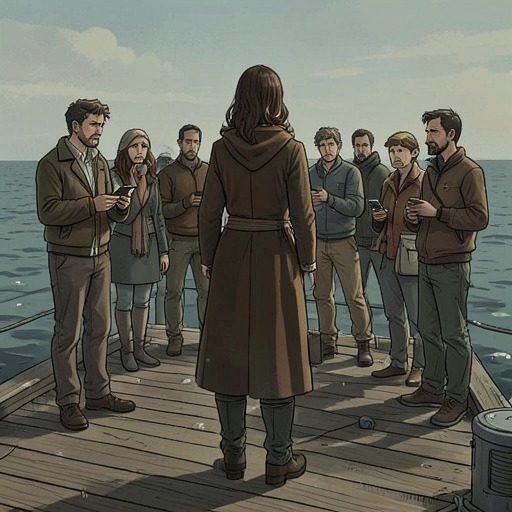
Laura Blacklock's missing-person status
The Woman in Cabin 10Laura Blacklock's missing-person status turns a disappearance aboard the Aurora Borealis into a public and increasingly confused search, in which an unconfirmed body, miscommunicated evidence, and online speculation make her seem dead before she is found alive in Norway. The gap between what happened to her on the ship and what the people waiting ashore could know is central to the episode: for days, a woman trapped below deck exists in public as a missing tourist, then as a presumed victim, while the evidence offered to her family never actually identifies her body.
Departure and the missing-person report
The Aurora Borealis left Hull on its maiden voyage on Sunday, September 20. As the harbor receded and the vessel entered the North Sea, Laura watched the shoreline disappear and thought of Judah Lewis and what she had left unfinished. Her phone felt heavy in her pocket; she hoped for a message before the ship moved beyond the range of UK transmitters. That departure establishes the separation behind the later alarm: Judah was not aboard, and contact between them depended on communication that soon failed.
The itinerary further obscured when and where Laura had vanished. Johann Nilsson told her they were in international waters and heading for Trondheim, although she thought the ship was supposed to visit Bergen first. The route was not simply a matter of geography: Laura also understood that crimes at sea occupied a murky jurisdictional area. On some cruise ships, disappearances could be left to onboard security, employed by the cruise line, without a clear police jurisdiction taking charge. In the open sea, the distance from shore and the uncertainty over who could investigate compounded the difficulty of establishing what had happened.
A report published by the Harringay Echo on Saturday, September 26, supplied the first public timeline. Laura, 32, lived in West Grove in Harringay, and her partner, Judah, 35, had reported her missing after she stopped replying to messages aboard the ship. The company said Laura had not been seen since a planned trip to Trondheim on Tuesday, September 22. It had initially assumed she had chosen to cut her trip short; only when she failed to return to the UK on Friday and Judah raised the alarm did it become clear that her departure had not been planned.
Laura's mother, Pamela Crew, said it was extremely out of character for her daughter not to make contact and appealed for anyone who had seen her to come forward. The report noted that Laura was also known as Lo. The public appeal thus framed the disappearance as an abrupt break from her ordinary ties, while providing no explanation for the interval between her last reported sighting and the alarm.
A disappearance concealed aboard ship
The public account of a passenger missing from an itinerary concealed a more immediate reality: Laura was still on the ship, but trapped in a windowless compartment below sea level. The space was roughly four feet by six; its fixtures were bolted or screwed down, and the steel hull stood between her and the water. She believed it was probably still Tuesday, September 22, and hoped that Ben Howard would look for her when she failed to disembark at Trondheim. Her confinement made the distinction between being absent from the passenger list and being unreachable literal: she could not leave, and those outside could not hear her.
When the gangway was lowered and passengers began disembarking, Laura recognized the metallic grinding of the mechanism. She screamed that she was on the boat and struck the door, but the plastic ceiling deadened the sound. The ship's ordinary operations continued around her while her attempt to announce her presence went unheard. Elsewhere, she had stood on deck in wind and salt spray, looking across a horizon with no land or other ship in sight and recognizing that there was no way to call for help. The scale of the vessel and the remoteness of the sea offered no reliable route to rescue.
The disappearance also involved the erosion of physical clues. During the search for the missing woman, Laura realized that a tube of mascara—the one link she believed she had to the missing girl—was gone. In a case already dependent on uncertain memories and sightings, the loss of an object she regarded as a connection to the incident deepened the sense that evidence could vanish along with the person it might help explain.
The body report and public speculation
On Monday, September 28, BBC News reported that Danish fishermen had dredged a woman's body from the North Sea off Norway. The report said Scotland Yard had been called in to assist the investigation and that the woman's identity was still being confirmed. It described the possibility that the body was Laura as speculation, not an identification. Judah, contacted at home, declined to amplify that speculation and said he was devastated by her continued disappearance.
The distinction between a body being found and Laura being identified was quickly blurred in public discussion. On the Whodunnit forum, users discussed the report and repeated claims about how often people disappeared from cruise ships. Some turned suspicion toward Judah because he was out of the country; another participant suggested that Laura might have been suicidal. An anonymous poster claiming to be a family friend described her as unstable and said she took medication for depression, using that characterization to imply a possible suicide.
Judah joined the discussion under his own name and challenged those claims. He said that Laura took medication for anxiety, not depression, and rejected the assumption that medication made her unstable or suicidal. He confirmed that he had been in Russia working, and pointed out that the body had not been identified as Laura, so the case remained a missing-person investigation rather than a murder investigation. The forum administrator then closed the thread. The exchange shows how quickly the absence of confirmed facts invited competing stories—and how Laura's medication and mental health could be turned into an explanation for her disappearance before her whereabouts were known.
Clothing mistaken for confirmation
On Tuesday, September 29, Judah emailed Laura's close friends and immediate family with an update. Scotland Yard had asked him to identify photographs sent by the team handling the case in Norway. The photographs showed clothes he recognized as Laura's, especially a distinctive pair of vintage boots. The body was still in Norway, and the family had not been told when they would be able to see it. Judah described the discovery as devastating but made clear that the family was waiting for further information; clothing was evidence associated with Laura, not proof that the body was hers.
That distinction was lost in the communication that followed. A later report stated that Laura's parents had spent several days believing the body had been identified as their missing daughter. Scotland Yard stressed that the body had never at any stage been identified as Laura, while acknowledging that the discovery of her clothes had been poorly communicated to the family. It attributed the failure to communication problems between forces. The episode shows how an evidentiary clue could acquire the force of a death confirmation in the absence of a direct identification, imposing grief on a family while Laura remained alive.
Resolution and significance
On Thursday, November 26, a report identified the body dredged from the North Sea as Anne Bullmer, not Laura. Anne had drowned; the same report said Richard Bullmer's body had been found separately near Bergen and that his gunshot wound was not self-inflicted. Laura, meanwhile, had been found alive and well in Norway. The report also said that police had interviewed her in connection with the deaths but were not treating her as a suspect. The body had never been hers, despite the clothes that had led her family to fear otherwise.
Laura's missing-person status therefore shifts through several distinct stages: an unexplained failure to make contact, an official appeal, public speculation about a body, a family's mistaken belief that clothing confirmed her death, and the eventual correction that she had survived. The ship's movement through international waters made the practical problem of locating her harder, while the news cycle and online forum filled the evidentiary gaps with conjecture. The final reversal does not erase the consequences of the error: for several days, Laura's family had to absorb what they believed was confirmation of her death, even as the actual woman remained beyond their reach.