Laura Blacklock's investigation of the cabin 10 mystery
The Woman in Cabin 10Laura Blacklock’s investigation of the cabin 10 mystery is a search for proof aboard a ship where the suspected crime may have taken place beyond clear police jurisdiction. What begins as an effort to establish that a woman was in Cabin 10 becomes a wider inquiry into who saw her, who might have known her, and why the people with authority aboard the Aurora Borealis are slow to act. As the evidence accumulates, Laura’s pursuit of corroboration also exposes her to the very isolation that makes the case so difficult to investigate.
A disappearance at sea
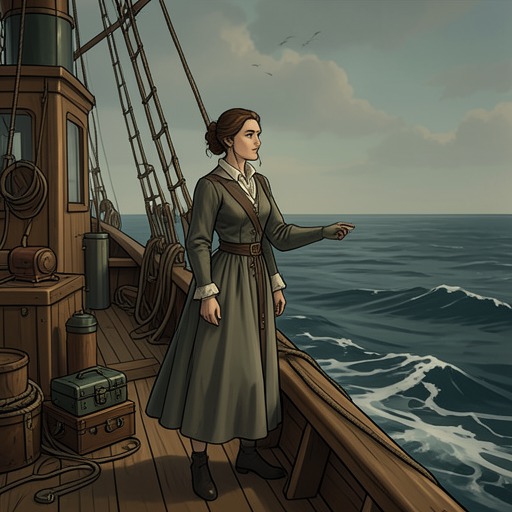
The investigation unfolds against the physical departure of the Aurora Borealis from Hull. Laura watches the ship leave the quay, pass the harbor lights, and enter the North Sea, where the sheltered harbor’s gentle movement gives way to open-water swells. The receding coast marks more than the start of a voyage: once land and its ordinary channels of communication fall away, Laura is increasingly dependent on the ship and its personnel. Later, when she is out on deck with no land or other vessel in sight, she recognizes that there is literally no way to call for help.
The ship’s luxury sharpens Laura’s awareness of how unequally its comforts are distributed. She reflects on the cost of a week aboard the Aurora Borealis in comparison with her salary and the inaccessible travel privileges she has watched other journalists enjoy. The contrast becomes concrete when she passes the crew’s windowless, cramped cabins. Johann Nilsson explains that there are only about a dozen staff, excluding the sailing crew, and that their accommodation is better than on some rival ships. Laura’s unease, however, is about the gap between these quarters and the airy rooms above: the vessel’s polished surface depends on a less visible working life below it.
Seeking corroboration
Laura’s inquiries gain urgency because she cannot rely on her first report alone. She knows that crimes committed aboard cruise ships can fall into a legal gray area: a disappearance may be handled by onboard security employed by the cruise company, without a clear outside police authority taking control. Ben Howard recognizes the difficulty and advises Laura to go to Richard Bullmer, the person at the top of the ship’s hierarchy, rather than continue trying to persuade Johann Nilsson. He also proposes asking passengers whether they saw anyone enter or leave the supposedly empty cabin, or noticed the theft of Laura’s mascara. Even a second person who heard a splash, Laura reasons, could make it harder for Richard to dismiss her account.
The passenger inquiries produce observations, not a complete explanation. When Laura asks Alexander Belhomme whether he heard noises near Cabin 10, he says he was awake during the night and saw people moving about. He recalls a cabin crew member visiting Tina West and seeing Cole Lederer out of bounds near the aft cabins. His report gives Laura possible leads, but it does not establish what any of those movements meant.
A photograph offers firmer support for Laura’s belief that the cabin’s missing woman existed. Seeing it, Laura realizes that it places Cole, Archer Fenland, and Alexander Belhomme in the same room as the woman she saw. The image gives her a reason to ask Cole what he knows, but she hesitates as he switches off his camera and packs it away. The evidence is significant precisely because it does not yet explain the woman’s identity or fate; it confirms a connection while leaving Laura to decide how openly she can pursue it.
Richard Bullmer and the limits of authority
Richard Bullmer listens as Laura recounts her experience in detail, taking her through it from different angles until she has nothing further to add. He acknowledges that it was frightening and says he will discuss the matter with Johann Nilsson and Captain Larsen. For the moment, he proposes meeting again the following morning, after the staff have prepared for dinner. His courteous response offers a procedure, but not an immediate resolution.
Laura presses the practical question of where the ship can stop so that she can report the incident to police. Richard says that Trondheim is due the next morning and may be the most useful destination, though he will consult the captain about whether an earlier stop is appropriate. He cautions that Norwegian police might not have authority if the incident occurred in British or international waters. Laura asks directly what would happen if the ship were in international waters, bringing the central obstacle into focus: reaching land would not automatically settle which authorities could investigate.
That uncertainty gives the investigation its particular pressure. The Aurora Borealis is not a floating city, but it shares the contradictory legal position of a ship in international waters. Laura’s knowledge of cruise-ship disappearances tells her that cases can be brushed aside when no clear police jurisdiction assumes responsibility and the investigation remains with a company’s own security staff. The sea is therefore not just the setting of the suspected crime. It is part of the system that can delay scrutiny and leave a passenger’s account dependent on people employed by the ship.
From inquiry to confinement
As Laura’s suspicions sharpen, her ability to investigate openly narrows. During one attempt to get away from the pressure of the ship, she stands at the rail and sees only dark waves, horizon, and no sign of land or another vessel. Her thoughts turn to the impossibility of contacting anyone. Later, trapped in a windowless compartment below the waterline, she finds that the door will not yield and that the room offers nothing she can use to force it. Her confinement makes the danger of the investigation literal: the ship that carried her toward evidence has also become a place where she cannot summon help.
Laura’s understanding of the case deepens while she is held. She believes she knows that Anne Bullmer was not as ill as she had pretended, and she fears that what she knows about Anne makes it unsafe for her to be released. The investigation has thus moved beyond the initial question of whether a woman was present in Cabin 10. It now involves what the people around Anne stand to protect, and whether Laura can ever get her account beyond the ship.
Carrie’s explanation adds a personal and economic history to that danger. She says she met Richard Bullmer while working as a waitress at The Magellan and trying to establish herself as an actress. Richard was married, and, in Carrie’s account, the relationship was hidden from public view; she believed that he and Anne lived separate lives, with Anne in Norway and Richard in London. Carrie describes being drawn into a life she had not previously imagined and says Richard spoke of a future together after Anne’s death. Her account reveals the affair and the unequal circumstances in which it developed, but it does not give Laura a safe route to the truth: Carrie says she cannot know whether anyone aboard can be trusted. When Laura urges her to tell others, Carrie refuses and proposes an exchange of clothes instead. The investigation has become a test not only of evidence but of whether two women caught inside the same concealed history can risk acting together.