Lindgren Lounge
The Woman in Cabin 10The Lindgren Lounge is a public social space aboard the Aurora Borealis, but it functions as more than a place for coffee and conversation. It is a threshold between the ship’s polished passenger world and the hidden, controlled spaces below deck: a room in which people can watch one another, exchange partial information, and perform normality while the crisis surrounding Laura Blacklock’s account of the missing woman grows more difficult to suppress.
Setting and Social Function
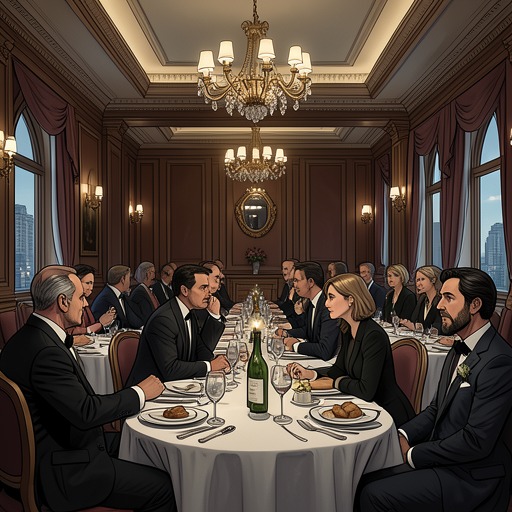
The lounge first appears as a comparatively open and sociable interior. After Laura leaves the spa in a state of growing dread, she finds Cole Lederer sitting at a table with his camera in front of him and Chloe Jenssen across from him, absentmindedly eating salad while looking out of the window. Chloe invites Laura to sit beside her and treats the room as an ordinary place of holiday conversation, asking whether the spa had been “amazing.” Laura, however, can no longer experience the lounge’s comfort without the pressure of the ship’s enclosed spaces and the unresolved Cabin 10 incident. She admits that she is claustrophobic, turning a casual exchange into an indirect reminder that even the apparently airy passenger areas remain part of a floating, enclosed environment.
The lounge also gathers together people whose interests and loyalties do not coincide. Its social openness allows Laura to move between companions, but it exposes her to the same scrutiny that makes her feel disbelieved elsewhere. Cole’s camera is visible on the table, Chloe watches from beside him, and the room becomes a place where Laura must decide whom to approach and what each person may know. The lounge therefore operates as a social surveillance space: no one is formally interrogating Laura, yet every glance, silence, and casual conversation may become significant.
Photography and Intimacy
Cole’s camera gives the lounge a special evidentiary importance. When he casually tosses it to Laura and invites her to scroll through the photographs, she moves backward through images from the voyage: clouds and gulls, the previous night’s poker game, Richard Bullmer laughing as he gathered Ben Howard’s chips, and Lars Jenssen reacting to a losing hand. The sequence transforms the camera into an informal record of the ship’s public life, preserving gestures and relationships that its passengers may not realize have been observed.
One photograph of Chloe is especially revealing in its emotional texture. Taken from very close, it captures the tiny hairs on her cheek in the lamplight and the slight movement of a smile at the corner of her mouth. Laura feels intrusive while looking at it, sensing an intimacy between Chloe and Cole that the image preserves without explaining. The photograph makes the lounge a place of layered looking: Cole has watched Chloe, Laura watches the photograph, and Chloe remains physically present nearby. The camera thus complicates the distinction between innocent documentation and invasive observation.
The next image is of Laura herself. Cole has photographed her at the moment she flung up her head in alarm and spilled her coffee, capturing an expression she did not intend to display. Laura flinches at the sight of her own face. The lounge consequently contains not only evidence about other passengers but an unwanted image of Laura, one that records her vulnerability and reminds her that she too can be made into an object of someone else’s gaze.
Conversations Under Pressure
Later, after dinner, Laura stands beside Owen White at the lounge’s long window while both look out into the fog. She considers whether to charm him, dismiss him, or seek someone more immediately useful to Velocity. The scene gives the room an investigative function: Laura is not simply socializing but assessing possible sources of information, trying to convert the ship’s informal gatherings into a means of understanding what has happened.
The conversation around her is shaped by money and institutional power. Owen discusses his financial interests and his work at an investment company, speaking quietly about whether the relevant business arrangement is sustainable and observing that Richard Bullmer can afford to wait because he and Anne Bullmer possess substantial resources. He regrets that Solberg could not attend, since the subject falls within Solberg’s area of expertise. The lounge therefore links the luxurious cruise to the financial structures behind it, revealing that the passengers’ leisure is supported by wealth, investment, and unequal authority.
The room also exposes gendered social pressure. Archer Fenland, extremely drunk, corners Hanni and blocks her exit with his large body while she maintains a polite smile and holds a jug of coffee. When she manages to slip from his arm with what appears to be practiced dexterity, his expression briefly combines foolishness and anger before he moves away. The encounter is not presented as a formal confrontation, yet it makes the lounge’s sociability feel coercive: manners conceal discomfort, and a woman’s ability to leave depends on quick judgment and practiced evasiveness.
A Space of Missing Information
The lounge’s apparent normality is repeatedly undermined by absences. On the evening of the canceled northern-lights talk, Richard and Cole are missing, Chloe is said to be ill in her cabin, and Anne Bullmer attends while looking pale and displaying a deep purple bruise on her collarbone. The planned presentation was to have combined Richard’s talk with Cole’s photographs, but Richard has been called away and Cole has injured his hand. The lounge is consequently marked by the people who should be present but are not, as well as by explanations that may be incomplete.
Laura’s later efforts to understand the Cabin 10 incident depend on precisely this conflict between visible and missing information. She demands access to corridor CCTV because she believes the woman she saw must have been recorded. Yet the lounge, like the rest of the passenger deck, offers only fragments: a photograph, a statement about illness, a whispered business judgment, or an unexplained absence. Its social life produces testimony, but not certainty.
That tension expands beyond the ship after Laura is reported missing. The Whodunnit forum turns the case into a public spectacle, debating whether Laura’s former relationship with Judah Lewis suggests murder and whether her anxiety medication supports a suicide theory. Anonymous posters convert incomplete information into confident narratives, while Judah corrects the record by explaining that Laura takes medication for anxiety, that he was working in Russia, and that the recovered body had not yet been identified as Laura. The forum’s arguments reproduce the lounge’s basic structure on a larger scale: observers assemble a story from partial signs, and social judgment threatens to replace verified evidence.
Narrative Significance
The Lindgren Lounge represents the unstable middle ground between comfort and danger aboard the Aurora Borealis. It is bright enough for photographs and conversation, yet the fog outside, the bruises and absences within, and Laura’s growing claustrophobia prevent it from becoming a secure refuge. Unlike the stripped and empty Cabin 10 or the cramped staff corridors below the waterline, the lounge displays the ship’s promise of civilized leisure. Its function is precisely to show how easily that promise can coexist with concealment.
As a narrative location, the lounge concentrates the novel’s concern with who gets to see, record, interpret, and be believed. Cole’s camera preserves moments that passengers would otherwise control; Laura’s search for CCTV seeks institutional confirmation; the lounge’s conversations circulate private knowledge as social performance; and the online forum later magnifies conjecture into stigma. The space therefore becomes a miniature version of the novel’s wider information system, in which evidence is always present but never fully secure, and in which a person’s fate can be shaped by the story other observers choose to tell about what they have seen.