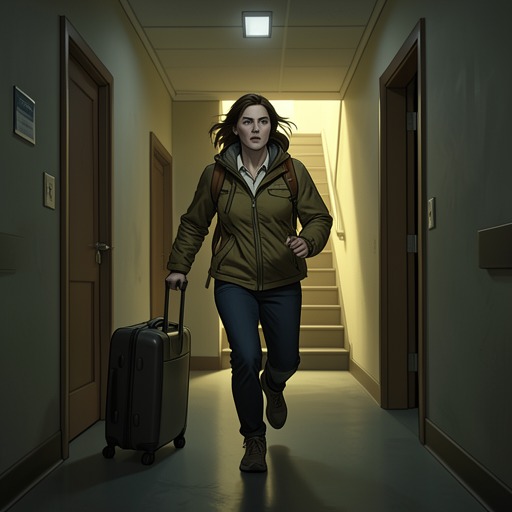
Lo falls from the Aurora into the fjord
The Woman in Cabin 10Laura Blacklock’s fall from the Aurora into the fjord is the violent culmination of an escape attempt made under pressure: the ship’s engine has started, Richard Bullmer is close by, and there may be little time before the vessel leaves. Seeking a route out, she climbs over the glass barrier of a balcony above the water. Her footing slips, and she falls backward into the dark fjord. The scene turns a shipboard escape into an immediate struggle for survival, with the sea that has surrounded the voyage becoming the danger below her.
Causes and Setting
The ship’s departure had first become real to Laura when she watched the Aurora leave Hull. From a balcony, she noticed its engine change from a discreet purr to a louder grind as the vessel turned away from the quay. It passed the harbor’s green and red navigation lights, left the shelter of the harbor wall, and entered the North Sea; the sheltered lapping of the water gave way to rolling swells, while Hull diminished on the horizon. By the time of the later escape attempt, the ship’s engine carries a different meaning: it signals a possible loss of her chance to get away.
Laura knows the Aurora is in international waters, and she has already reflected on the uncertain jurisdiction surrounding crimes aboard cruise ships. In her understanding, when there is no clear police authority to take control, investigations may be left to the ship’s own security, employed by the cruise line. This legal ambiguity forms part of the event’s atmosphere, though the immediate obstacle is more concrete: she is on a vessel surrounded by open water and cannot count on simply calling for help. Earlier, on deck, she had looked across the North Sea and found no land or ship in sight, with no practical way to summon assistance.
At the moment she decides to move, Laura hears the engine starting. She remembers that, on departure from Hull, the engine had run for some time before the ship actually set off, so she cannot know precisely how long remains. She estimates that the gangway might still be down, but recognizes that the interval could be short. Richard is in the cabin, and she cannot tell from the blurred reflection in the balcony barrier whether he is asleep. When she peers into the room, he shifts to reach for a glass, forcing her to retreat and making an ordinary exit through his space seem too risky.
The Balcony Escape Attempt
Laura considers entering an empty adjoining cabin by climbing between the verandas, then leaving through its door and making for the gangway. Her determination clarifies as she weighs the danger: at first she thinks of escaping for herself, Anne, and Carrie, then settles on the fact that she must escape for herself too. She believes she has done nothing to deserve being added to the women Richard has harmed. The decision is not a claim that the route is safe; it is a refusal to remain aboard at his mercy.
Her clothing becomes part of the problem. The flowing silk kimono is unsuitable for climbing, so she removes it, gathers the fabric, and tosses it over the privacy screen. The screen itself is too high to scale without equipment or a ladder. Instead, she chooses the rib-height glass barrier overlooking the sea, reasoning that she can lift a leg over it and use the privacy screen to stand. The route depends on balance, strength, and a secure grip, none of which the smooth glass easily provides.
The drop gives the maneuver its particular terror. Laura knows she is above the water and looks down at the dark waves beside the ship. She has never thought of herself as phobic about water, but the sight makes her stomach turn. She reminds herself that Carrie had used the balcony route to enter her cabin, and takes that as evidence that the crossing can be done. Yet the comparison cannot remove the difference between entering a cabin and traversing an exposed glass barrier above a fjord.
Laura pulls herself onto the barrier and sits astride it. To one side, the cabin and its open curtains leave her visible from the veranda doors; to the other is a sheer drop that looks, from her position, like the height of a two- or three-story house. She grips the slippery glass with her legs, then raises one foot and hauls herself upright by the frosted privacy screen. The next move is to edge around its seaward side and swing across to safety. In practice, she has to balance with little purchase while trying not to draw Richard’s attention.
The Fall and Its Significance
Laura has kept her espadrilles on, hoping they will protect her feet and provide extra grip. As she shifts her weight out over the water, the sole of her supporting foot slips against the sharp edge of the glass. She clamps her fingers onto the barrier, but the grip fails: first one nail breaks, then another, and finally her hands lose the glass altogether. The fall comes too suddenly for her to scream. For an instant she feels the wind against her cheek and her hair moving in the darkness; then she is falling backward toward the fjord.
She hits the black water with a force she compares to a gunshot, and the impact drives the breath from her lungs. The next sensation is descent: air bubbling from her lungs, icy water striking through her body, and a current rising from below to catch at her feet. The event therefore ends not with arrival at safety but with Laura submerged and in immediate danger. Her intended escape has become an uncontrolled fall, and the narrative’s shift from careful calculations about the barrier to the bodily shock of impact makes the change in stakes abrupt and unmistakable.
The fall also gathers the cruise’s recurring conditions into one physical crisis. A departure once witnessed from a private balcony now threatens to carry Laura away before she can reach shore; the ship’s height and polished glass, features of a luxury setting, become obstacles to survival. Her earlier sense of isolation in international waters returns in more extreme form: at the moment of impact, she is alone in the fjord, beyond the shelter of the ship’s interior and with no secure route back aboard. The scene’s immediate outcome is peril rather than resolution.